
Leaving Us in Tiers: Can Homophily Generate Human-Like Social Hierarchies?
Leaving us in tiers: can homophily be used to generate tiering effects?
This paper explores the generative mechanisms of "tiering" in human social networks—the phenomenon where individuals maintain a few core ties and many weak acquaintances—using the multi-agent simulation tool, Construct. The authors propose an augmented homophily model that incorporates high-salience "personal facts" to recreate the hierarchical distribution of ties observed in human societies (as described by Zhou et al.).
TL;DR
Why is your social circle divided into a tiny group of best friends, a modest group of "sympathy" ties, and a massive ocean of acquaintances? This paper uses multi-agent simulations to prove that the simple "like seeks like" (homophily) principle isn't enough to create this structure. To get realistic results, models must include "Personal Facts"—highly salient, rarely shared secrets that act as the glue for our closest relationships.
Background: The Mystery of the Tiered Network
Anthropologists and sociologists, including Robin Dunbar, have long noted that human networks are not uniform. We exist in "babushka doll" shells:
- T1 (Core): 3–5 very close ties.
- T2 (Sympathy Group): 15–20 friends.
- T3 (The Band): 30–50 regular contacts.
- T4 (The Clan): ~150 acquaintances.
Standard simulation models often struggle to replicate this. If everyone simply interacts with people "similar" to them based on general interests, the network becomes a "blob" rather than a hierarchy. This paper asks: What is the missing ingredient?
Methodology: Personal vs. General Knowledge
The researchers utilized Construct, a dynamic network simulator that models the co-evolution of social and knowledge networks. Their key innovation was the "Personal Fact."
The Two Tiers of Information:
- General Facts: Things like "the weather" or "popular news." These are common and easy to share.
- Personal Facts: Core values, deep secrets, or unique life experiences. These are highly salient (weighted heavily in interaction probability) but rarely shared.
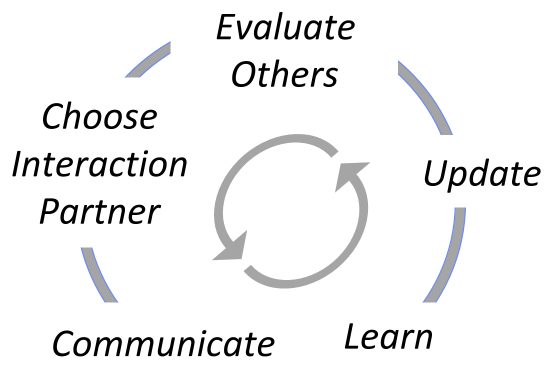 Figure 1: The Construct cycle where agents rank partners based on similarity and expertise.
The simulation calculates interaction probability () as a function of Relative Similarity: Where is what the agent knows, is what they think the other knows, and is the weight of that fact.
Experimental Results: The "Personal" Breakthrough
The study conducted a full factorial design across 100 conditions, varying population size (250 to 1,250 agents) and the number of personal facts.
The Failure of Simple Homophily
When agents only had "General Facts," they didn't develop strong preferences. They interacted with a broad range of people, creating "fat" top tiers (T1 and T2 were way too large).
The Success of the Augmented Model
As the number of Personal Facts increased to 10 per agent, a beautiful exponential decay emerged in interaction frequency. The simulation finally "binned" agents into tiers that matched the Zhou et al. (2005) empirical distribution.
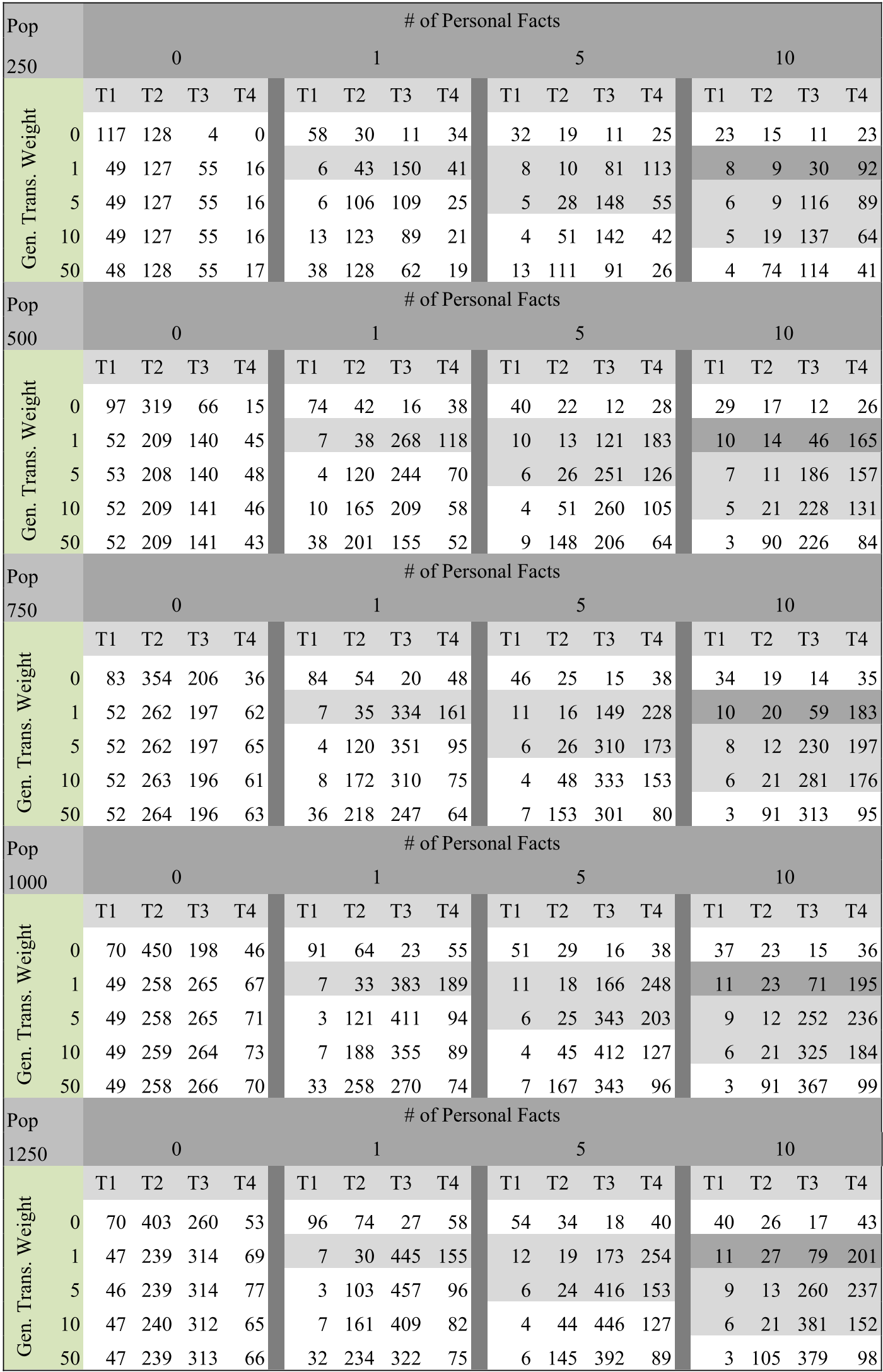 Table 4: Notice how the shaded areas (high personal facts) align with smaller T1/T2 groups and larger T4 groups.
Deep Insight: Why "Secrets" Create Tiers
The model reveals a profound social truth: The rarity of transmission is as important as the depth of the fact.
- Because personal facts are shared infrequently, they only build up between a few pairs.
- Once a dyad shares these facts, their "Relative Similarity" spikes, causing them to "lock in" to frequent interaction (creating T1).
- The "General Facts" allow for weaker, broader connections (T3 and T4), preventing the society from fracturing into isolated cult-like cells.
Critical Analysis & Conclusion
Takeaway
If you are building an Agent-Based Model (ABM) for disease spread or information diffusion, you cannot treat all social ties as equal. You must incorporate salience. Without modeling the "deep-level" facts that create strong ties, your simulation will overestimate how quickly information moves between distant groups.
Limitations
The study assumes a "closed" population (no one joins or leaves) and ignores geography. In the real world, you might be "T1" with someone just because they live next door, not just because you share "Personal Facts."
Future Outlook
This work provides a toolkit for simulation designers to "tune" their agents to act like humans. By adjusting the ratio of personal to general information, we can simulate different social environments—from the tight-knit "clique" of a startup to the broad, weak-tie network of a professional conference.