
Beyond the Thread: Mastering Social Network Analysis in MOOC Forums
Honing in on social learning networks in MOOC forums: examining critical network definition decisions
2017-02-27
Summary
Problem
Method
Results
Takeaways
Abstract
This paper investigates the impact of content-based network partitioning and various tie definitions (Direct Reply, Star, Copresence) on the structural analysis of MOOC discussion forums. Using the DIPTiC categorization model, the study clarifies how different interaction types—content-related vs. non-content—reveal distinct social learning patterns and instructor roles that are otherwise obscured in unpartitioned networks.
## TL;DR
Social Network Analysis (SNA) is often used to map how students interact in Massive Open Online Courses (MOOCs), but standard approaches often mix "noise" (socializing and logistics) with "signal" (content-based learning). This paper demonstrates that **partitioning networks into content-related and non-content activities** is essential to avoid distorted results and proves that how we define a "tie" between two users—whether they just post in the same thread or reply directly—drastically changes our understanding of who the "influential" learners really are.
## The Motivation: Why Your MOOC Data is Lying to You
In a typical MOOC, thousands of students interact in forums. However, traditional SNA often treats a "thank you" post the same as a deep conceptual question about statistics. Prior research has yielded contradictory results: some say social centrality predicts grades, others find no link.
The authors argue this is due to two critical failures:
1. **Lack of Partitioning**: Mixing social chatter with learning-related discourse masks the true structure of the "learning network."
2. **Arbitrary Tie Definitions**: There is no standard for what constitutes a "connection" in a threaded forum. Is it a direct reply? Or just being present in the same thread?
## Methodology: Defining the "Tie"
The researchers tested five distinct ways to map connections between 567 learners in a statistics MOOC (StatMed’14), moving from strict reply structures to broad "copresence."
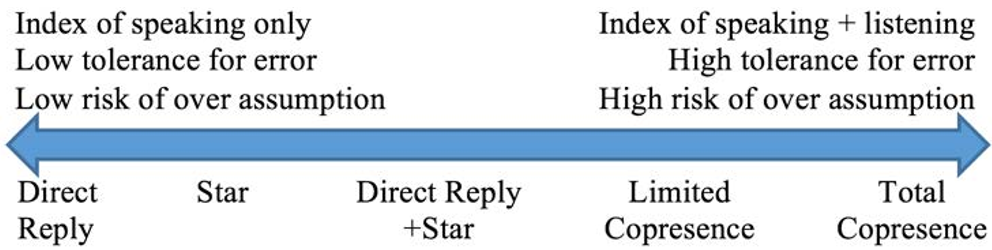
* **Direct Reply**: Strict parent-child post relationship.
* **Star**: All replies connect only to the thread starter.
* **Total Copresence**: Everyone in a thread is connected to everyone else.
* **Limited Copresence**: A hybrid model where connections are capped in large threads to reflect realistic reading limits.
## The Content vs. Non-Content Divide
Using a machine-learning model (DIPTiC), the authors split the forum into **Content-Related** (learning materials) and **Non-Content** (social/logistics).
The results were striking:
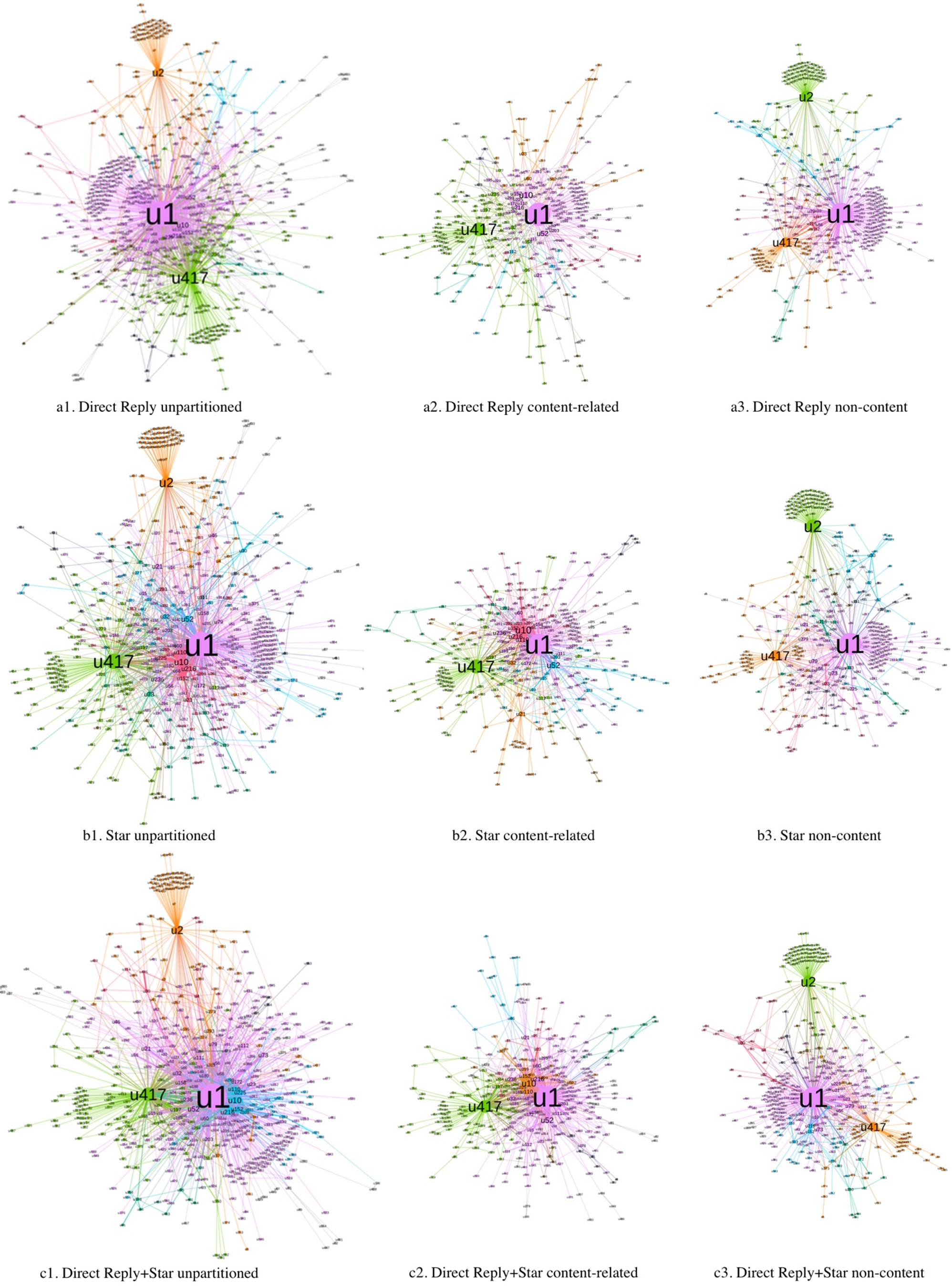
* **Masking Effect**: The "unpartitioned" network (the whole forum) looked almost identical to the non-content network. If you don't filter for content, the social "noise" drowns out the actual learning interactions.
* **Different Leaders**: The "top players" (high centrality nodes) in content networks were often entirely different individuals from the leaders in non-content networks.
## Key Insight: The Danger of "Total Copresence"
The study found that **Total Copresence** leads to a "ballooning" effect. In a "superthread" (a single thread with 80+ replies), every single person gets assigned a high "social degree" simply by showing up. This inflates the social status of users who might only have made one minor comment, making them look as influential as a Teaching Assistant.
## Instructor Roles: Hubs vs. Facilitators
By isolating the content-related network, the authors revealed how different instructors influence learning.
* **Instructor A (The Hub)**: Replied only to thread starters (hub-and-spoke model), resulting in less peer-to-peer interaction.
* **Instructor B (The Facilitator)**: Used social presence and responded within sub-threads, which successfully encouraged students to talk to *each other*, not just the instructor.
## Critical Analysis & Takeaways
This paper provides a much-needed "sanity check" for Learning Analytics researchers.
* **Lesson for Researchers**: Stop building "whole-forum" networks. They are dominated by social dynamics and won't tell you much about academic performance.
* **Lesson for Platform Designers**: Use **Limited Copresence** for dashboards. It more accurately reflects who is actually "listening" to whom.
* **Limitation**: The study relies on a single medical statistics MOOC. Social dynamics in a Humanities MOOC might differ significantly.
**Conclusion**: To understand learning in the crowd, we must first categorize what the crowd is talking about. SNA is a powerful scalpel, but only if you use it on the right data partition.