
How Deep Can We Rely on Emotion Recognition: Bridging Static Training and Real-Time Inference
How Deep Can We Rely on Emotion Recognition
The paper proposes a Facial Expression Recognition (FER) system leveraging a modified LeNet-5 Convolutional Neural Network (CNN) architecture. By employing data augmentation with random perturbations and a real-time Viola-Jones face tracking framework, the model achieves a 90% accuracy on the Cohn-Kanade Extended (CKP) dataset for seven basic emotions.
TL;DR
This research investigates the efficacy of deep learning for Facial Expression Recognition (FER) by optimizing a modified LeNet-5 architecture. By focusing on smart data augmentation and architectural refinements like ReLU and Dropout, the authors achieved 90% accuracy on the CKP dataset. More importantly, they demonstrate a hardware-efficient bridge between static image training and real-time video inference, maintaining 35 FPS on standard hardware.
Problem & Motivation: The "Heavy Model" Paradox
In the era of ImageNet, the common intuition is that "deeper is better." However, for specialized tasks like emotion recognition, massive architectures such as GoogLeNet and AlexNet often fail due to:
- Overfitting: The relatively small size of emotion datasets (compared to ImageNet) causes deep nets to memorize noise rather than learning features.
- Latency: Real-time applications (e.g., healthcare monitoring or lie detection) cannot afford the computational overhead of 100+ layer networks.
- Environmental Variance: Posed datasets like CKP do not naturally translate to "in the wild" video sequences where lighting and head poses vary.
The authors' insight was to revitalize a "classic" architecture—LeNet-5—and modernize it with contemporary deep learning tricks to find the "sweet spot" between depth and speed.
Methodology: Optimizing the Lightweight Backbone
The proposed model evolves from the LeNet-5 baseline, focusing on three critical enhancements:
1. Architectural Modernization
- ReLU Units: Replacing with ReLUs to speed up convergence by up to 6x.
- Dropout Strategy: Introducing dropout (0.4-0.5) between fully connected layers to break neuron co-adaptation, a key factor in their 10% accuracy gain.
- Weight Fillers: Testing Gaussian, Xavier, and UnitBall fillers. The UnitBall configuration (initializing values between [0, 1]) proved most effective for this specific domain.
2. Random Perturbation Augmentation
Instead of simple crops, the authors used a wide set of random perturbations:
- Skewing:
- Rotation: Sampled from
- Translation and Scaling: To ensure the model is invariant to the face's precise position within the Viola-Jones bounding box.
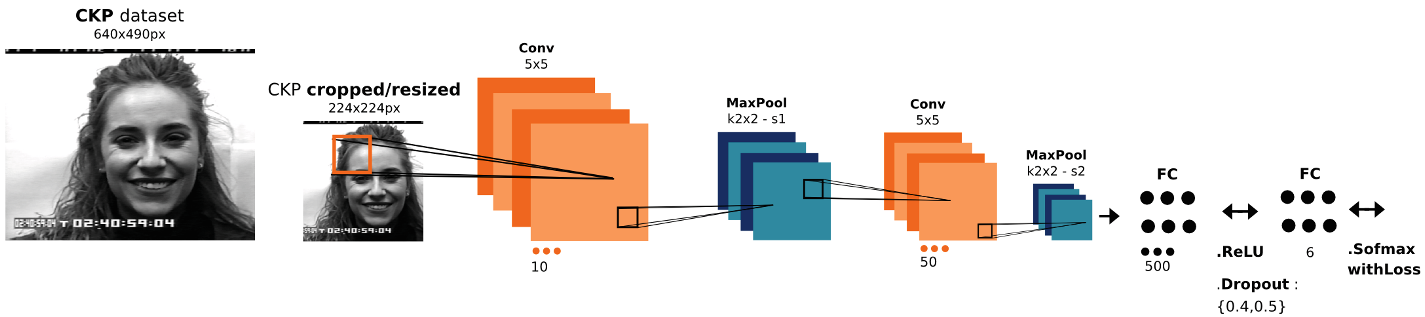 Fig 1: The pipeline from raw images to the augmented dataset and the CNN flow.
Experiments & Results: Efficiency Over Depth
The study compared the "LeNet-Ov" (optimized version) against industrial giants.
SOTA Comparison
Interestingly, while GoogLeNet and AlexNet achieved low training loss, they struggled to generalize on the validation set within reasonable processing times. The modified LeNet-5 emerged as the winner.
| Method | Accuracy (CKP Test) | F1-Score |
|---|---|---|
| Gaussian Init | ~75% | 0.81 |
| UnitBall Init (Proposed) | 90% | 0.906 |
| Xavier Init | ~89% | 0.90 |
Real-Time Performance
The system was integrated with a Viola-Jones face tracker. While the static test achieved 90%, the "in the wild" video test revealed challenges:
- Contempt was recognized with high confidence.
- Anger and Happiness were more difficult to distinguish in dynamic sequences compared to static peaks.
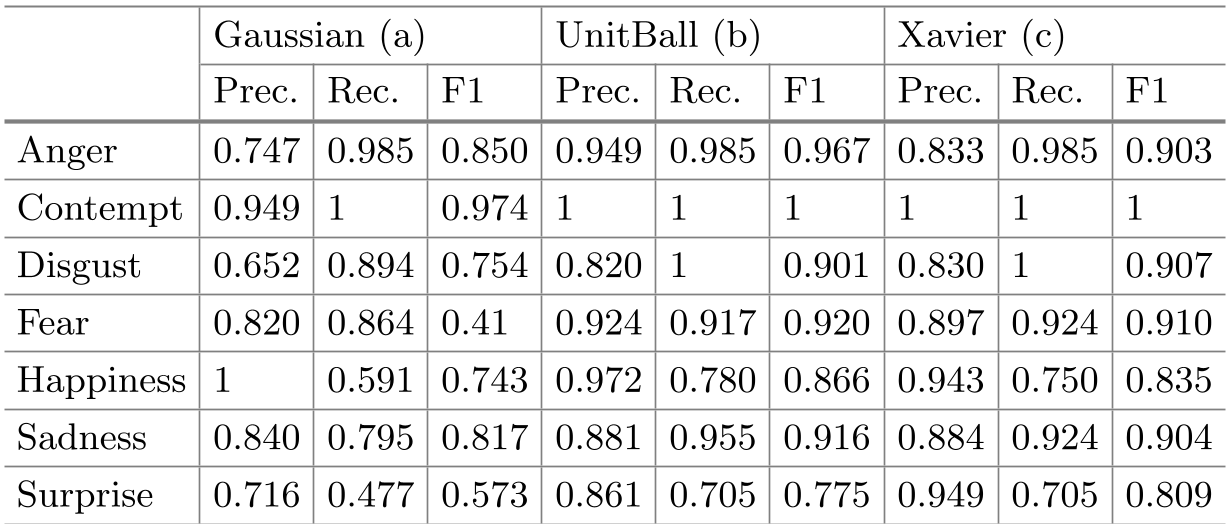 Table 3: Detailed Percision, Recall, and F1-Scores across different weight initializations.
Critical Analysis & Conclusion
Takeaway
The paper confirms that we can rely on deep emotion recognition even with lightweight models. The key to success isn't necessarily more layers, but better regularization (Dropout) and specialized initialization (UnitBall).
Limitations
The jump from static "apex" frames (the peak of an emotion) to dynamic video remains a significant hurdle. As shown in the video framework's confusion matrix (Fig 4), temporal transitions can lead the model to misclassify active expressions as "Contempt" or "Neutral" if the peak intensity isn't sustained.
Future Outlook
The authors suggest that future work should integrate Active Learning—allowing human judgment to refine the real-time tracker—and expanding the augmentation to include more diverse lighting conditions to move from "posed" accuracy to true "in the wild" reliability.