
Model-Checking Social Leakage: "How Did They Know?"
“How Did They Know?”—Model-Checking for Analysis of Information Leakage in Social Networks
This paper investigates the application of formal model-checking to analyze information leakage in intersecting social networks. By leveraging a variation of the BDI (Belief-Desire-Intention) agent formalism and the PRISM probabilistic model-checker, the authors quantify the risk of privacy violations caused by synchronized user accounts and automated forwarding behaviors.
TL;DR
Even if your privacy settings are locked down, your friends' cross-platform bots might be leaking your secrets. This paper introduces a formal verification framework using PRISM model-checking to quantify exactly how information "leaks" through the cracks of intersecting social networks. By modeling users and platforms as rational agents, the researchers can calculate the mathematical probability of your boss seeing that vent-post you thought was private.
The Illusion of Control in Social Networks
Most users treat social media privacy as a local setting: "I share with Bob, and Bob is my friend." However, transparency in social networks is a transitive and intersecting problem. If Bob uses a synchronization tool like Zapier to link his Facebook to a public Twitter feed, your "private" data is now public.
The authors identify a critical gap: existing privacy tools focus on individual access control lists (ACLs), failing to account for the dynamic, multi-platform ecosystem where information behaves like a fluid, finding every available path to reach unauthorized nodes.
Methodology: Social Networks as Multi-Agent Systems (MAS)
To solve this, the paper simplifies the complex human-software interaction into a formal agent specification. They utilize the BDI (Belief-Desire-Intention) paradigm but modify it for the social web by focusing on Communicational Attitudes:
- : Agent told agent that is true.
- : Agent received communication from agent .
The Avatar Context
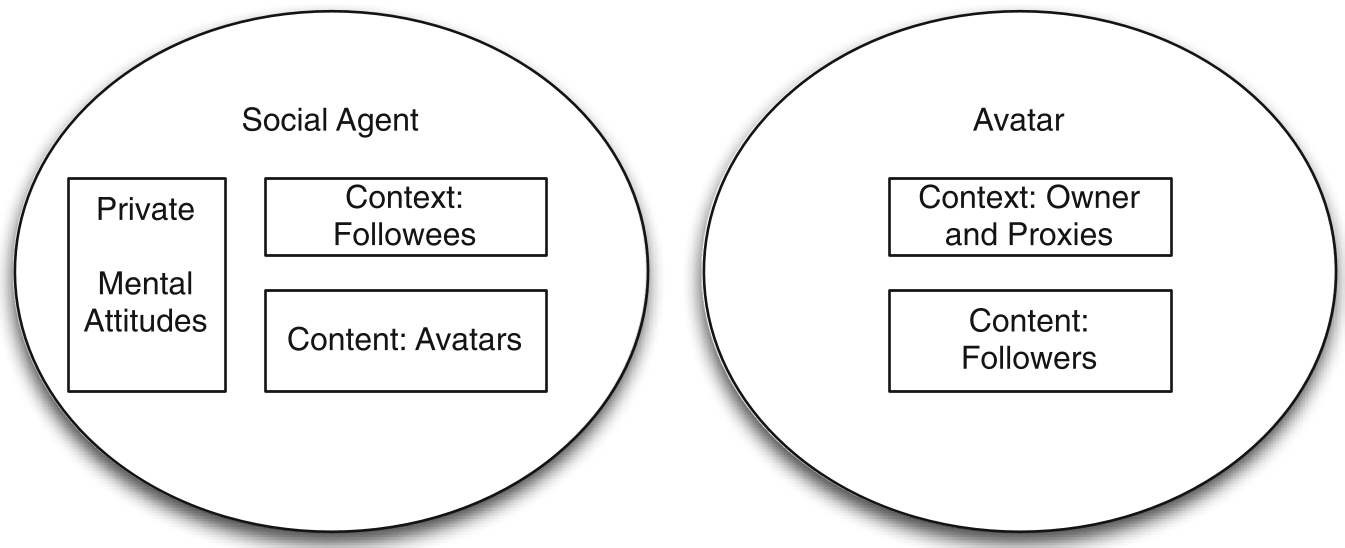
The brilliance of this approach lies in the "Avatar" model. Each user is a primary agent, but their profile on SN1 or SN2 is an Avatar Agent. An avatar acts as a proxy that broadcasts messages from its "Context" (the user) to its "Content" (the followers).
Quantifying Global Risk with PRISM
The researchers implemented their models in PRISM, a probabilistic symbolic model-checker. This allows them to move beyond a binary "leak/no-leak" status and into probabilistic risk assessment.
They simulate five scenarios of increasing complexity:
- Basic Relay: Direct follower-followee interaction.
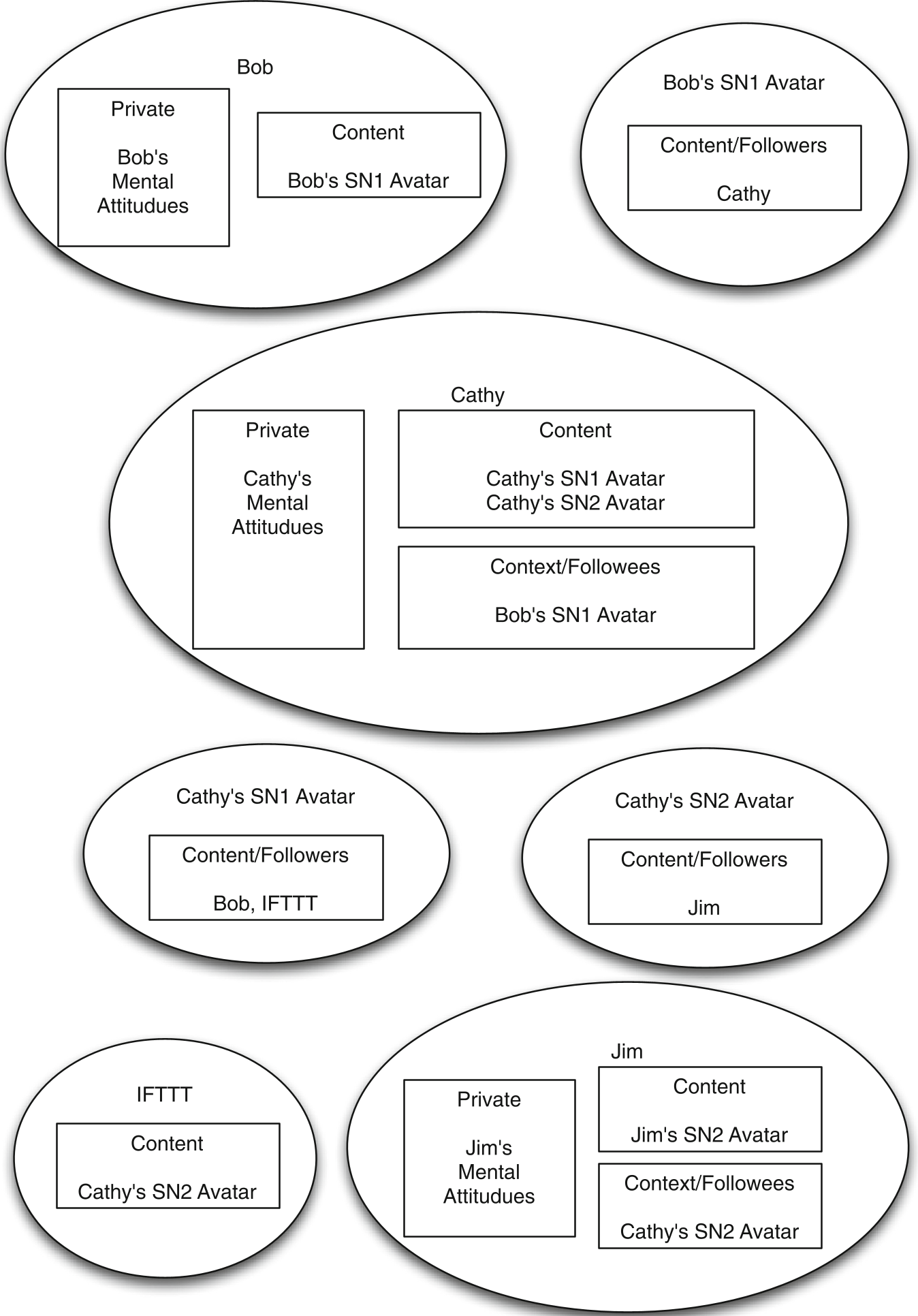
- Synchronization Agents: Automated bots that bridge two networks (e.g., Bob's SN1 posts automatically appearing on SN2).
- Probabilistic Forwarding: Modeling the 10% chance that a human follower will manually repost a message.
- Normative Constraints: How a "Please don't repost" request reduces leakage probability (e.g., from 10% to 1%).
Key Results and Insights
The table below illustrates how hidden sync-agents and human behavior dramatically alter the risk profile of a single post:
| Scenario | Alice (Follower) | Charlie (Unauthorized) | Risk Insight |
|---|---|---|---|
| Ex 1: Basic | 1.0 | 0.0 | System works as intended. |
| Ex 2: Sync Bot | 1.0 | 1.0 | Full Leak: The bot bypasses all SN1 privacy reach. |
| Ex 5: Complex | 1.0 | 0.109 | Hidden Risk: A 10.9% chance of leakage via indirect paths. |
The most important takeaway: Information leakage is often non-intuitive. Even when users follow norms, the presence of a single misconfigured synchronization agent in a follower's network can create a "bridge" that renders the original poster's privacy settings moot.
Critical Analysis & Future Outlook
While this work provides a robust theoretical foundation, it faces a data acquisition challenge. To check these models for a real user, we would need access to the follower lists and sync-settings of every person in their network—data that most platforms (rightfully) keep hidden for privacy reasons.
The Path Forward:
- Automated Extraction: Using APIs to automatically build PRISM models from current user settings.
- Epistemic Logic: Moving beyond simple message relaying to model how agents reason about information (e.g., "If both Alice and Bob say it, it must be true").
- Privacy-as-a-Service: SNS providers could integrate this model-checking natively, warning a user: "Posting this has a 15% chance of reaching your 'Restricted' group due to your followers' settings."
By treating privacy as a verified system property rather than a static setting, we can finally begin to answer the question: "How did they know?"