
How Much Do We Actually Remember? Quantifying the 3.6 Bits-Per-Parameter Limit in LLMs
How much do language models memorize?
This paper introduces a rigorous information-theoretic framework to measure language model capacity, separating "unintended memorization" (dataset-specific info) from "generalization" (distributional info). By training hundreds of GPT-style transformers, the authors establish that modern models have a consistent capacity of approximately 3.6 bits-per-parameter.
TL;DR
If you've ever wondered if an LLM "knows" your data or is just "really good at patterns," this paper provides the mathematical scalpel to separate the two. Researchers at Meta, Google DeepMind, and Cornell have found that GPT-style models can store roughly 3.6 bits of information per parameter. They prove that once a model's "capacity" is full, it is physically forced to start generalizing—a phenomenon that perfectly explains the emergence of double descent.
Background: The Memorization Paradox
Modern LLMs like Llama-3 are trained on trillions of tokens despite having only billions of parameters. This creates a massive bottleneck. Does the model memorize specific training examples (a privacy and efficiency nightmare), or does it learn universal rules? Previous attempts to answer this relied on "extraction" (prompting a model to spit out training data), but this is flawed: if a model solves 2+2=4, it didn't necessarily "memorize" that specific line from its training set; it learned the concept of addition.
The Core Insight: Memorization as Compression
The authors turn to Kolmogorov Complexity. The intuition is elegant: A model has memorized a datapoint if that datapoint can be compressed into a shorter string using the model as a reference.
To solve the "generalization vs. memorization" dilemma, they split information into:
- Unintended Memorization (): Info about a specific dataset that doesn't help with new data.
- Generalization (): Info about the underlying data-generation process (e.g., grammar, facts).
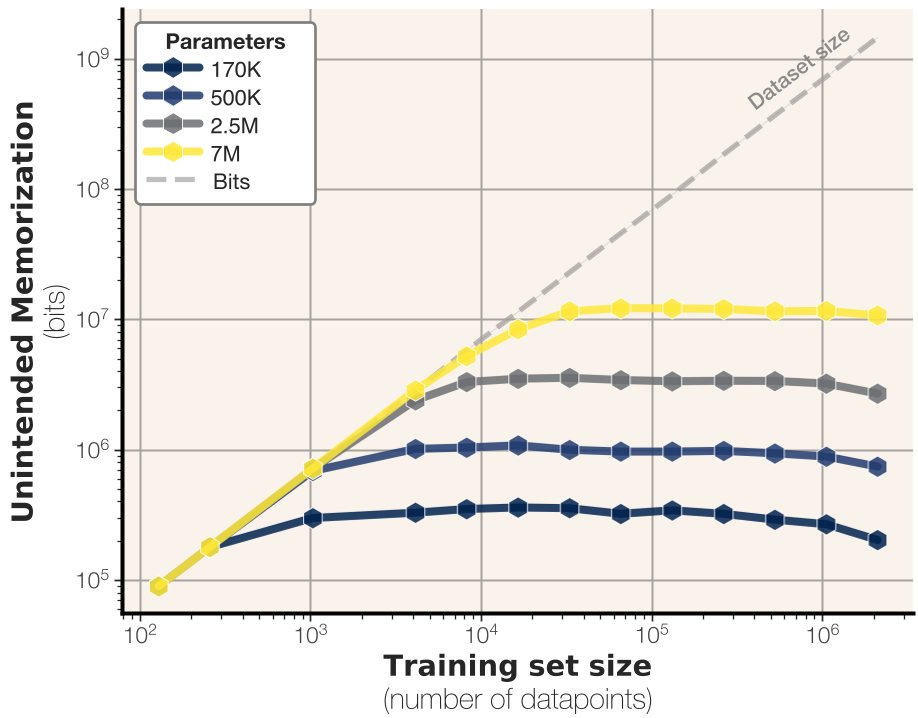 Figure 1: On random data where generalization is impossible, memorization plateaus at exactly ~3.6 bits-per-parameter.
Methodology: Measuring the "Mind" of a Transformer
The researchers trained hundreds of models (500K to 1.5B parameters) on two types of data:
- Synthetic Bitstrings: Purely random, meaning . This allowed them to measure raw storage capacity.
- FineWeb Text: Real-world data where the model can either memorize strings or learn to generalize.
By using Arithmetic Coding, they converted model likelihoods into bit-counts. They discovered that regardless of the model size, the "storage density" (α) remains remarkably stable.
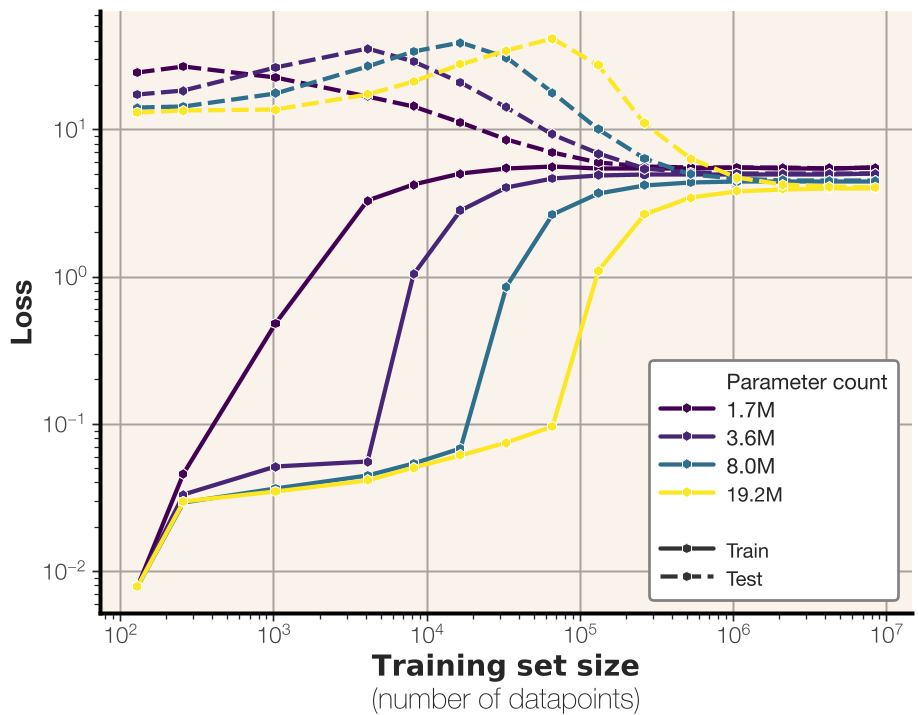 Figure 2: The classic "Double Descent" curve. Note how the test loss drops significantly only after the dataset size exceeds the model's total bit-capacity.
Key Results: The Scaling Laws of Privacy
The study yields several groundbreaking conclusions for the industry:
- Double Descent Explained: Double descent (where error increases then decreases) starts exactly when the data volume exceeds the model's capacity in bits. At this "overfitting" peak, the model is forced to overwrite specific memories with general patterns to save space.
- The Death of Membership Inference: As models are trained on more tokens (e.g., Llama-3's 15T tokens), the probability of finding a specific "memorized" average datapoint reaches nearly zero. The model's capacity is simply too crowded with generalized knowledge.
- The Rare Token Exception: While "average" points aren't memorized, outliers are. The authors found that documents with high TF-IDF (rare Japanese or Chinese tokens in an English dataset) are much more likely to be memorized because they don't fit into the "generalized" patterns.
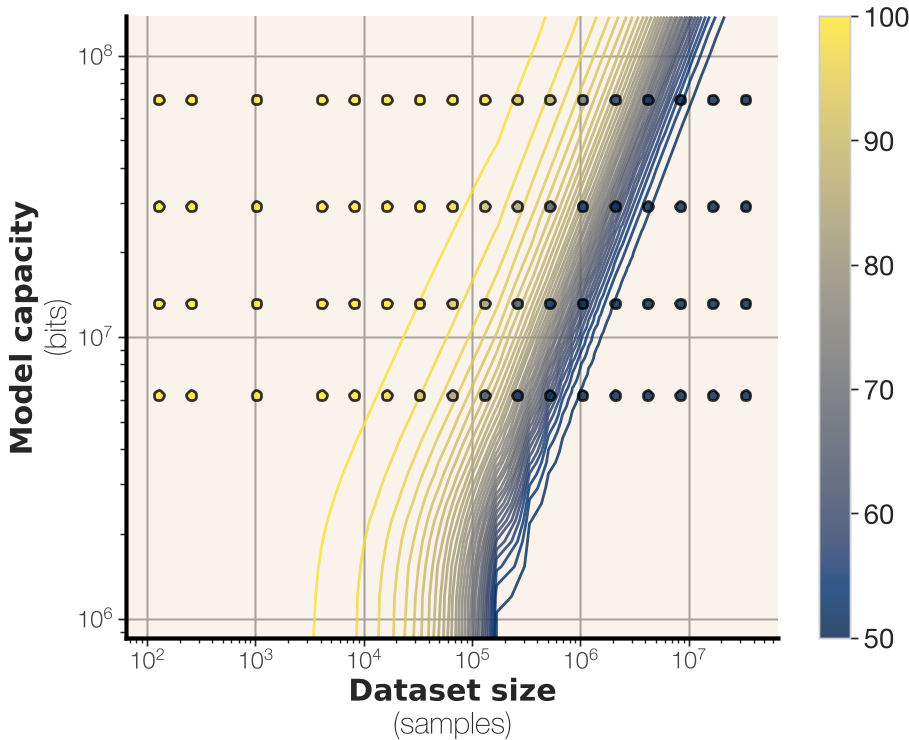 Figure 3: Predicted scaling laws for Membership Inference. Larger models memorize more, but larger datasets make discovery significantly harder.
Critical Analysis & Conclusion
This paper shifts the conversation from ad-hoc extraction attacks to a grounded, physical theory of model capacity.
Takeaways:
- For Developers: If you want to prevent memorization, deduplicate your data and ensure your token-to-parameter ratio is high (at least 100:1).
- For Researchers: The 3.6 bits-per-parameter limit suggests that FP32 training is largely overkill for raw storage; bfloat16 captures almost the same amount of information (3.51 bits).
Limitations: The study focuses on GPT-style decoders. Whether State Space Models (SSMs) like Mamba or hybrid architectures share this 3.6-bit limit remains an open question for future exploration.
Future Outlook
This work sets the stage for "Capacity-Aware" training. Imagine a training loop that detects when a model's capacity is full and automatically shifts its objective to prune "unintended memorization" while preserving generalization. As we hit the limits of data scaling, understanding how to use every bit of those 3.6 bits-per-parameter will become the next frontier in AI efficiency.