
The Optimization of Doomscrolling: An Analytical Review of "Value of Access"
How Often Should I Access My Online Social Networks?
This paper introduces the "Value of Access" (VoA) metric and an analytical framework to determine the optimal frequency for users to access Online Social Networks (OSNs). By modeling content generation as a Poisson process, the authors derive a closed-form expression for VoA based on timeline size and access rates, providing a theoretical foundation for user engagement and attention economy.
TL;DR
We often feel the compulsion to refresh our social media feeds, but how often is too often? This paper introduces Value of Access (VoA), a mathematical metric to quantify the "novelty" we get per refresh. By modeling the conflict between content generation and human attention limits, the authors provide a formula to calculate your personal "optimal refresh rate."
Background: The Economics of Attention
In the modern OSN landscape, information is infinite, but human attention is a scarce resource. This creates an Attention Economy. Most existing research looks at this from the platform's perspective (how to keep you scrolling to see more ads). This paper flips the script, asking: From a user's perspective, what is the most efficient way to consume this information without wasting mental energy?
The Problem: The Informational Law of Diminishing Returns
If you access Facebook or X every minute, the probability of seeing something new is low (low VoA). If you wait a week, the probability is 100%, but you’ve likely missed the window of relevance or "Age of Information."
The authors identify a gap: prior art assumes more access is always better for profit, but they prove there is an optimal tipping point where the cost of attention outweighs the value of new information.
Methodology: The VoA Framework
The core of the paper is an analytical model based on a Poisson collection of sources.
1. Defining VoA
VoA is the expected number of novel impressions (posts you haven't seen before) in a timeline of size K.
2. The Equation for Efficiency
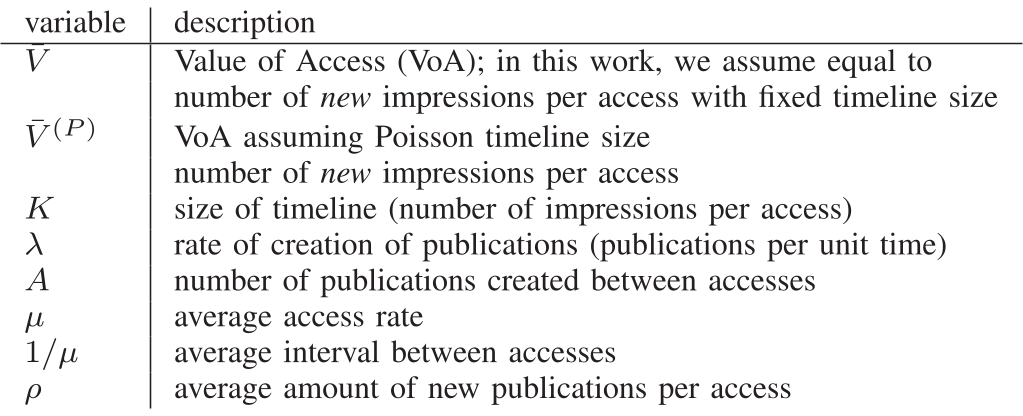
The authors derive a beautiful closed-form expression for the expected value of an access () when the time between jumps is exponentially distributed: Where:
- = Rate of new posts from your followed sources.
- = Your access rate.
- = Number of posts you scroll through per access.
Experiments: Theoretical vs. Reality (Facebook Data)
The authors tested their model using real-world data from the 2018 Brazilian elections. They deployed "bots" to follow political candidates and news outlets, measuring how many "new" vs. "repeated" posts they saw.
Key Insight: The "Facebook Tax"
One of the most provocative findings is that the Facebook News Feed algorithm actually reduces VoA. By prioritizing "engagement" or "relevance," the algorithm often shows you the same popular post multiple times at the top of your feed, forcing you to scroll much deeper (larger ) to find truly new information.
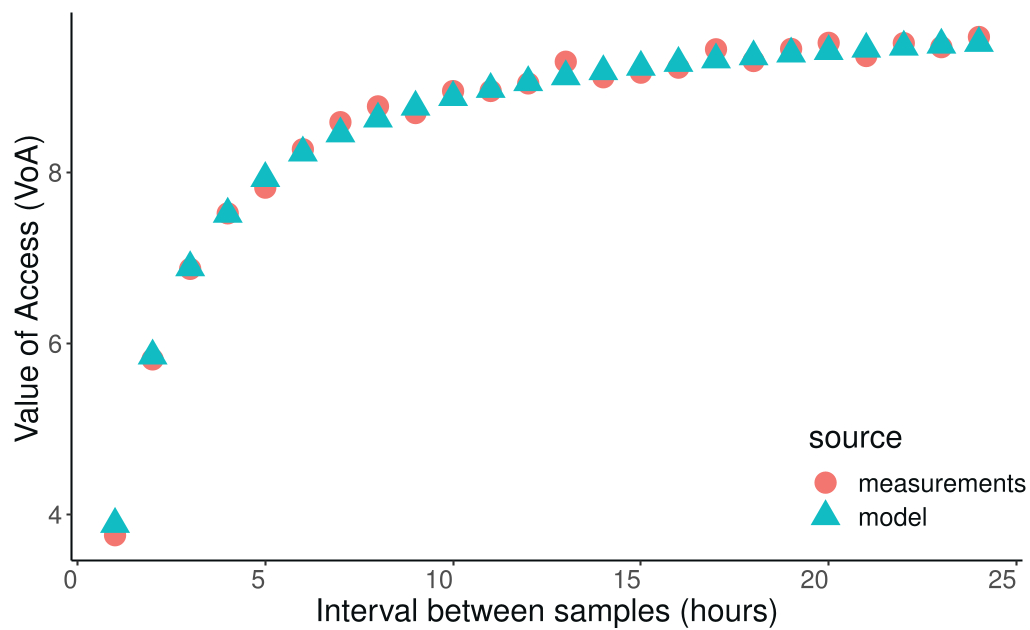 In the figure above, the model (Red) predicts a high VoA, but the actual Facebook Feed (Gray/Blue) provides much less novelty for the same amount of scrolling.
Finding Your "Sweet Spot" (The Optimal Sampling Rate)
By introducing a cost (the mental/monetary price of an access), the authors solve for the optimal rate :
Through sensitivity analysis, the paper reveals a counter-intuitive truth:
- The Power of Scrolling: If you can't stop yourself from checking often, you should scroll less (). However, the more efficient strategy is often to scroll deep () and access the network less frequently.
Critical Analysis & Takeaways
- The Algorithmic Friction: Personalized feeds (like Facebook's) introduce "position bias." They intentionally show repeated content to ensure "high-quality" posts aren't missed, but this effectively "taxes" the user's attention.
- Limitations: The model assumes a Poisson process for content, which may not account for "bursty" news cycles (e.g., breaking news events).
- The Middleware Future: The authors suggest the need for third-party "Gobo-like" apps that could help users manage their "information diet" by revealing their actual VoA in real-time.
Final Word
This paper transforms a psychological habit—checking social media—into a quantifiable optimization problem. It suggests that if OSN platforms truly wanted to respect user attention, they would provide tools to help users find their , rather than maximizing time-on-site at all costs.