
Google+ Linguistics: How Digital Footprints Reveal Social Identity
How you post is who you are: characterizing Google+ status updates across social groups
This study presents a large-scale linguistic characterization of Google+ status updates across diverse social groups including 10 countries, two genders, and 15 occupational categories. By analyzing 6.1 million distinct posts, the researchers demonstrate that demographic and professional backgrounds significantly influence microtext attributes and successfully implement an SVM-based classifier to infer user social information.
TL;DR
Researchers from the Federal University of Minas Gerais have conducted the first comprehensive linguistic audit of Google+ status updates. By analyzing over 6 million posts, the study identifies "linguistic particularities" tied to gender, geography, and job titles. The core discovery? Users rarely shed their professional skins online; your vocabulary acts as a persistent digital signature of your real-world social status.
Background: The Social Media Mirror
Is the way we talk on social media different from our offline lives? Or is the Internet simply a new stage for old habits? While previous research focused on Twitter’s brevity or Facebook’s personal nature, Google+ occupied a unique "professional-social" hybrid space. This paper investigates whether the "microtexts" we post—despite their brevity—carry enough signal to predict who we are, where we live, and what we do for a living.
Motivation: Beyond One-Dimensional Analysis
Most prior work in Internet linguistics treated social factors in isolation. This study posits that Gender, Location, and Occupation are interlocking factors that dictate "Internet dialects." The authors aimed to prove that even in "throwaway" status updates, our professional jargon and cultural background remain visible.
Methodology: Decoding the Microtext
The researchers built a pipeline to process over 29 million raw posts, narrowing it down to 6.1 million high-confidence English updates. They analyzed these through three technical lenses:
- Complexity (ARI): Measuring sentence length and character count to determine the "sophistication" of the post.
- Accuracy (Misspellings): Tracking deviation from standard English relative to native vs. non-native speakers.
- Semantics (LIWC): Categorizing words into psychological and functional bins (e.g., "Money," "Social," "Religion").
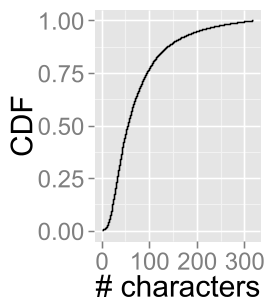 Figure 1: CDFs of characters, words, and sentences per post, confirming that Google+ posts are indeed "microtexts."
Core Insights: The "Professional" Signal
The data revealed several striking patterns:
- The Gender Gap: Men tend to write more complex sentences and discuss "Power," "Money," and "Work," while women use more "Social" and "Affection" words. Men were also found to be more "formally accurate" in this specific OSN environment.
- The Mother Tongue Effect: Even when writing in English, users from Indo-European language backgrounds (Germany, France) showed higher structural complexity (ARI) compared to those from Austronesian backgrounds (Philippines, Malaysia), suggesting a transfer of native syntactic patterns into English posts.
- Occupational Leaks: The strongest signal came from jobs. Legal and media professionals make the fewest typos, while religious professionals use specific semantic markers that make them highly identifiable to machine learning models.
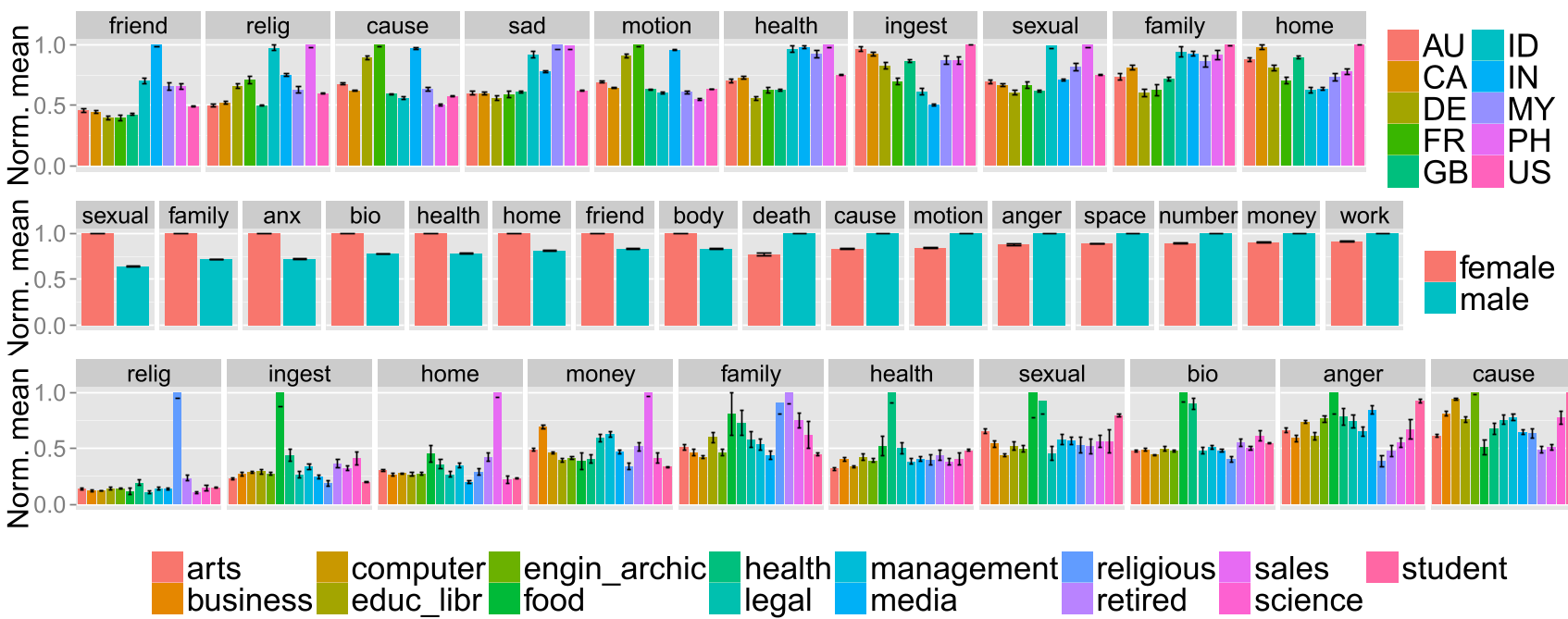 Figure 5: Semantic differences across social groups—religion, work, and family categories show high variance.
Experimental Validation: The Social Inference Task
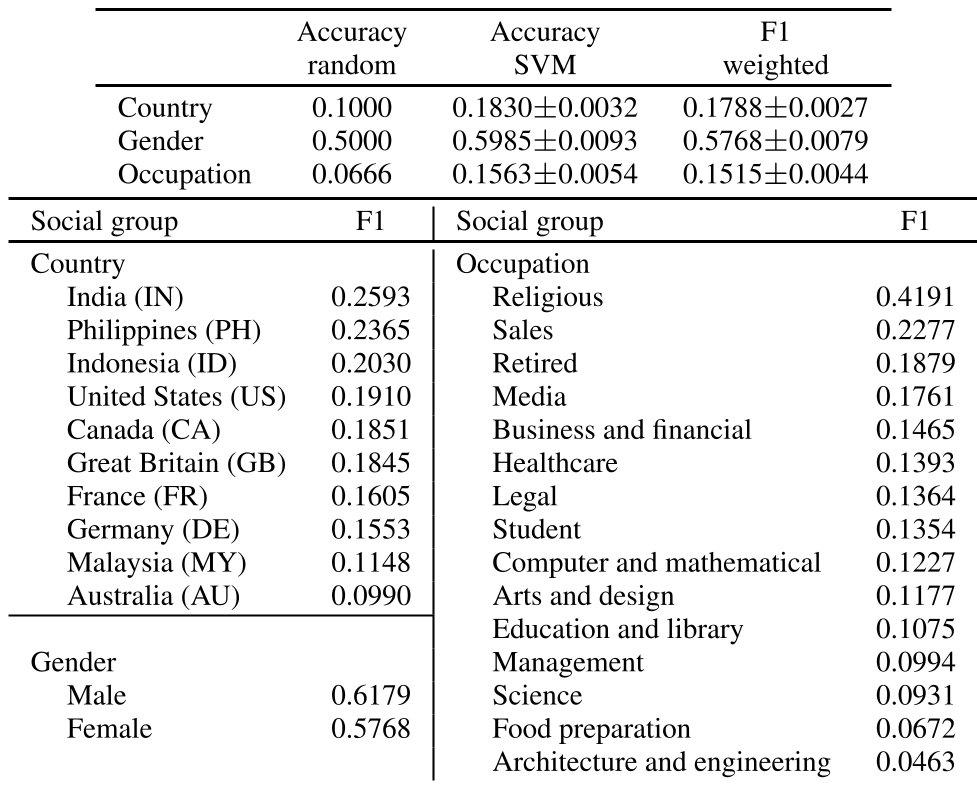
To prove these insights weren't just theoretical, the team trained an SVM (Support Vector Machine) classifier using 76 linguistic features.
- Occupation Inference: The model was 134.6% more accurate than random guessing.
- Country Inference: Boosted accuracy by 83%.
Interestingly, "Religious" workers were the easiest to classify, while "Architects and Engineers" were the hardest, suggesting some professions have a more distinct "linguistic brand" than others.
Critical Analysis & Conclusion
Takeaway
This research highlights that social media is an extension of our professional identity. The persistence of "workplace jargon" in social status updates suggests that platforms like Google+ (and by extension, modern platforms like LinkedIn) are not just communication tools—they are data-rich environments for sociolinguistic profiling.
Limitations & Future Work
The study is limited to English-speaking posts, which might introduce a selection bias (only the most educated or tech-savvy users in non-English countries). Future research should explore "Sentiment" markers—do different social groups feel differently, or just talk differently? In the age of AI, these linguistic markers may become the primary way we distinguish between human-generated content and synthetic "bot" personas.