
HRM-Text: Challenging the Scaling Dogma with Hierarchical Recurrence
HRM-Text: Efficient Pretraining Beyond Scaling
The paper introduces HRM-Text, a 1B-parameter model utilizing a Hierarchical Recurrent Model (HRM) architecture and a task-completion training objective. It achieves SOTA-level efficiency, performing competitively with 2B-7B models like Llama 3.2 and Qwen 3.5 while using up to 432x less compute and 900x fewer training tokens.
TL;DR
The prevailing AI wisdom says "more is more": more data, more compute, more parameters. HRM-Text turns this on its head. By replacing standard Transformers with a Hierarchical Recurrent Model and swapping raw-text pretraining for a task-specific objective, the authors produced a 1B model that rivals 7B giants. The kicker? It used 900x fewer tokens and cost only $1,500 to train from scratch.
The "Data Hunger" Problem
Traditional LLM pretraining is a brute-force endeavor. Models are fed trillions of tokens from the open web, much of it "noise," simply to learn general representations. This puts foundational research out of reach for anyone without a massive GPU cluster. Furthermore, standard autoregressive training is inherently inefficient: why spend compute predicting the prompt when we only care about the answer?
Methodology: The Bio-Inspired Engine
The authors introduce a dual-pronged solution that co-designs the model's structure and its learning goal.
1. Hierarchical Recurrent Architecture
Inspired by the human brain's frontoparietal loop, HRM-Text uses a dual-timescale design:
- L-Module (Fast): Handles local iterative refinement and execution.
- H-Module (Slow): Maintains stable semantic context and strategic planning across cycles.
To prevent the "gradient explosions" common in deep recurrence, they developed MagicNorm. This technique exploits the asymmetry between forward and backward passes, providing the stability of PostNorm during inference while maintaining the smooth gradient flow of PreNorm during training.
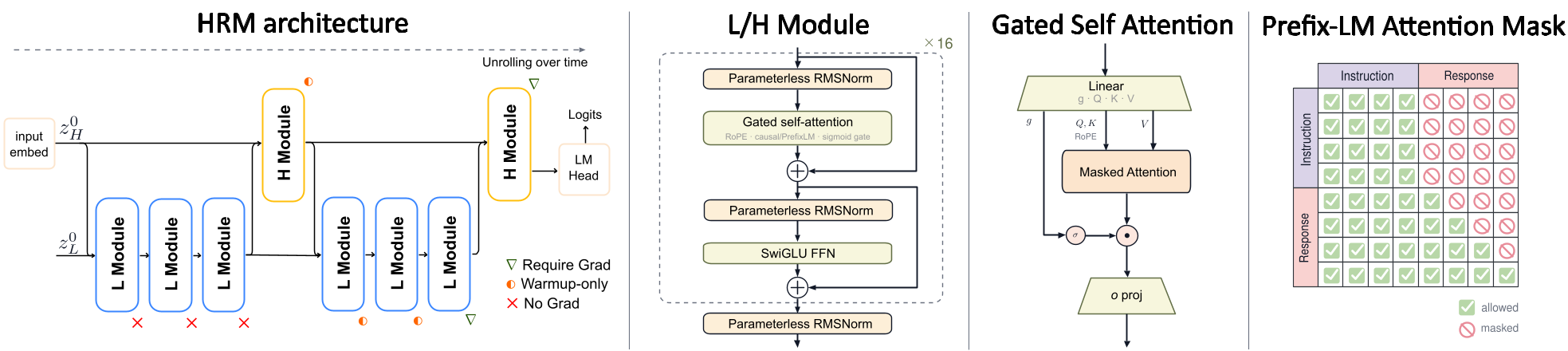
2. Task-Completion Objective & PrefixLM
Instead of predicting every token in a web crawl, HRM-Text focuses exclusively on Instruction-Response pairs.
- Response-only Loss: The model only calculates loss on the answer, not the prompt.
- PrefixLM Masking: Unlike causal Transformers that can only "look back," HRM-Text uses bidirectional attention for the instruction—essentially acting as an encoder-decoder hybrid within a single stack.
Hard Evidence: Efficiency Gains
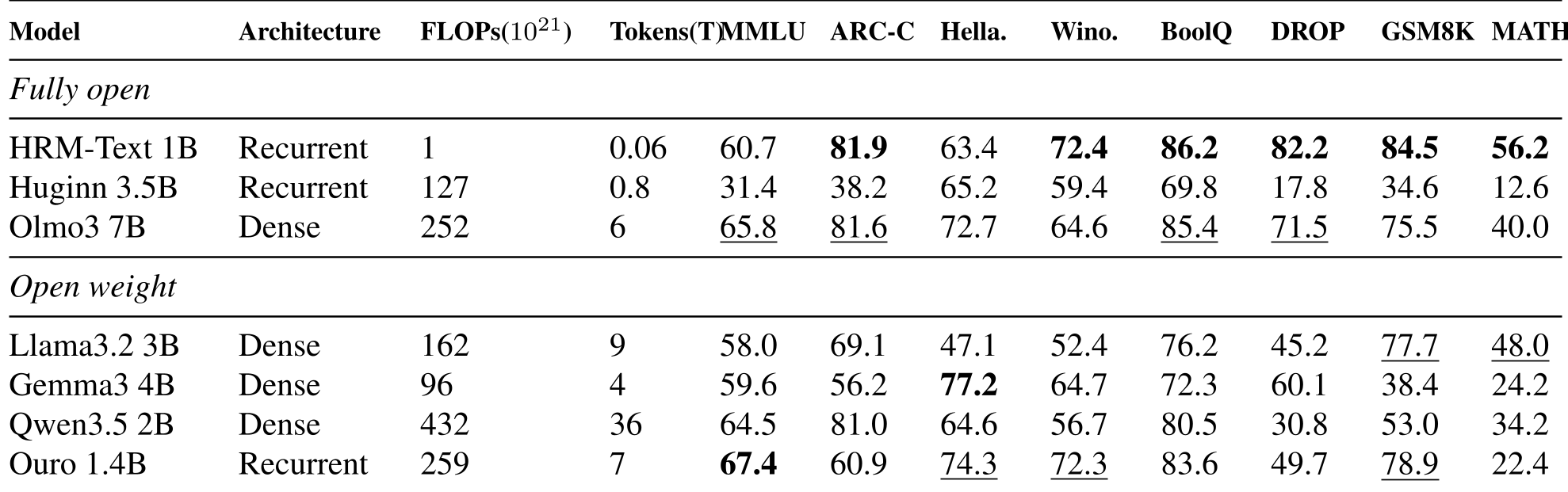
The results are a wake-up call for the industry. HRM-Text 1B achieved a 60.7% MMLU and 84.5% GSM8K, matching or beating models with 3x-7x more parameters that were trained on up to 36 trillion tokens.
Key Insights from Ablations:
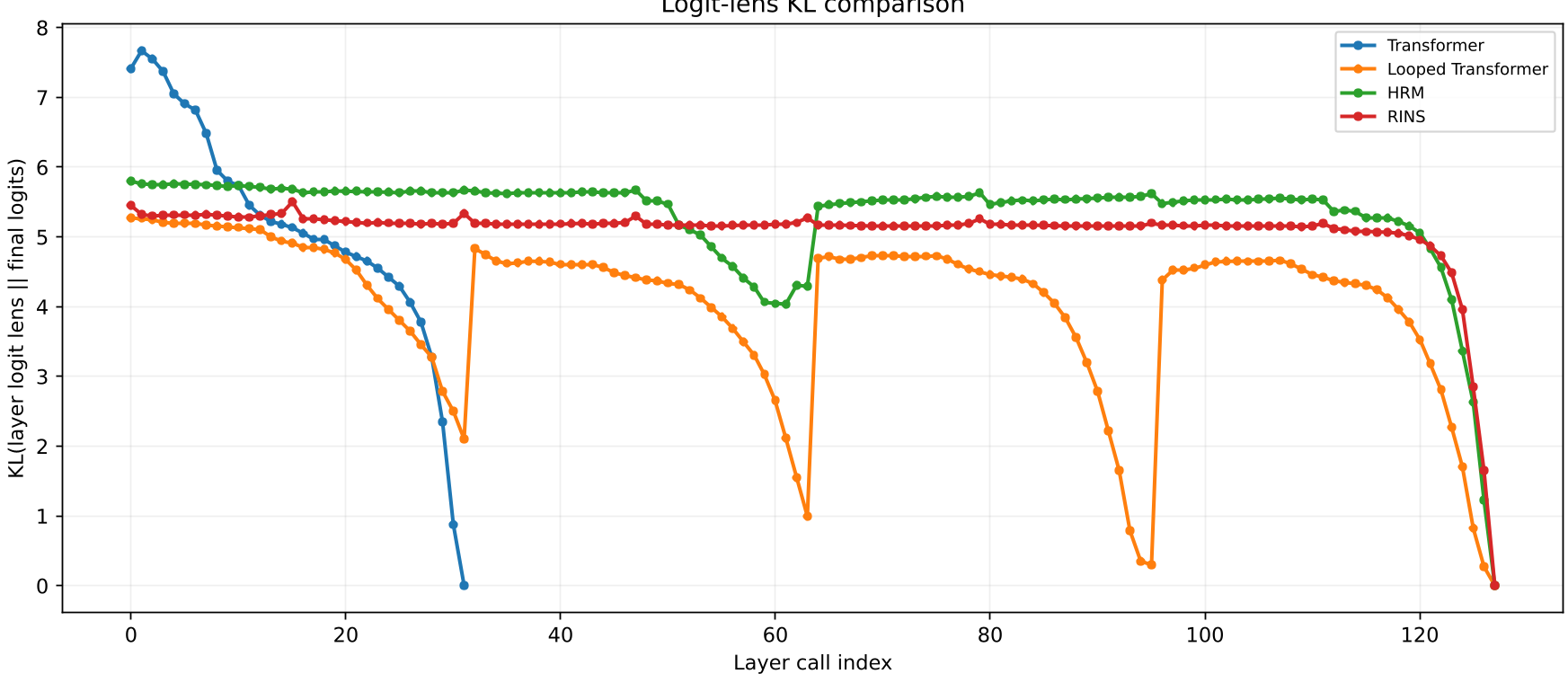
- Effective Depth: Logit lens analysis shows that HRM-Text maintains "active change" in its representations into much deeper layers compared to standard Transformers, which tend to converge to a stable distribution early.
- Sample Efficiency: The response-only objective led to significantly lower NLL (loss) for actual task completion compared to standard causal modeling.
Critical Perspective
While HRM-Text is a breakthrough for efficiency, it has its limits.
- Knowledge vs. Reasoning: The model excels at task execution (reasoning) but holds less "world knowledge" than models trained on trillions of tokens.
- Inference Overhead: Recurrence increases serial depth, which can slow down token generation unless paired with mechanisms like Adaptive Computation Time (ACT) to skip unnecessary loops for simple queries.
Conclusion: Democracy for Foundational AI
HRM-Text proves that foundational pretraining isn't just for Big Tech. By "working smarter, not harder" through hierarchical recurrence and targeted objectives, the entry price for pretraining has dropped from millions of dollars to the price of a high-end laptop. This shift could trigger a new era of architectural innovation from the broader academic community.
Takeaway: The next SOTA might not come from more GPUs, but from a better structural inductive bias.