
The HTP Model: Decoding the DNA of Social Machines like Wikipedia
The HTP Model: Understanding the Development of Social Machines
The paper introduces the HTP model (Heterogeneous networks, Translation, Phases), a socio-technical framework designed to analyze the formation and evolution of "social machines" on the Web. By mapping the interplay between human actors and technological actants, the model explains how platforms like Wikipedia achieve stability and adapt over time through iterative development cycles.
TL;DR
The Web is not just code; it is a Social Machine—a living organism where humans and software co-evolve. This paper introduces the HTP Model, a framework that uses Heterogeneous networks, Translation, and Phases to explain how Web activities emerge from chaos, find stability (SOTA consistency), and eventually scale into global ecosystems.
Background Positioning
Published at WWW '13, this work moves beyond the "Web as a database" view. It positions itself at the intersection of Web Science and Sociology, providing a rigorous analytical lens to understand the life cycles of digital platforms through Actor-Network Theory (ANT).
Problem: The "Engineering Only" Blind Spot
Most developers treat Web growth as a scaling problem: more servers, faster algorithms. However, the authors argue that this ignores Interpretive Flexibility. A technology's path is determined as much by human acceptance as by its technical specifications. Without a model to track the "social" side of the machine, we cannot predict why a platform like Wikipedia succeeded while many expert-led encyclopedias failed.
Methodology: The HTP Trifecta
The HTP model operates on three logical levels to demystify complex Web activities:
1. Heterogeneous Networks (H)
The model treats humans and technologies (actants) as equal nodes. A "Network" isn't a static graph; it is a dynamic association driven by a shared Agenda.
- Insight: If the actors lose interest or the technology fails to meet the agenda, the network collapses.
2. Translation (T)
This is the "engine" of development. It follows an iterative loop:
- Problematisation: Defining a goal that makes the network indispensable.
- Interessement & Enrolment: Convincing new actors to join.
- Mobilisation: Achieving a stable state where the network delivers outcomes.
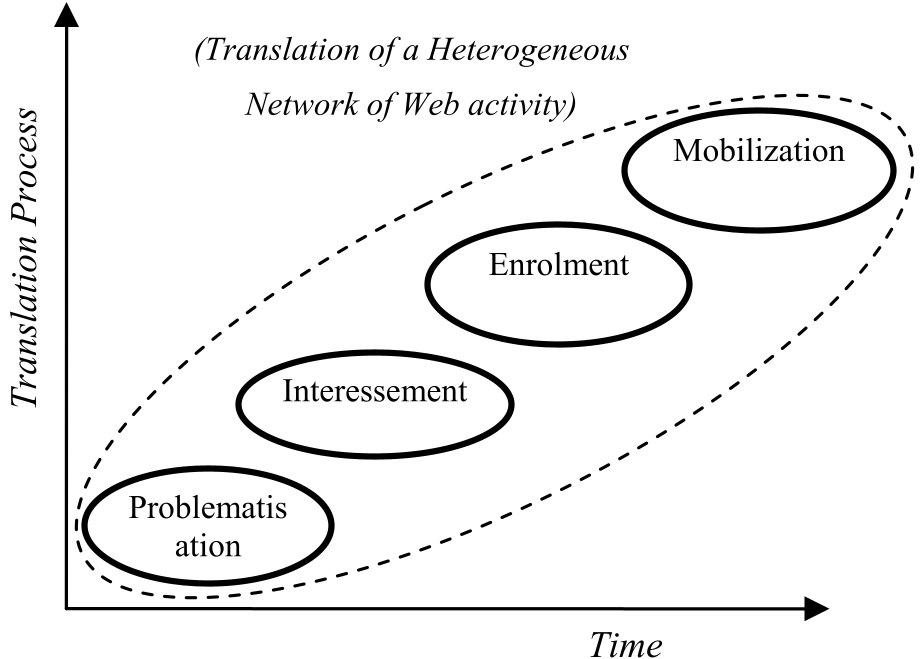 Figure 1: The iterative nature of network translation, moving from unorganized participants to a mobilized machine.
3. Phases (P)
Successful networks often become "black-boxed" and serve as the foundation for the next phase. HTP analyzes these layers to show how one stable machine (like an open-source license) enables the next (like a collaborative encyclopedia).
Case Study: Deconstructing Wikipedia
The authors apply HTP to Wikipedia to prove its utility:
- Phase 0 (Nupedia): The "focal actors" (Jimmy Wales, Larry Sanger) tried to build an expert-led system. It was stable but slow.
- Phase 1 (Wikipedia): A new "Obligatory Passage Point" (OPP) was created—the Neutral Point of View (NPOV). This allowed non-experts to contribute, causing a "Translation" that grew the network exponentially.
- Phase 2 (Wikimedia): The success of Wikipedia led to the creation of the MediaWiki software, which then "translated" into a whole family of projects (Wiktionary, Wikinews).
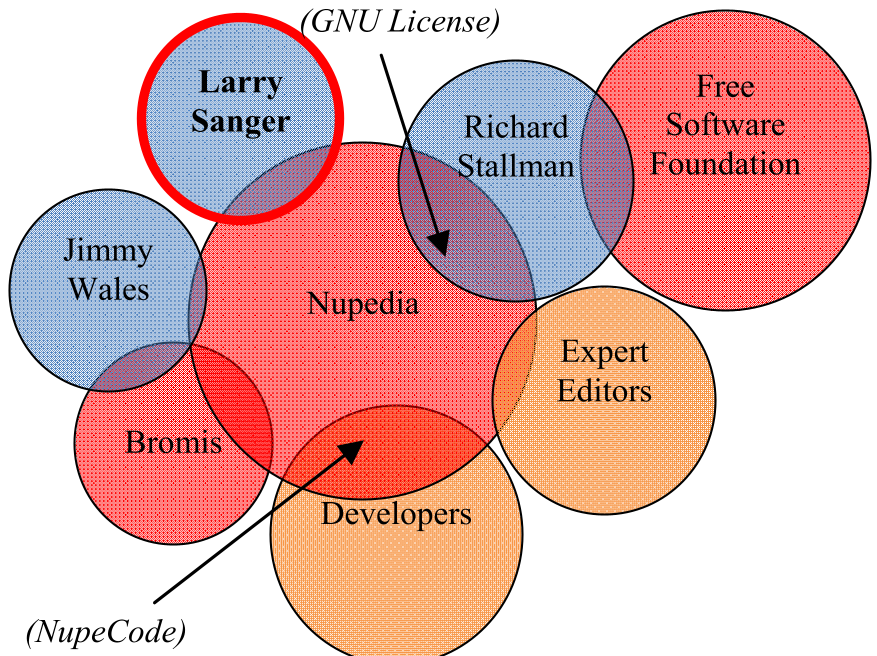 Figure 2: Phase 0 illustrates the early alignment of actors (Nupedia, GNU License) that preceded the birth of Wikipedia.
Critical Analysis & Conclusion
Takeaway
The HTP model proves that stability is temporary. A social machine is only "sustainable" as long as its human and technical components remain committed to a shared agenda. Wikipedia's shift from .com to .org wasn't just a domain change; it was a critical "Translation" to remove conflicting financial agendas (like Bromis) that threatened the network's core logic.
Limitations
While the HTP model is excellent for post-hoc historical analysis, its predictive power is still being tested. It requires deep qualitative data (archives, emails, logs) to map the "agendas" of actors accurately, which may be difficult for closed-source or private platforms.
Future Outlook
As we enter the era of AI-driven Social Machines, where LLMs act as autonomous "actants," the HTP model provides a vital framework for understanding how AI agents will reshape our social and technical networks.