
Destination Node-Driven Routing: Revolutionizing Latency in Social MANETs
HTTP message response time on destination node-driven routing for social MANET
This paper proposes "Destination Node-Driven Routing" for Social MANETs (Mobile Ad-hoc Networks) built upon SNS group trust. The method shifts the responsibility of path discovery from the source to the node nearest to the public Wi-Fi access point, achieving significantly reduced HTTP response times compared to traditional source-driven protocols like AODV.
TL;DR
Accessing the Internet via a MANET (Mobile Ad-hoc Network) has long been plagued by high latency and security concerns. This paper introduces a Social MANET architecture that leverages SNS-based trust and a novel Destination Node-Driven Routing protocol. By allowing nodes near an access point to proactively initiate routing, the system cuts HTTP response times from 5 seconds to under 0.5 seconds, making ad-hoc internet sharing practically usable for the first time.
The Problem: Why Your Ad-hoc Internet is Slow
In a standard MANET using AODV (Ad-hoc On-demand Distance Vector) routing, the process is reactive. When a user (the source) wants to visit a website, the terminal starts hunting for a route. This "Source-driven" approach creates a massive bottleneck:
- Request Latency: The HTTP request hangs while RREQs (Route Requests) propagate through the network.
- TCP Failure: If a route isn't found within a few seconds, TCP connection requests fail and trigger a 3-second backoff/retransmission, frustrating the user.
- Trust Issues: Using a stranger's phone as a relay is a security nightmare.
The Solution: Trust and Proactivity
The authors solve the trust issue by defining a Social MANET, where only members of the same SNS group (e.g., a Facebook group) participate.
1. The Community Token
To manage this, they use a Community Token—a data structure containing:
- Group ID: To verify SNS membership.
- Max-Battery/Max-Time: To prevent relay nodes from being drained unfairly.
- Source Address: Hardcoded MAC addresses to ensure packets find their way back.
2. Destination Node-Driven Routing
The core innovation is the reversal of the routing initiation. Instead of the source node asking "Where is the Internet?", the node currently connected to a Wi-Fi Access Point (the destination) proactively broadcasts RREQs to the source node.

In this architecture, the terminal 'X' acts as the bridge. It knows who the source is via the Community Token and establishes the path before the source even clicks a link.
Experimental Validation
Using the Scenargie simulator, the researchers compared their method against traditional source-driven routing.
Performance Gain
The results were dramatic. In the source-driven model, HTTP response times hovered around 4.8 seconds. In the destination-driven model, this dropped to roughly 0.4 seconds.

Why the difference? In the source-driven model, the initial "no route" state caused a TCP connection failure, leading to a mandatory 3-second wait. The destination-driven model had the "pipes" ready before the data started flowing.
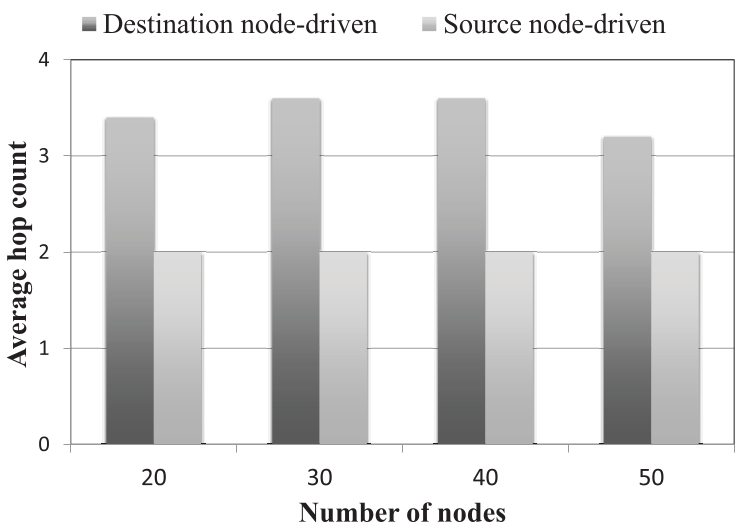
The Trade-off: Hop Count
The only downside observed was a slight increase in the average hop count. Since the "Destination" node is actually the relay node connected to the AP (adding one hop from the AP itself), the total path length is usually about one hop longer than the theoretical minimum. However, the gains in latency far outweigh this minor overhead.
Critical Insight: The Value of Social Trust
The most profound takeaway is that Trust is a Routing Metric. By limiting the network to an SNS circle, the authors move from an "unreliable/hostile" environment to a "cooperative" one. This allows for more aggressive, proactive routing protocols that would be too "noisy" or risky in an open MANET.
Final Takeaway
This research provides a practical blueprint for "Traveler's Networks"—allowing tourists without local SIM cards to securely and quickly hitchhike on the data connections of trustworthy locals. By making the gateway (Destination) the driver of the connection, we can eliminate the "startup lag" that has killed previous attempts at ad-hoc internet sharing.