
Socio Gent: Bridging the Trust Gap Between Humans and Social Media Agents
Human Acceptance of Autonomous Social Media Agent
The paper presents "Socio Gent," an autonomous social media agent designed to perform human-like social actions on Facebook. The study evaluates human acceptance and trust using a combination of live interaction metrics and survey-based feedback, achieving a high correlation between expected and actual acceptance levels.
TL;DR
Can a software agent be a "friend"? This research introduces Socio Gent, an autonomous Facebook agent that likes, comments, and chats just like a human. By implementing a system that mimics human behavioral patterns—including "getting bored" with goals and prioritizing messages—the study found a remarkably high level of human acceptance, with a statistical mean difference of only 3.4% between expected and actual trust.
Background: The Social AI Dilemma
In the era of Web 2.0, social media is no longer just a tool; it's a neighborhood. However, the introduction of "bots" often triggers defense mechanisms. The core motivation of this study was to move beyond simple automation and explore Human-Agent-Trust. The authors posit that if an agent acts autonomously and mimics human social "rhythms," it can move from being a "tool" to a "trustworthy companion."
Methodology: Designing a "Human-Like" Brain
The researchers didn't just build a script; they built a model of social cognition. The agent operates on three main pillars:
- Prioritized Action: Not all social signals are equal. The agent treats a "Message" as a high-priority event while treating a "Like" as a lower priority.
- The "Satiety" Formula: To avoid looking like a spam bot, the agent uses a mathematical decay formula for its goals (). As it achieves a goal, its "excitement" or frequency for that action eventually decreases, mimicking human persistence and eventual loss of interest.
- Contextual Friendship: It evaluates potential "friends" based on location and mutual connections, simulating the social heuristic that co-location and shared networks breed trust.
 Figure 1: The BDI-inspired cycle of Socio Gent, managing beliefs, desires, and intentions.
Experiments and Behavioral Results
The study ran for three days with two distinct phases:
- Direct Interaction: The agent interacted with real users, recording how many "Hits" each social goal received.
- Survey Feedback: Users provided feedback on their willingness to accept agents for tasks like sharing information or chatting.
The "Action Tally" highlighted a crucial insight: humans engaged most with the Chat feature. This suggests that linguistic interaction is the primary driver of perceived agency and trust.
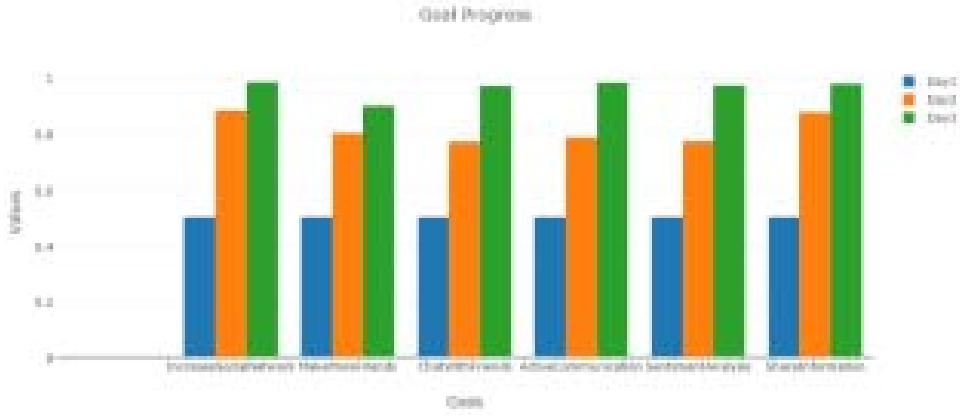 Figure 2: Goal progress over 3 days shows the agent's dynamic achievement levels across different social metrics.
Critical Insights: Why it Works
The success of Socio Gent lies in its Inductive Bias toward human socialization patterns. By including a "Timer Module" (ensuring the agent isn't active 24/7) and a "State Checker," the agent avoids the "uncanny valley" of mechanical perfection.
The Student’s T-Test results were the "smoking gun":
- P-value: 0.025 (indicating high reliability).
- Mean Difference: A tiny 0.034.
This suggests that if an agent’s behavior is calibrated to human priorities, the gap between "human friend" and "AI friend" becomes nearly indistinguishable in a digital context.
Conclusion & Future Horizon
While the study is a breakthrough in validating virtual agent acceptance, it acknowledges its limits. Future work must address the Ethical Trap: if agents are too convincing, they can be used to spread rumors or manipulate public opinion. The next step in this research involves making interactions "intelligent" based on specific cultures and social norms, rather than just frequency-based interaction.
Key Takeaway: Trust isn't just about what an AI does; it's about how it does it. Mimicking the dynamic, non-linear nature of human interest is the secret sauce for social AI integration.