
Bridging the Gap: Data-Driven Human-Agent Interaction via Crowdsourcing
Human-Agent Interaction Model Learning based on Crowdsourcing
This paper presents a methodology for learning human-robot interaction models using large-scale data collected via crowdsourcing. The authors develop the "Firefighter Robot game" and utilize Markov Decision Processes (MDP) combined with supervised classification (Gradient Boosting) to optimize supervisory policies for mixed-initiative missions.
TL;DR
To solve the unpredictability of human behavior in mixed-initiative systems, this paper leverages crowdsourcing to collect massive interaction data. By training a Factored Markov Decision Process (MDP) on this data, the authors developed a supervision strategy that dynamically switches between autonomous and manual modes, outperforming static or random triggers in a firefighting simulation.
Problem & Motivation: The Human Bottleneck
In high-stakes environments—like operating UAVs or emergency response robots—the "human-in-the-loop" is often the greatest variable. While automation handles routine tasks, human operators provide critical tactical and ethical judgment. However, factors like cognitive workload, stress, and boredom lead to performance degradation.
The core challenge is: When should the system take control, and when should it yield? Static models fail because they don't account for the non-deterministic nature of human response. This paper argues that instead of guessing human behavior, we should learn it from a "crowd" of real interactions.
Methodology: From Clicks to Intentions
The authors designed the Firefighter Robot game, a multi-task scenario requiring robot navigation and resource management.
1. Data Collection via Gamification
By deploying the game online, the team collected over 85 hours of data. Each second of gameplay was recorded as a 16-dimensional vector including robot pose, battery levels, tree fire status, and raw keystrokes.
2. Discretization and Intention Learning
A major technical hurdle was the "curse of dimensionality." To manage a state space of ~12,960 states, the authors used Gradient Boosting to map raw keyboard sequences and robot orientations into a discrete "Human Intention" variable (e.g., "Intending to move North-East").
3. The Factored MDP Framework
Instead of a massive transition matrix, the authors used a Dynamic Bayesian Network (DBN) to represent the mission. By assuming conditional independence between certain variables (e.g., battery level is independent of tree status given the previous state), they simplified the learning of the transition function .
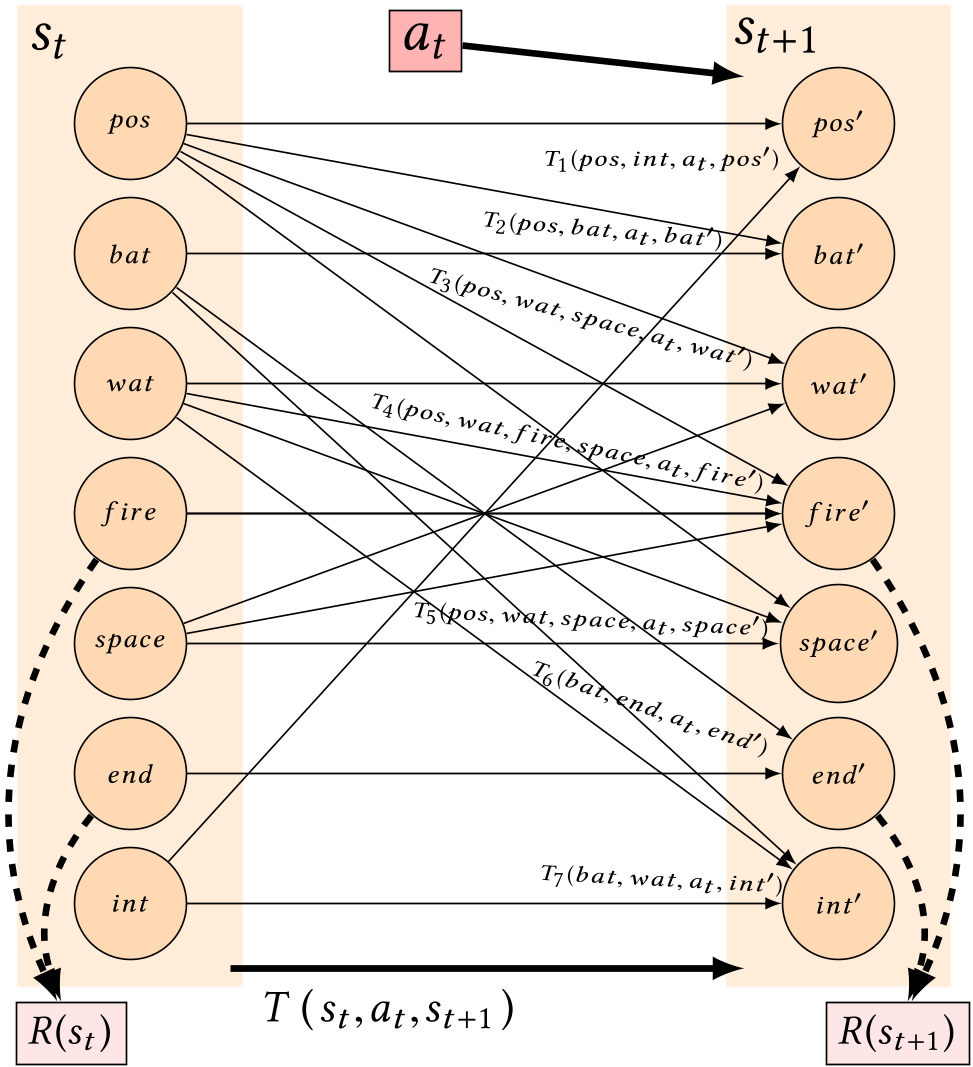 Figure: The DBN structure showcasing how next-state variables (primed) are influenced by a subset of current variables and the supervision action.
Experiments: Proving the Strategy
The model was validated using the PROST solver (a Trial-based Heuristic Tree Search algorithm). The researchers compared four strategies:
- CM (Constant Manual): Human controls everything.
- CA (Constant Autonomous): Robot follows a hard-coded heuristic.
- RD (Random): Mode switches randomly (baseline).
- OP (Optimized): MDP-based dynamic switching.
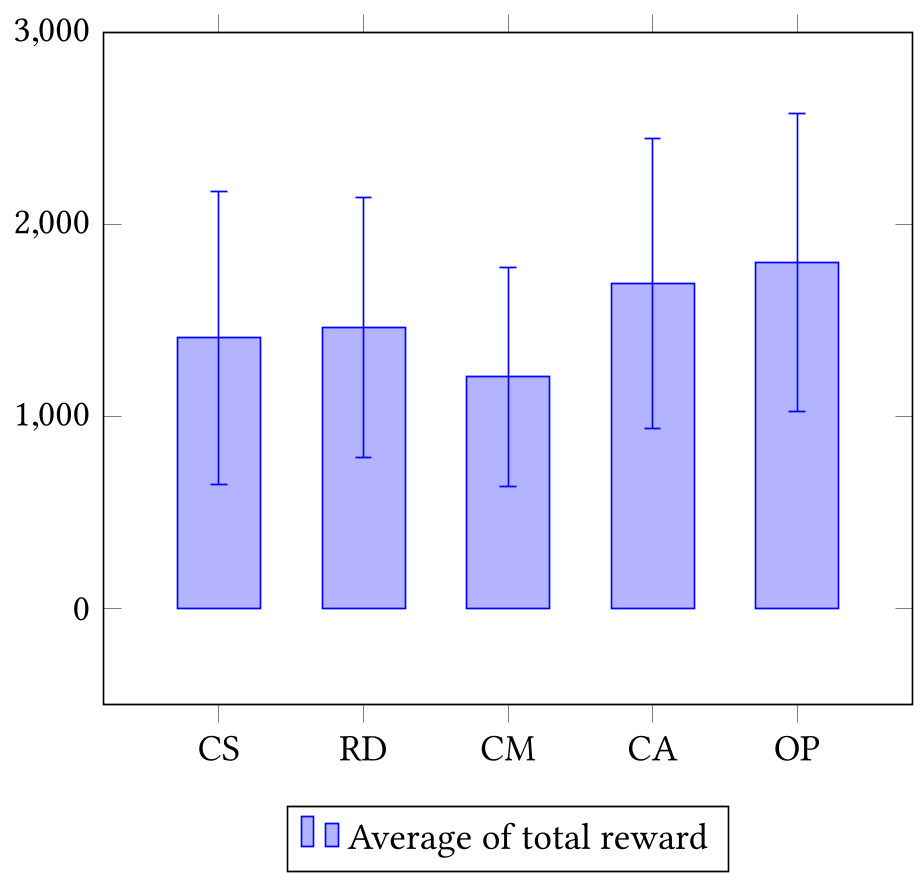 Figure: The optimized policy (OP) achieves the highest expected reward, proving that a learned model of interaction can effectively mitigate human errors and workload.
Critical Analysis & Conclusion
The study successfully moves Human-Agent Interaction (HAI) from theoretical modeling into the realm of empirical machine learning.
Key Takeaways:
- Intent over Action: Mapping raw inputs to "intentions" is a robust way to handle noisy human data.
- Mixed-Initiative Value: Dynamic autonomy is superior to both full manual control (which overwhelms the user) and full autonomy (which lacks tactical flexibility).
Limitations & Future Work: While the model assumes the state is fully observable, the authors acknowledge that human "mental state" is actually a hidden variable. Transitioning to a Partially Observable MDP (POMDP)—incorporating physiological sensors to estimate "stress" or "fatigue"—is the logical next step for truly adaptive HAI.