
Perfection Not Required: Why Developers Are Embracing "Imperfect" AI Agents
Perfection Not Required? Human-AI Partnerships in Code Translation
This paper investigates human-AI partnership in code translation, focusing on the use of Unsupervised Neural Machine Translation (NMT) like TransCoder for application modernization. Through interviews with 11 software engineers using a design scenario approach, it explores how professionals interact with and tolerate "imperfect" AI outputs that may contain logical or compilation errors.
TL;DR
In the world of software engineering, "correctness" is binary—code either works or it doesn't. However, a landmark study from IBM Research suggests that software engineers don't actually need AI to be perfect. By treating AI as a "junior partner" and providing the right UI tools—like confidence scores and alternate suggestions—developers can effectively use flawed AI outputs to accelerate complex tasks like application modernization.
The "Brittle Code" Problem: Why AI Translation is Hard
Traditional Neural Machine Translation (NMT) treats code like natural language. But unlike a slightly mistranslated sentence in a novel, a single misplaced semicolon or a logical "off-by-one" error in code can crash an entire enterprise system.
The prevailing concern has been: Would professional developers ever trust a system that is fundamentally probabilistic and prone to "hallucinating" logic?
Methodology: The UX of Uncertainty
The researchers didn't just ask "Do you like AI?". They placed 11 veteran engineers (experts in Java and Python) in front of TransCoder, a state-of-the-art unsupervised NMT model. They used a three-stage progression of UI variants:
- Raw Translation: A simple side-by-side view.
- Confidence Highlighting: Low-confidence tokens were highlighted in red (an "uncertainty map").
- Alternate Translations: Providing a dropdown of "other ways" the AI thought the code could be written.
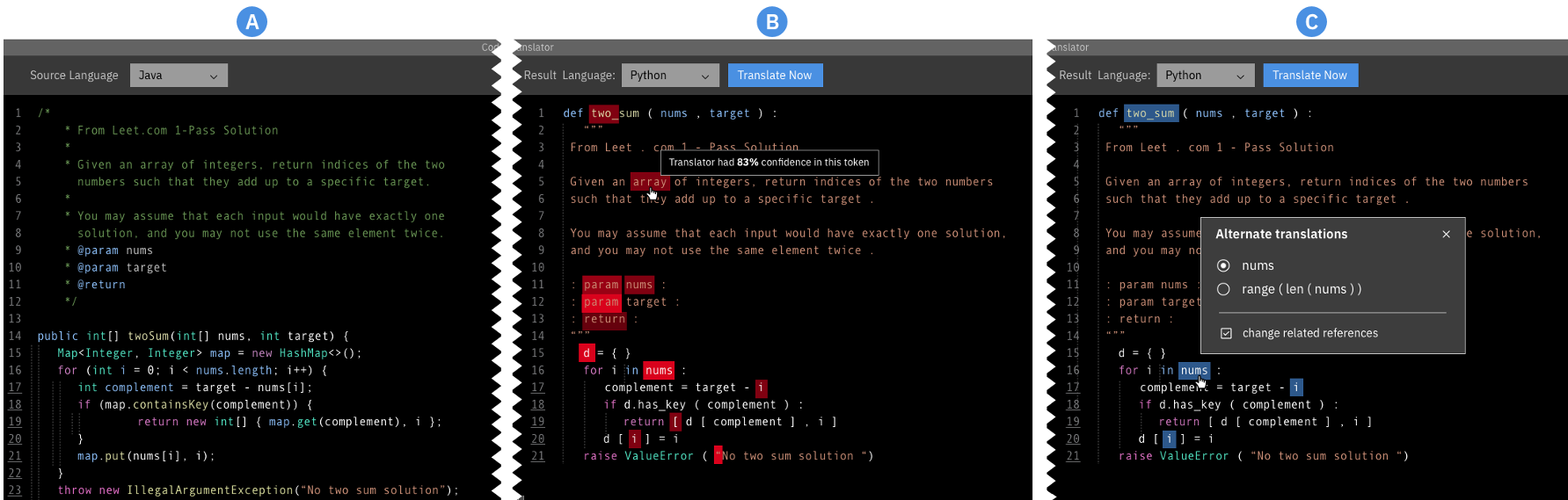 Figure 1: The study's interface showing how low-confidence red highlights and alternate translations help guide human review.
Key Insights: Verification, Not Understanding
One of the most striking findings was that developers don't care how the AI works. When asked if they needed to understand the underlying "magic" of the transformer model, the response was a resounding "No."
Instead, they treated the AI output exactly like code written by a fellow human:
- Trust No One: Developers have a "trust, but verify" mindset. If the code passes the unit tests and a manual review, it’s good to go.
- AI as a "Checklist": Red highlights (low confidence) didn't make developers distrust the tool; they used them as a "to-do list" to prioritize their review effort.
- The Power of "Maybe": Alternate translations acted as a "Quick Fix" menu. Interestingly, comparing two different AI-generated approaches often helped developers spot logical errors they would have missed in a single output.
Results: The Utility of the Imperfect
Even when the AI produced code with explicit logic errors (e.g., a loop that returned wrong values), the engineers found it useful.
"As long as it’s giving me a head start... I’ll take it. It’s easier than rewriting from scratch." (P2)
The study identified that the "Modernization Lifecycle" (moving legacy COBOL or Java to Cloud-native Python) is currently a "rats' nest" of undocumented code. In this high-friction environment, an AI that is 70% right is infinitely better than 0% help.
Critical Analysis & The Future of Human-AI Partnerships
This research shifts the goalposts for AI developers. The race shouldn't just be for the highest BLEU score or pass@1 rate; it should be for the best Explanability and Steerability.
Limitations
- Subjectivity: The value perceived is still tied to the developer's experience level. High-seniority "architects" might view AI differently than junior coders.
- Small Sample Size: While 11 engineers provide deep qualitative data, a larger quantitative study would help define the "Acceptability Threshold" (i.e., at what % of errors does the tool become a net-negative for productivity?).
Conclusion: The "New Normal" for DevTools
The future of AI in software engineering is not a "black box" that replaces the coder, but a transparent "partnership." By designing interfaces that acknowledge AI's fallibility, we can create tools that allow humans to do what they do best—verify and think critically—while the AI handles the "tedious" lifting of syntax translation.
The Takeaway: If you're building AI tools, don't hide the uncertainty. Highlight it. It's the key to human trust.