
Simulating the Implicit: A Fuzzy-Logic Approach to Human Behavior and Social Networks
Human behavior and social network simulation: fuzzy sets/logic and agents-based approach
The paper introduces a hybrid framework for simulating individuals and groups within social networks by combining Fuzzy Logic/Fuzzy Sets with Multi-Agent Systems (MAS). It aims to model complex human variables like stress and motivation to enhance the realism of social dynamics in military and manufacturing environments.
TL;DR
Human behavior is rarely deterministic, yet most simulations treat it as such. This paper presents a framework that uses Fuzzy Sets and Multi-Agent Systems (MAS) to model the "grey areas" of human psychology—like the link between fatigue and workplace conflict—providing a more realistic tool for manufacturing and military decision-making.
Background & Positioning
In the landscape of modeling, we often see a divide: physical systems are modeled with high-precision math, while human systems are often oversimplified or modeled with rigid statistics. This work positions itself as a theoretical and methodological bridge, moving away from binary "0 or 1" social relationships toward a nuanced, continuous representation of the human condition in a social context.
The Problem: The Deterministic Fallacy
Most traditional Human Behavior Models (HBMs) fail because they treat human response as a fixed output of a specific input. They neglect critical internal variables:
- Imprecision: Emotional states like "stress" cannot be captured by a single integer.
- Coupling: Fatigue affects motivation, which in turn affects social performance.
- Scale: Moving from an individual's psyche to a group's social network is mathematically complex.
Methodology: The Two-Phase Fuzzy Framework
The authors tackle the complexity through a dual-layered architectural approach.
Phase 1: Psychological Evolution via FDE
To model individual behavior, the authors use Cognitive Maps. Instead of static weights, they employ Fuzzy Differential Equations (FDE). The degree of an element evolves based on its relations with other elements.
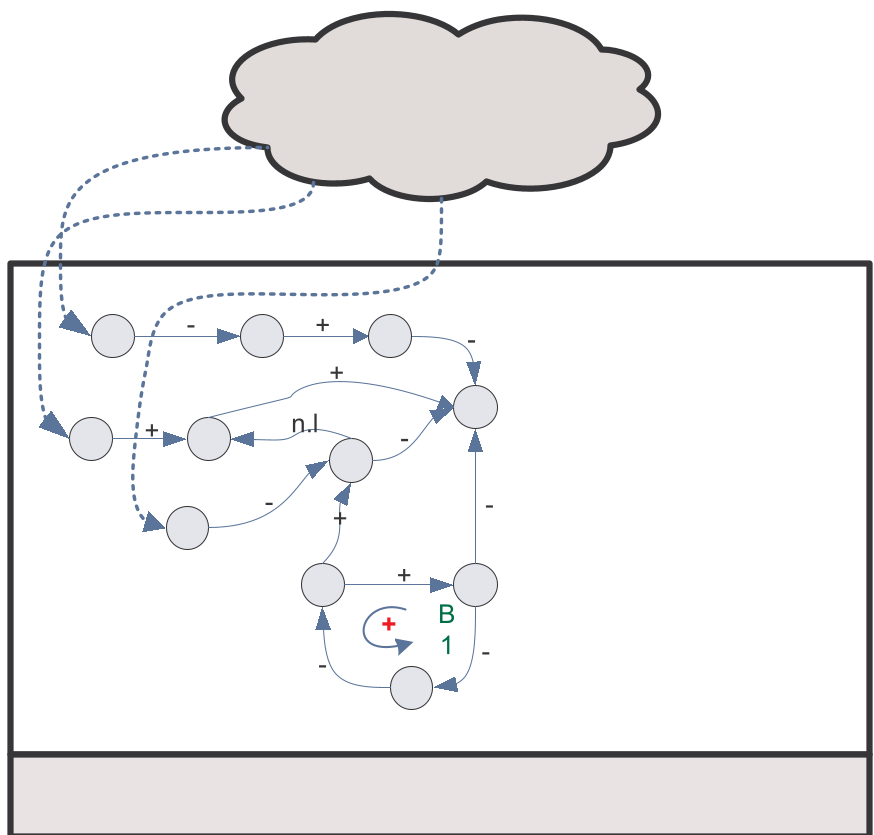
The core innovation here is the use of triangular fuzzy numbers (e.g., "Very Low" to "Very High") to represent state variables. The simulation doesn't just produce a single line; it produces a region of uncertainty (an n-cube in state space) based on -cut computations.
Phase 2: Sociological Interaction via Mamdani Inference
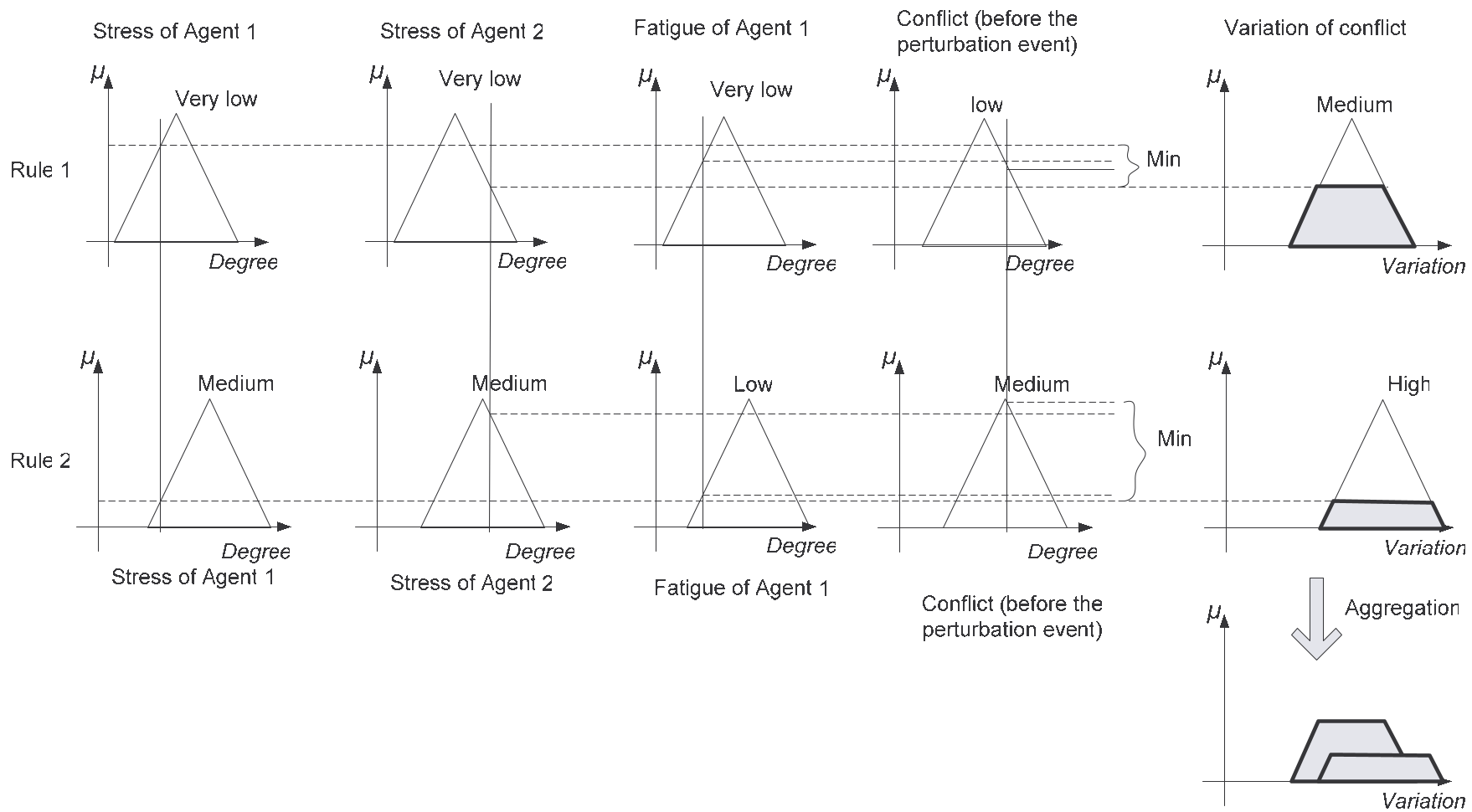
Once the individual's state is calculated, these "fuzzy" internal states are fed into a Mamdani Fuzzy Inference System. This determines social outcomes.
- Input: Stress levels of Agent A and Agent B.
- Rule: IF (Stress A is High) AND (Stress B is High) THEN (Conflict Variation is Very High).
- Output: A "defuzzified" crisp value that updates the social network's structure.
Experiments and Insights
The simulation results (visualized through trajectory plots) show that human behavior doesn't follow a simple linear path. By sampling the "external surface" of the uncertainty region, the authors illustrate how small initial variances in mood or fatigue can lead to vastly different social outcomes over time.
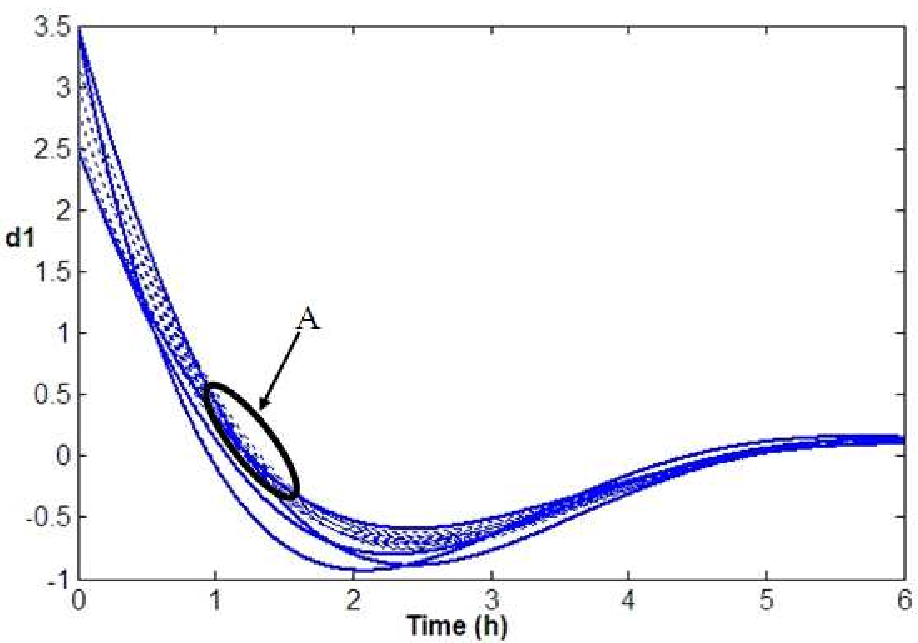
The behavior of "Element 1" across various trajectories demonstrates that the system remains stable yet flexible, accurately reflecting how a group of workers might react to environmental perturbations in a manufacturing plant.
Critical Analysis & Conclusion
Takeaway
The hybrid approach—using continuous differential equations for internal psychology and discrete fuzzy rules for social interaction—is a powerful paradigm. It allows for a multi-scale simulation that feels "human."
Limitations
- Quantification Difficulty: Defining the initial "fuzzy rules" still relies heavily on expert intuition or subjective psychological theories.
- Computational Cost: Resolving FDEs through multiple -cuts is significantly more expensive than standard ODEs, potentially limiting the scale of the social network.
Future Work
The next step for this research is the integration of automated event detection. In a real-world scenario, agents need to "sense" their environment (e.g., a machine breakdown) and automatically evaluate its impact on their stress/fatigue levels without manual input.