
Interactions Among Human Behavior, Social Networks, and Societal Infrastructures: A Computational Epidemiology Perspective
Interactions among human behavior, social networks, and societal infrastructures: A Case Study in Computational Epidemiology
This paper presents a computational epidemiology framework that explores the co-evolution of public policy, individual behavior, and social networks during infectious disease outbreaks. Using the SimDemics simulation tool, the authors analyze both non-adaptive strategies (e.g., pre-vaccination) and adaptive interventions (e.g., social distancing and quarantine) within a large-scale synthetic population of Chicago (8.8 million agents).
TL;DR
This study revolutionizes epidemiological modeling by moving beyond static "snapshots" of society. By treating social networks as living, breathing entities that adapt to fear and policy, the researchers demonstrate that when we act and how people respond is far more important than the specific medical tools at our disposal.
Perspective: The PIN Problem
The core of this research is the PIN problem—the triad of Public policy, Individual behavior, and the interaction Network. In a crisis (like an avian flu pandemic), people don't just sit still; they stay home, avoid work (presenteeism vs. absenteeism), or flee cities. Most classical models ignore this "selection and influence" co-evolution, leading to policies that fail when they meet real-world human behavior.
Methodology: The SimDemics Architecture
The researchers utilize SimDemics, a massive-scale simulation tool. Unlike aggregate models (using differential equations), SimDemics is disaggregated: it tracks every individual agent.
- Synthetic Population: 8.8 million agents for Chicago, statistically identical to census data but anonymized.
- Activity Templates: Each agent has a "minute-by-minute" schedule (work, school, shopping) creating a bipartite graph of People and Locations.
- CGDDS Framework: A mathematical model where:
- D (Disease): Updates health states based on contacts.
- M (Mobility): Assigns locations based on state.
- A (Activity): Generates new activity patterns (behavioral response).

Adaptive vs. Non-Adaptive Strategies
The paper highlights a stark contrast in effectiveness between static planning and dynamic response.
1. The Limitation of Static Vaccination (Non-Adaptive)
The study found that unless you have "perfect knowledge" of the network to target "high degree" nodes (the super-spreaders), random vaccination is surprisingly ineffective for highly transmissible diseases. For a high transmissibility rate (τ = 0.0003), even vaccinating 5.6% of the population yielded negligible gains.
2. The Power of Behavioral Timing (Adaptive)
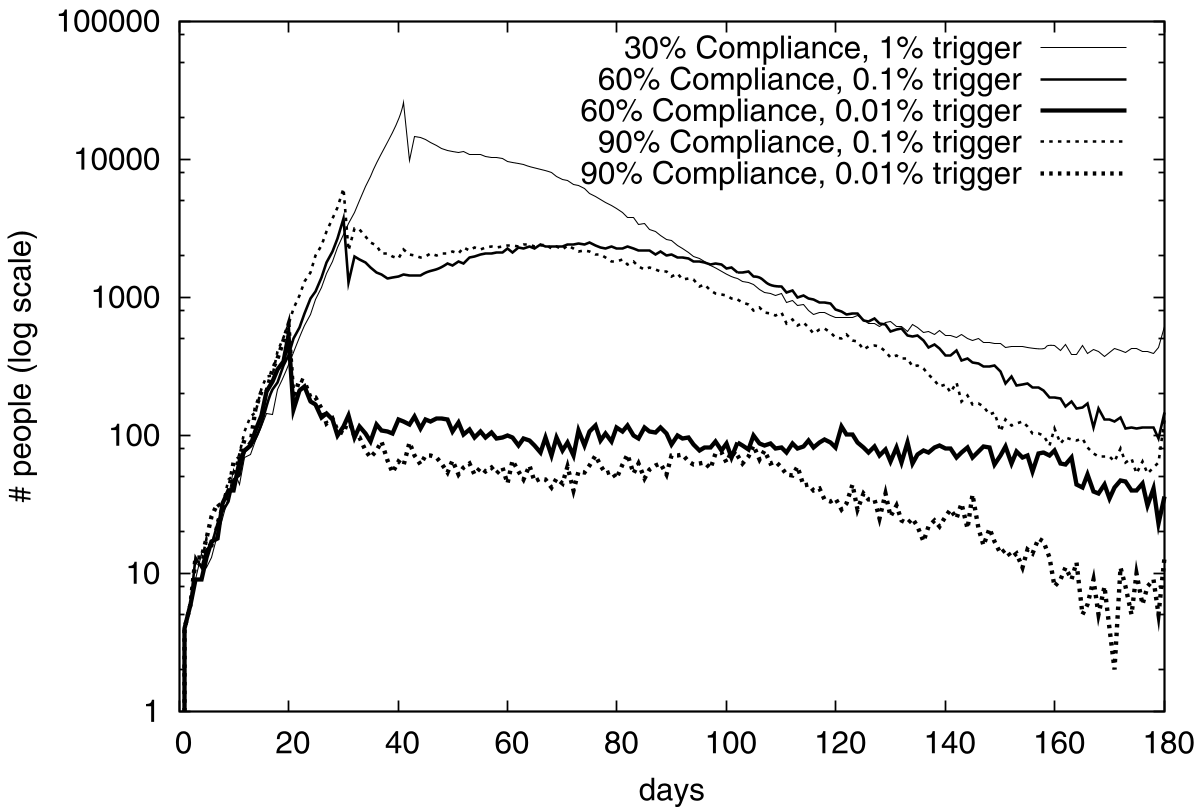
Adaptive interventions—such as school closures and household quarantine—were highly sensitive to Prevalence Triggers.
| Prevalence Trigger | Cumulative Proportion Ill |
|---|---|
| Never Intervene | 44.7% |
| 10% Infection | 20.3% |
| 1% Infection | 3.9% |
| 0.01% Infection | 1.7% |
Instituting social distancing when only 1% of the population is ill can reduce the final "attack rate" by over 90%.
Mathematical Insights: Games Against Nature
The authors formalize these interactions using Stochastic Optimization and Game Theory:
- The Vaccination Game (VG): Players weigh the cost of vaccination () against the probability of getting infected and the resulting loss ().
- Equilibria: In "pure Nash equilibria," a community reaches a state where components of unvaccinated individuals stay below a critical size.
- Complexity: The paper proves that finding the optimal set of nodes to vaccinate to minimize an epidemic is NP-complete, necessitating the use of heuristic simulations like SimDemics.
Critical Analysis & Conclusion
Takeaway
The value of this work lies in its Inductive Bias: the belief that the structure of social interaction is the primary driver of disease, not just the biology of the virus. It shows that policy success is fragile and highly dependent on public compliance and early detection.
Limitations
- Data Latency: The model assumes "perfect situational awareness" in some adaptive scenarios, which is rarely true in a real-world rolling crisis.
- Computational Expense: Large-scale agent-based models (ABMs) are computationally heavy, making real-time optimization difficult.
Future Work
The authors suggest that future research should focus on Multi-Stage Policy Games (MSPG), where individuals decide to "stay home" day-by-day based on local neighborhood infection rates, creating a truly bottom-up dynamical system.