
Decoding the Silent Dialogue: How Sparse Speech Features Reveal Complex Intent in HCI
Human Behaviour in HCI: Complex Emotion Detection through Sparse Speech Features
This paper introduces a method for detecting complex emotional states, specifically "thinking," by analyzing the pitch-contours of sparse discourse particles (DPs) like "hm," "uh," and "uhm" in naturalistic Human-Computer Interaction (HCI). Using Hidden Markov Models (HMMs) and Shifted Delta Cepstra (SDC) features, the authors achieved an 89% weighted average accuracy in classifying these affective cues.
TL;DR
In the quest for truly "Companion-like" technology, researchers at Otto von Guericke University have bypassed complex sentence analysis to focus on the smallest units of speech: discourse particles (DPs) like "hm" and "uhm." By treating these signals as acoustic fingerprints, they’ve developed a system capable of detecting the complex emotion of "thinking" with 89% accuracy, proving that how we say "uh" matters as much as what we say.
Background: The Loss of Information in Machine Talk
Most current AI or HCI systems suffer from a "semantic filter"—they listen to the words but miss the attitude. In Human-Human Interaction (HHI), we use prosodic cues to signal attention, understanding, or hesitation. When machines ignore these, humans adapt by speaking in "command-like" styles, leading to a sterile and often frustrating experience. The authors argue that to bridge this gap, we must decode Complex Emotions, which are often encoded in the intonation of speech fragments rather than just vocabulary.
The Insight: Small Particles, Big Meaning
The core thesis is elegant: Specific monosyllables carry the same intonation curves as full-length sentences. Because particles like "hm" are free of lexical and grammatical inflection, they are "pure" signals of a speaker's affective state.
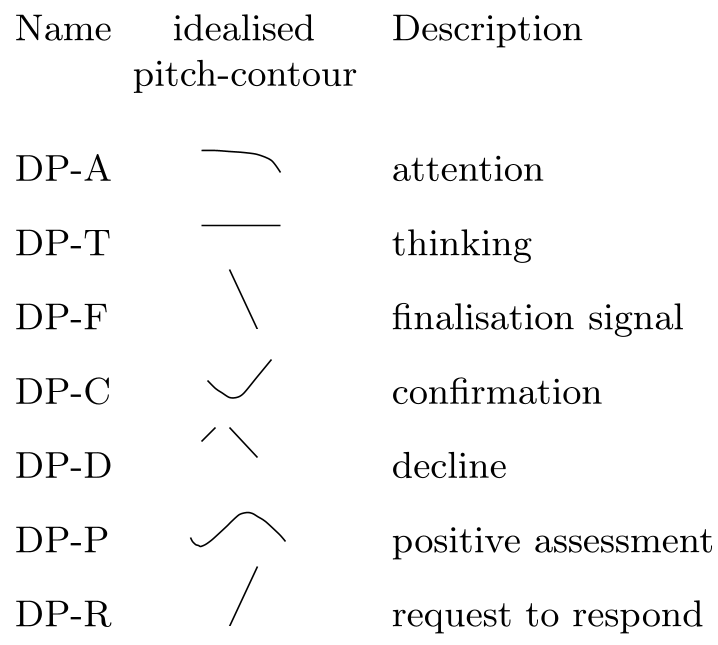
The researchers categorized these into seven form-function relations:
- DP-T (Thinking): A specific pitch contour indicating cognitive processing.
- DP-C (Confirmation): Indicating agreement.
- DP-R (Request to respond): Signaling a hand-off in the dialogue.
Methodology: Mining Pitch Contours
The study utilized the LAST MINUTE corpus, a naturalistic dataset of 133 subjects interactively preparing for a journey. The technical pipeline involves:
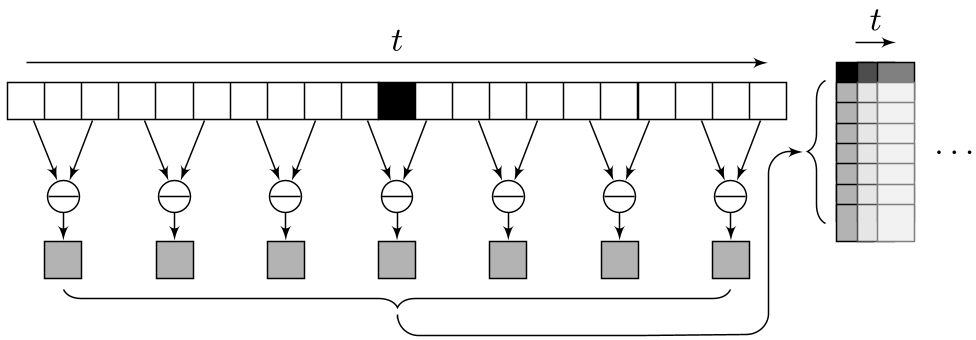
- Pitch Extraction: Using autocorrelation and low-pass filtering.
- Temporal Context: This is the "secret sauce." Since a static pitch value means little, the authors used Shifted Delta Cepstra (SDC). SDC looks at a much broader temporal window (±10 frames), allowing the model to "see" the shape of the pitch rise or fall.
- Classification: A 3-state Hidden Markov Model (HMM) with Gaussian Mixture Models handles the varying lengths of these short utterances.
Key Results: Age, Gender, and Accuracy
The researchers found fascinating behavioral patterns:
- Female Bias: Female subjects used "hm" significantly more than males.
- Age Dynamics: Elderly users increased their use of DPs like "uh" and "uhm" compared to younger users.
- Task Influence: In "Problem Solving" phases, the frequency of "hm" (thinking) actually increased, as users navigated the logic of the system.
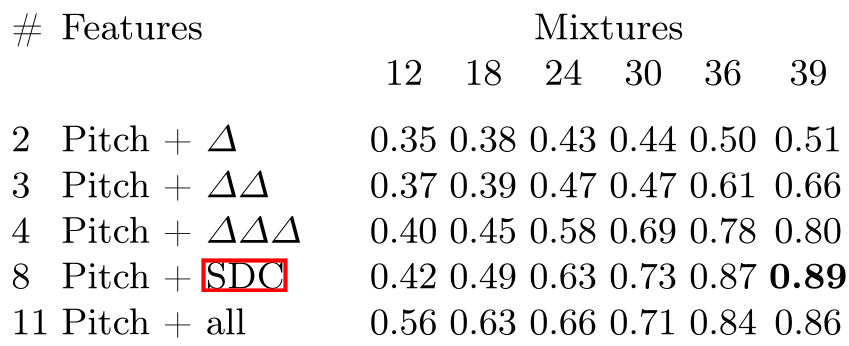
In terms of raw performance, the jump from simple pitch to SDC-enhanced features was dramatic:
- Pitch + Delta: ~51% Accuracy.
- Pitch + SDC: 89.31% Accuracy.
Critical Analysis & Conclusion
The value of this work lies in its efficiency. Instead of monitoring every millisecond of a conversation, a system can wait for "sparse" triggers—discourse particles—to gauge the user's state.
Limitations: The training set for "non-thinking" classes remains unbalanced, leading to higher misclassification for less frequent particles. Additionally, while "thinking" is well-defined, other complex emotions like "irritation" or "irony" still lack standardized form-function mappings.
Future Outlook: This research paves the way for "Cognitive Technical Systems" that can pause when they sense a user is thinking or offer help when they sense hesitation, without needing a single explicit word of feedback.