
Modeling Emotion Influence: Bridging Social Contagion and Deep Learning via GCRN
• Human-centered computing → Collaborative and social computing; • Applied computing → Sociology; • Computing methodologies → Neural networks
The paper proposes an Attention-based Graph Convolutional Recurrent Network (GCRN) for user emotion classification on social media. It integrates multimodal content features with social "emotion influence" from a user's neighborhood, achieving SOTA performance on a real-world Sina Weibo dataset.
Executive Summary
TL;DR: This paper introduces an Attention-based Graph Convolutional Recurrent Network (GCRN) to predict user emotions by looking at both what they post and how their friends feel. By combining GCNs to capture social influence and LSTMs to capture temporal personality, the model achieves a significant performance leap on the Sina Weibo dataset.
Positioning: This work bridges the gap between Spatio-Temporal Graph Modeling and Sentiment Analysis, moving beyond individual-centric models to a social-influence-aware paradigm.
Problem & Motivation: The "Social" in Social Media
Traditional emotion analysis treats users as isolated islands. However, the authors verify two key psychological intuitions through data observation:
- Emotional Contagion: Users in a "friend-related" group have a 27.1% emotion similarity, significantly higher than random pairs (20.7%).
- Emotional Persistence: Users are most likely to stay in their current emotional state (43.7% transition probability to the same emotion).
The challenge lies in quantifying this influence. Not all friends are equal, and the timing of their posts matters.
Methodology: The Attention-based GCRN
The proposed architecture solves the problem in three distinct stages:
1. Multimodal Feature Fusion (Pre-training)
Before tackling the graph, the authors use a Cross-media Auto-encoder to map text (Paragraph Vector) and images (SentiBank) into a shared latent space . This ensures that even if a tweet lacks an image, the model can still process the underlying emotional signal.
2. Capturing Social Influence (Spatial)
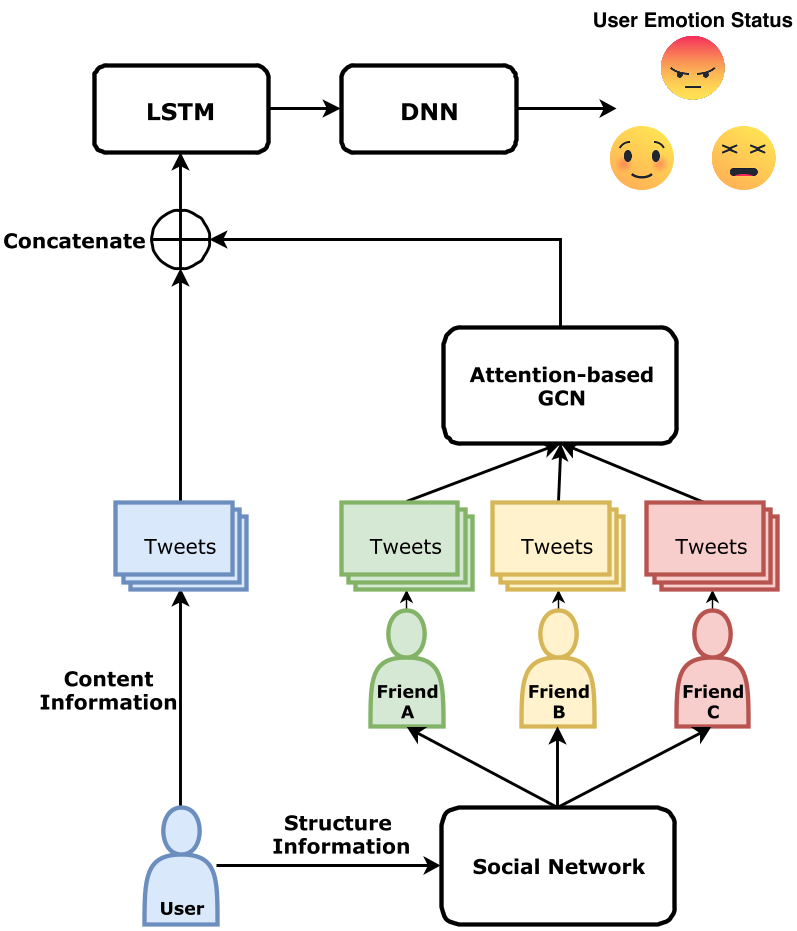
The model uses an Attention-based GCN to aggregate friend features.
- The Intuition: For a user , the model looks at neighbors within -hops.
- The Attention: Instead of a simple average, it calculates , a weight representing how much friend influences user based on their shared history and content similarity.
3. Tracking Emotion Evolution (Temporal)
The aggregated social influence is concatenated with the user's own content features and fed into an LSTM. This allows the model to "remember" previous states while integrating new "shocks" from the social network.
Experiments & Results
The model was tested on a massive Sina Weibo dataset (1.7M+ tweets).
SOTA Comparison:
| Method | Happy F1 | Sad F1 | Macro-F1 |
|---|---|---|---|
| LSTM (Individual only) | 0.846 | 0.385 | 0.531 |
| GCN (Static Social) | 0.831 | 0.316 | 0.516 |
| GCRN-Attention (Ours) | 0.902 | 0.421 | 0.577 |
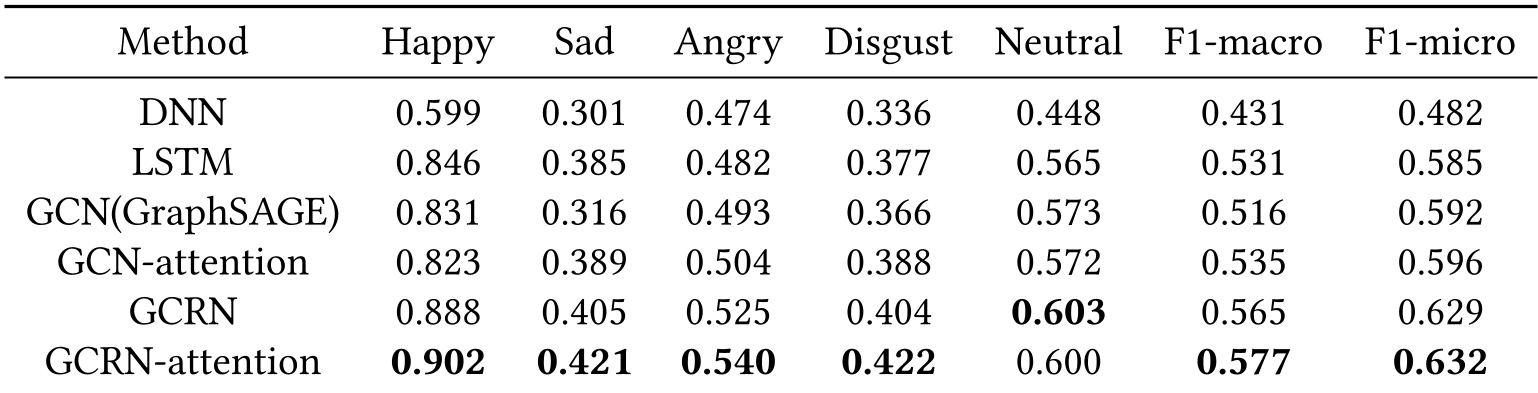
- Insight on Attention: The attention mechanism showed the largest gains in identifying "Happy" and "Sad" emotions, suggesting that friends with strong positive or negative vibes have the most measurable impact.
- Duration of Influence: Sensitivity analysis revealed that a 3-day window for social influence is the "sweet spot"—long enough to gather data, but short enough to remain relevant.
Critical Analysis & Conclusion
Takeaway: The success of GCRN-attention confirms that emotion is a collective phenomenon. By quantifying "influence weights," we can better understand how opinions and moods ripple through a network.
Limitations:
- The model relies on emoticon-based labeling for the dataset, which may introduce noise if users use emoticons sarcastically.
- It assumes a fixed network topology, whereas social ties are often dynamic.
Future Outlook: Integrating Interaction Data (likes, shares, @-mentions) into the attention layer could further refine the "Influence Weight" , making it the definitive tool for real-time public opinion monitoring.