
Beyond the Digital Facade: Redefining HCI for Cultural Heritage and Tourism
Human-Computer Interaction, Tourism and Cultural Heritage
This paper explores the state-of-the-art in Human-Computer Interaction (HCI) specifically for tourism and cultural heritage in Mediterranean Europe. It proposes a "Communicability Analyst" profile to bridge the gap between formal and factual sciences, aiming to enhance the design of interactive systems for safeguarding cultural assets.
TL;DR
This research challenges the current "educational mercantilism" in European HCI, arguing that the failure of interactive systems in tourism stems from a lack of true transdisciplinary training. It proposes the emergence of a Communicability Analyst—a professional capable of blending formal computer science with the factual nuances of semiotics and cultural history.
Background: The Mediterranean Paradox
In Southern Europe—encompassing France, Greece, Italy, Portugal, and Spain—tourism is the economic lifeblood. While the 1990s promised a revolution through "virtual tourism" and 3D reconstructions of Da Vinci’s works, the reality has been stymied. The transition from off-line multimedia to on-line interactive systems has been plagued by obsolete software engineering models, rigid copyright policies, and a fundamental misunderstanding of "human factors."
The Core Problem: The Babel Tower of Terminology
The author identifies a significant "noise" in the academic and industrial sectors: the misuse of the terms Multidisciplinarity, Interdisciplinarity, and Transdisciplinarity.
- The Issue: Universities often use these as marketing buzzwords to attract students without changing the underlying vertical, siloed structures of education.
- The Consequence: A "Babel Tower" effect in Europe where a PhD from one country is not recognized in another, and where mathematicians or business graduates lead HCI labs without deep technical or pedagogical expertise.
Methodology: The Transdisciplinary Bridge
The paper leans heavily on the epistemological foundations laid by Jean Piaget and Seymour Papert. It argues that HCI is the ultimate intersection of "Formal Sciences" (logic, math) and "Factual Sciences" (social sciences, history).
The Communicability Analyst
To solve the current deadlock, the author proposes a new professional profile: the Communicability Analyst. This role is not just a UI/UX designer but a mediator who understands:
- Tourism legislation and geography.
- Software quality metrics (MEHEM, MECEM).
- Semiotics—to understand the "interactive language" being created.
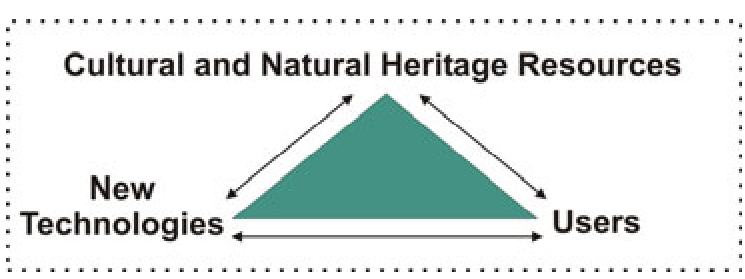 Figure 1: The intersection of Hardware/Software, Users, and Cultural/Natural Heritage contents.
Critical Analysis: Why Traditional Software Engineering Fails
The paper argues that traditional software engineering is "totally obsolete" regarding cultural heritage because it ignores globalization and the "human factor." In the U.S., there is a horizontal tendency to adapt curricula quickly. In Europe, however, "mercantilism" (the business of training) often sidelines the actual quality of the interactive work.
The author highlights that "humanistic training is not a warrant of quality" if it lacks technical rigor. Conversely, technical expertise without semiotic understanding leads to systems that are functional but "communicatively dead."
Figure 2: The paper illustrates how vertical departmental structures in Mediterranean universities obstruct the real goals of HCI by prioritizing status over transdisciplinary synthesis.
Future Outlook: From Fashion to Function
The "mercantilist" risk is that cultural heritage becomes a "fashionable" content used to sell mediocre software or degrees.
- The Goal: Move toward a model where professionals autonomously boost free access to multimedia databases.
- The Metric: Success should be measured by the "high quality-low costs" equation, achieved through heuristic evaluations rather than marketing claims.
Conclusion
The safeguard of our cultural heritage in the digital age depends on a "u-turn" in how we train the next generation of designers. By embracing the Communicability Analyst model and a rigorous transdisciplinary approach, the industry can move past 3D gimmicks toward meaningful interactive experiences that truly preserve local identity.
Takeaway: We must stop treating HCI as a "beach parasol" that loosely covers unrelated areas and start building it as a rigorous bridge between the logic of the machine and the soul of culture.