
HDD: Decoding the Complex Machinery of Human Development and Social Change
Human Development Dynamics: An Agent Based Simulation of Adaptive Heterogeneous Games and Social Systems
This paper introduces a Human Development Dynamics (HDD) model, a techno-social simulation that integrates macro-societal constraints with individual agency. By fusing non-linear system dynamics with spatial Agent-Based Modeling (ABM) and evolutionary game theory, it maps the co-evolution of economic growth, cultural shifts, and democratization.
TL;DR
Is democratization an inevitable byproduct of wealth, or a fragile state prone to collapse? This paper presents the Human Development Dynamics (HDD) model, a sophisticated techno-social simulation that combines Game Theory and Agent-Based Modeling (ABM). It proves that while economic growth fuels cultural shifts toward secularism and democracy, the path is non-linear and fraught with "punctuated reversals" if institutions outpace societal values.
Background: Beyond Neoclassical Growth
For decades, neoclassical growth models focused almost exclusively on capital and technology. The Human Development (HD) perspective, however, argues that economic progress (Y) is inextricably linked to cultural values:
- Rational-Secular (RS): A shift from traditional religious authority to bureaucratic and technological logic.
- Self-Expression (SE): Post-industrial values where existential security leads to demands for participation and liberty.
- Democratization (D): The institutionalization of these values.
The authors' core "Insight" is that these forces are not just macro-trends; they are the result of millions of micro-scale interactions—economic transactions that succeed or fail based on how similar agents are in their political and social outlooks.
Methodology: The Macro-Micro Fusion
The researchers built a "lattice world" where 500 agents interact within a specific "talk-span" (social radius).
1. The Interaction Engine
The model uses an Evolutionary Prisoner’s Dilemma (PD). Agents choose to Cooperate or Defect based on:
- Similarity: Agents are more likely to trade if their RS and SE values align (Social Judgment Theory).
- Memory: Using Robust Adaptive Planning (RAP), agents remember past interactions, allowing for the emergence of "Tit-for-Tat" or stable productive relationships.
2. The Coupling Mechanism
Individual attributes are updated via non-linear equations derived from the World Values Survey (WVS). Wealth (Y) generated from successful cooperation feeds back into the agent's values, creating a co-evolutionary loop.
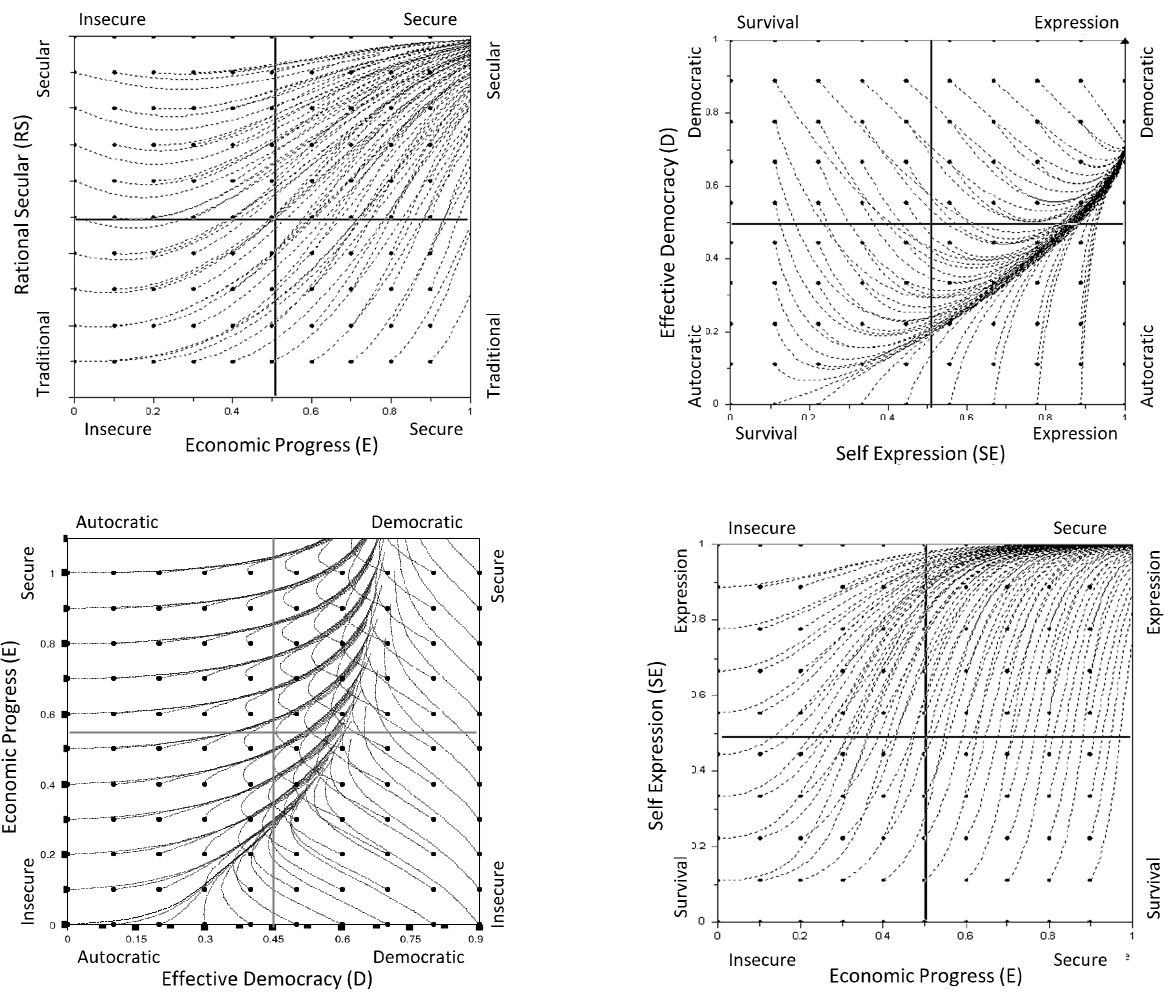 Figure 1: The conceptual framework showing the feedback between individual agency (PD games) and societal outcomes (RS, SE, D, Y).
Experiments: Sensitivity and Sensitivity
The authors conducted a quasi-global sensitivity analysis (180 runs, 700 iterations each). The OLS regression results (Table 1) reveal the hidden drivers of social evolution.
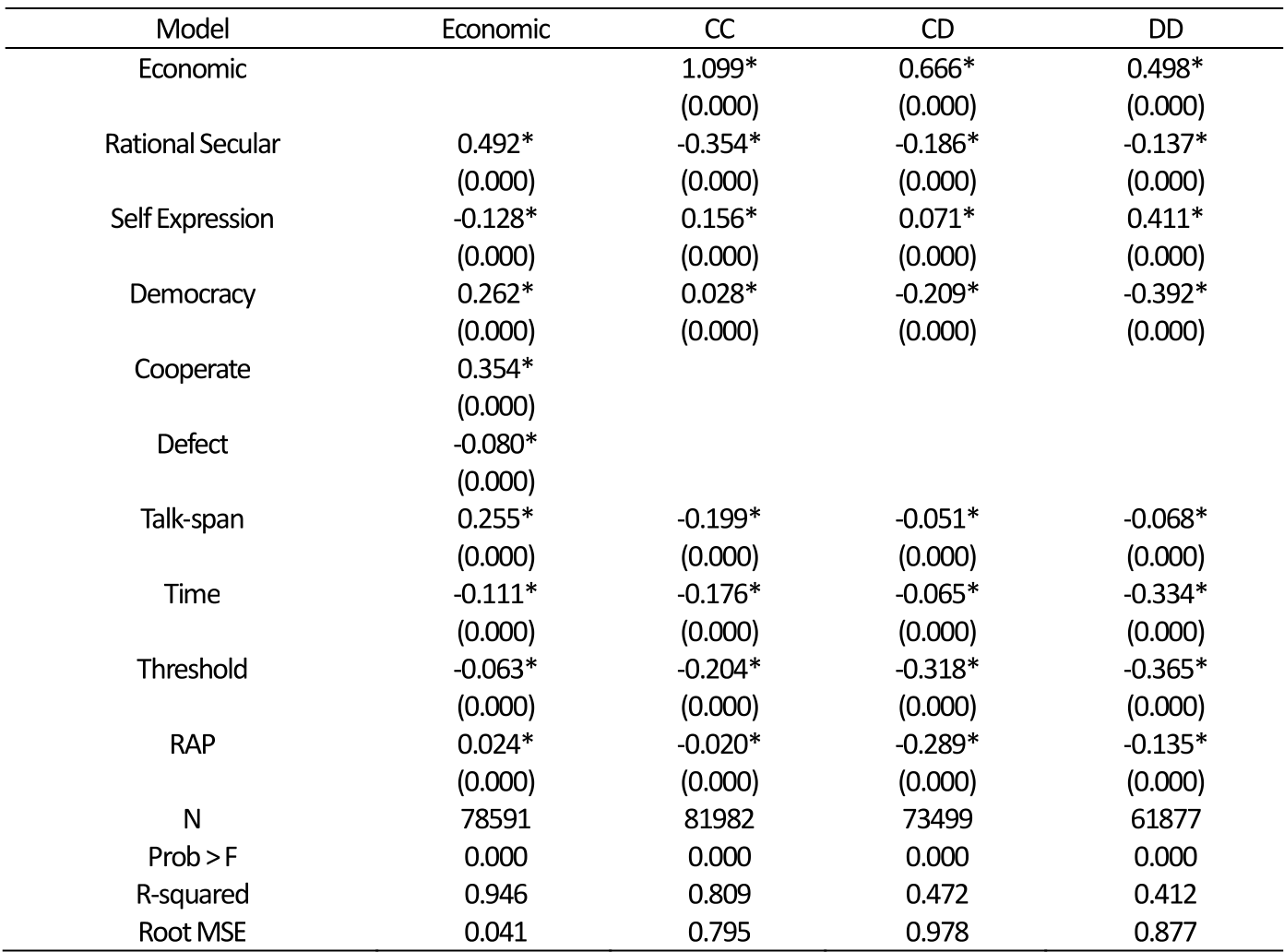 Table 1: Impact of various parameters on Economic Prosperity and Strategy choice (CC = Mutual Cooperation).
Key Findings:
- Trust as a Growth Engine: Mutual cooperation (CC) has a massive positive impact on economic development ().
- The Secular Advantage: Rational-Secular values are significant drivers of development (), speeding up the transition to industrial efficiency.
- The Stability Gap: The simulation confirms that democratic norms (D) and institutions that grow faster than the underlying economy are inherently unstable, often leading to autocratic "reversions."
Critical Insight: The Price of Self-Expression
A fascinating nuance in the results is the slightly negative coefficient for Self-Expression (SE) regarding immediate economic growth. The authors suggest a "transitional friction": as societies move toward post-industrial values, focus might shift from raw production to personal autonomy, causing a temporary dip in traditional productivity metrics before long-term democratic stability takes hold.
Conclusion & Future Outlook
The HDD model moves social science closer to the "harder" sciences by providing a testbed for policy. It demonstrates that:
- Modernization is staged: You cannot skip the "existential security" phase and expect stable democracy.
- Geography matters: Expanding the "talk-span" (connectivity) accelerates development by allowing for more diverse and frequent cooperation.
Future Work: The authors plan to integrate an endogenous "education" component to see if increased agent cognition (RAP) can mitigate the "punctuated reversals" seen in developing nations.
Keywords: Complex Adaptive Systems, Agent-Based Modeling, Game Theory, Modernization, World Values Survey.