
Human Emotion Classification: Enhancing PCA with Fuzzy Logic for Robust Recognition
Human Emotion Classification Using Fuzzy and PCA Approach
The paper introduces a "Fuzzy PCA" approach for human emotion classification from static facial images. It leverages the Viola-Jones algorithm for robust face detection and an enhanced Principal Component Analysis (PCA) framework that utilizes average eigenfaces to represent emotional categories like happiness, sadness, anger, and surprise.
TL;DR
This research addresses the instability of automated emotion recognition caused by lighting and expression variance. By evolving the classic Principal Component Analysis (PCA) into a Fuzzy PCA approach—using average eigenfaces to represent emotional classes—the authors achieved near-perfect recognition for high-intensity emotions like surprise and happiness while maintaining computational efficiency.
The Challenge: Why Face Recognition Fails in the Wild
Human-Computer Interaction (HCI) demands that machines understand non-verbal cues. However, current systems often buckle under two main pressures:
- Luminous Sensitivity: Changes in light shift pixel values dramatically, confusing standard classifiers.
- Expression Fluctuation: A "happy" expression is not a single static state; it varies across individuals and time.
Current methods relying on rigid 2D features are often too receptive to noise, clutter, and head poses. The authors argue that a more "fuzzy" approach is needed to capture the essence of an emotion without being distracted by individual specificities.
Methodology: The Core of Fuzzy PCA
The system workflow follows a precise pipeline: Detection -> Projection -> Classification.
1. Robust Detection
The system employs the Viola-Jones algorithm, utilizing Haar-like features to identify facial regions within a camera frame. This ensures that the subsequent PCA analysis is focused only on relevant pixels.
2. From PCA to Fuzzy PCA
In standard PCA, an image is projected into a low-dimensional "face space." The novelty here lies in the Fuzzy Approach:
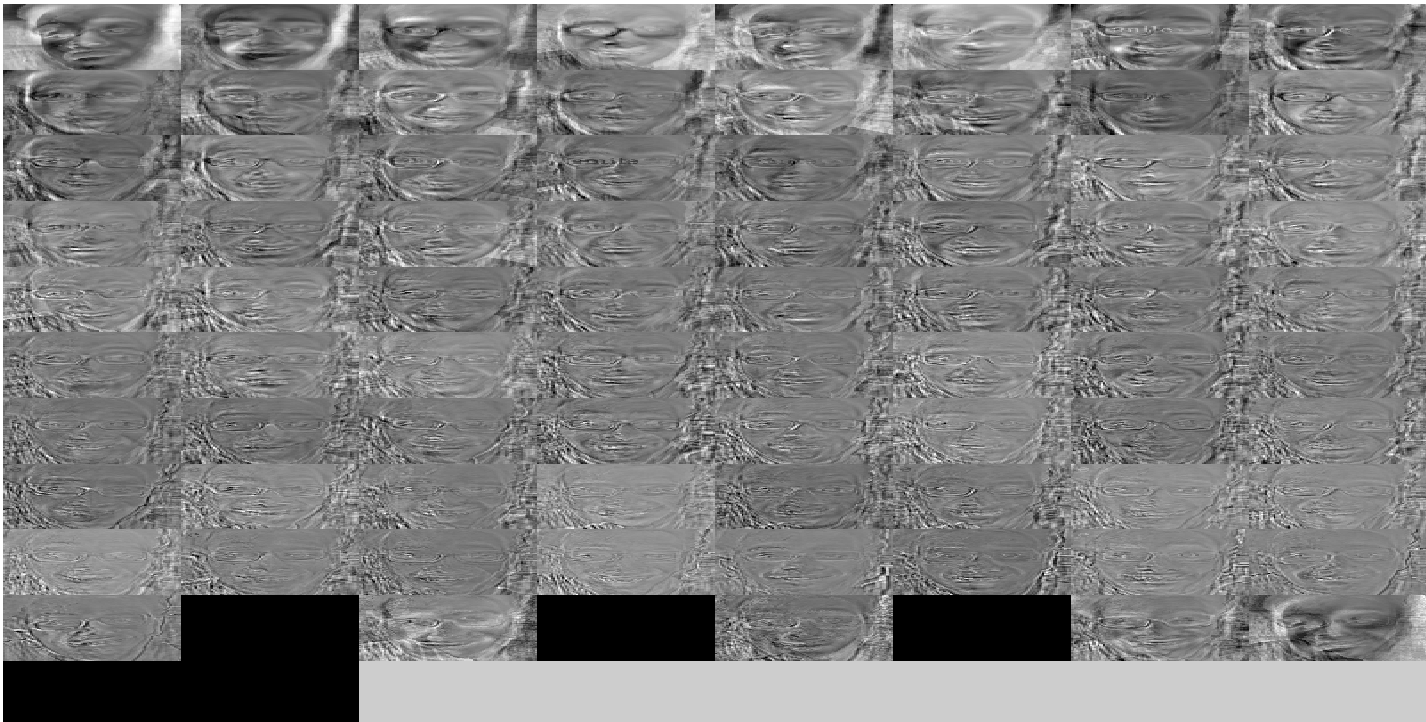
- Average Eigenfaces: Instead of comparing an input to a single image, the system calculates the mean value of various expressions for each emotion (e.g., different types of smiles).
- Covariance & Eigenvalues: By solving , the system identifies the eigenvectors (principal components) that represent the highest variance.
- Dimensionality Reduction: Approximately 90% of the variance is captured in the first 5% to 10% of dimensions, allowing for fast processing.
Experimental Insights
The efficacy of the Fuzzy PCA approach was tested against four primary emotions. The results highlights a clear distinction between "high-signal" and "low-signal" expressions.
Performance Metrics
| Detected Emotion | Happy | Sad | Anger | Surprise |
|---|---|---|---|---|
| Happy | 97% | 0 | 0 | 0 |
| Sad | 0 | 63% | 12.5% | 0 |
| Anger | 0 | 20% | 75% | 0 |
| Surprise | 0 | 0 | 0 | 100% |
Key Observations:
- Surprise & Happiness: These expressions often involve distinct shifts in the mouth and eyes, making them easily separable in the eigenface space.
- The Sadness Gap: Sadness only achieved 63%, frequently being confused with Anger or Neutral states. This suggests that the "variance" in sad faces is more subtle and may require higher-order features than what standard PCA provides.
Critical Analysis & Future Outlook
The "Fuzzy PCA" approach is a clever optimization for resource-constrained environments (like laptop cameras or embedded systems). By using average eigenfaces, the authors successfully create a buffer against the noise of individual facial differences.
Limitations: The system still struggles with "confused" or "neutral" states, which often bleed into the "Sad" and "Anger" categories. Additionally, while it handles lighting better than prior systems, it does not yet utilize Auto-exposure algorithms to pre-process the hardware input.
Future Work: The researchers aim to integrate auto-exposure control directly into the face-tracking device to ensure optimal feature capture regardless of environmental darkness or glare, and to explore more efficient comparison algorithms to reduce latency further.
References
- Turk, M., Pentland, A.: Eigenfaces for recognition. Journal of Cognitive Neuroscience (1991).
- Yang, J., et al.: Two-dimensional PCA: a new approach to appearance-based face representation. IEEE TPAMI (2004).