
EBS and D-Isomap: Bridging Physics-Based 3D Modeling and Manifold Learning for Emotion Recognition
Human emotion recognition using a deformable 3D facial expression model
This paper presents an automatic emotion recognition framework utilizing a deformable 3D facial mesh model driven by Elastic Body Splines (EBS). By tracking 26 fiducial points in video sequences, the system generates physics-based deformations that are subsequently classified using a Discriminative Isomap (D-Isomap) to achieve high-accuracy affective state mapping.
Executive Summary
Recognizing human emotion accurately is the "Holy Grail" of affective computing. While 2D systems have paved the way, they often crumble under varying lighting or head poses. This paper introduces a robust, automatic pipeline that treats the human face as a physical Elastic Body. By combining Elastic Body Splines (EBS) for 3D deformation and a Discriminative Isomap (D-Isomap) for classification, the authors achieve a staggering 88.2% accuracy in identifying the six basic human emotions from video sequences. This work effectively moves the field from static 2D analysis to dynamic, physics-driven 3D interaction.
The Core Problem: Why 2D is Not Enough
Most existing human-computer interaction (HCI) systems rely on 2D landmarks. However, the human face is a complex 3D structure. When a person turns their head or the lighting changes, 2D patches lose their geometric integrity. Furthermore, many 3D systems are "static"—they look at a single frame rather than the process of deformation. The authors identified that to truly understand emotion, we must model the dynamic transformation and the intrinsic geometry of how skin and muscle move.
Methodology: Physics Meets Geometry
1. The Elastic Body Spline (EBS) Model
Instead of just tracking points, the authors model the face using a mesh wireframe (54 characteristic points). They apply the Navier partial differential equation (PDE) to simulate how muscular force vectors cause displacement across the facial surface.
The beauty of EBS lies in its ability to generate a smooth, realistic warp based on only 26 tracked "control points." The rest of the 28 "dependent points" are calculated mathematically, ensuring the mesh follows the laws of physical elasticity.
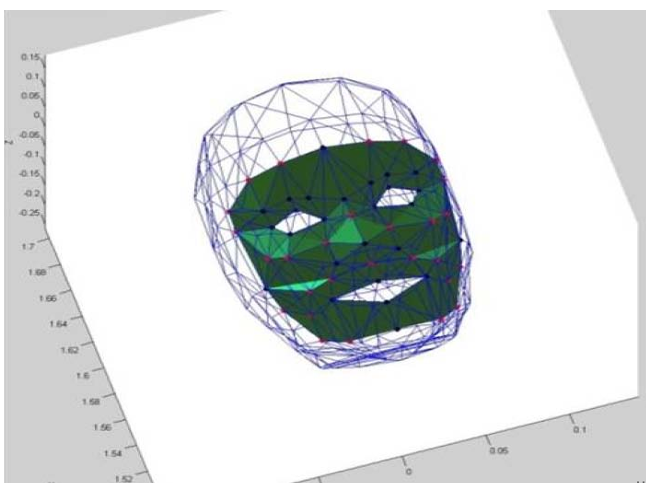 Fig 1: The dual-layered mesh model featuring 26 control points (black) and 28 dependent points (red).
2. D-Isomap: Dimensionality Reduction with a Purpose
A 3D facial model with 54 points creates a 175-dimensional feature space—far too complex for simple classification. The authors use Isomap to find the "manifold" (the underlying structure) of the data.
However, standard Isomap is unsupervised. The authors' D-Isomap adds a discriminative weight factor ().
- If two points belong to the same emotion (e.g., Happy), their distance is shortened.
- If they belong to different emotions (e.g., Happy vs. Sad), their distance is expanded. This creates a feature space where emotion clusters are naturally separated and easy to classify using a Nearest Class Center (NCC) approach.
Experimental Validation
The model was tested on two major datasets: the RML Emotion database and the Mind Reading DVD database.
Visual Results
The EBS model successfully reconstructed expressions across different genders and facial structures, proving its flexibility (Poisson’s ratio adjustments).
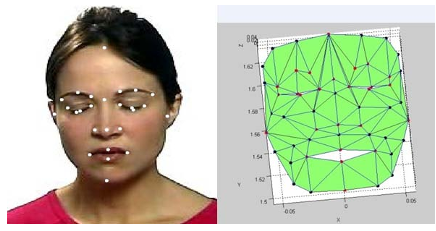 Fig 2: EBS facial model constructions showing (a) Anger, (b) Sadness, (c) Anger, and (d) Happiness.
Performance Comparison
When compared against standard techniques like PCA, GMM, and traditional Neural Networks, the D-Isomap approach consistently came out on top.
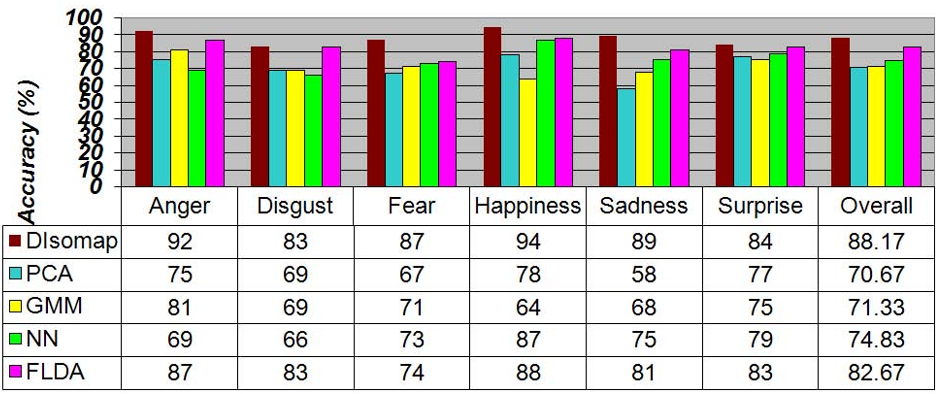 Fig 3: Comparative accuracy across different classification schemes.
The superiority of D-Isomap is clear in the numbers: it achieved 88.2% accuracy while using only 20 dimensions, compared to the 67.2% achieved by original Isomap.
Deep Insights & Conclusion
Takeaway: The real breakthrough here isn't just the 3D model, but the integration of physical constraints (EBS) with supervised manifold learning (D-Isomap). By forcing the computer to respect the physical limits of a human face while simultaneously optimizing for class separation, the system becomes significantly more robust to noise and individual variation.
Limitations: While the tracking is automatic, the initial generic mesh alignment still assumes a relatively frontal start. Future work might explore how this model handles extreme profile views or occlusions (like glasses or masks).
Future Outlook: This technology is a precursor to more empathetic AI assistants and could be integrated into VR platforms for real-time, emotionally accurate avatar puppeteering.