
Beyond Pixels: 3D Deformable Modeling for Robust Human Emotion Recognition
Human emotion recognition using a deformable 3D facial expression model
2012-05-01
Summary
Problem
Method
Results
Takeaways
Abstract
This paper introduces an automatic 3D facial emotion recognition system using Elastic Body Splines (EBS) and a Discriminative Isomap (D-Isomap) classifier. It recovers 3D deformation features from 2D video sequences using a physics-based mesh model and achieves an 88.2% recognition accuracy across seven emotion classes.
## TL;DR
This research bridges the gap between 2D video processing and 3D affective computing. By treating the human face as an **elastic physical body**, the authors utilize **Elastic Body Splines (EBS)** to track 3D muscle deformations and a novel **Discriminative Isomap (D-Isomap)** to classify emotions. The result is a system that achieves **88.2% accuracy**, far surpassing standard manifold learning techniques.
## Background: The Limits of 2D Vision
Facial expressions are inherently 3D processes driven by underlying musculature. Standard 2D approaches (like simple CNNs or landmark geometry) often break down when the subject turns their head (pose variation) or enters a poorly lit room. While 3D models solve this, most require manual landmarking or expensive 3D scanners. This paper proposes a way to extract **dynamic 3D features** directly from standard video using automated tracking and physical simulation.
## Methodology: Physics-Based Deformation & Manifold Learning
### 1. Elastic Body Splines (EBS)
Instead of treating landmarks as independent points, this method treats the face as a continuous mesh governed by the **Navier partial differential equation (PDE)**.
The core intuition is that when a "control point" (like the corner of the mouth) moves, the surrounding skin should deform following the physical laws of elasticity. By solving the PDE, the system generates a smooth 3D warp that reflects realistic muscular force fields.
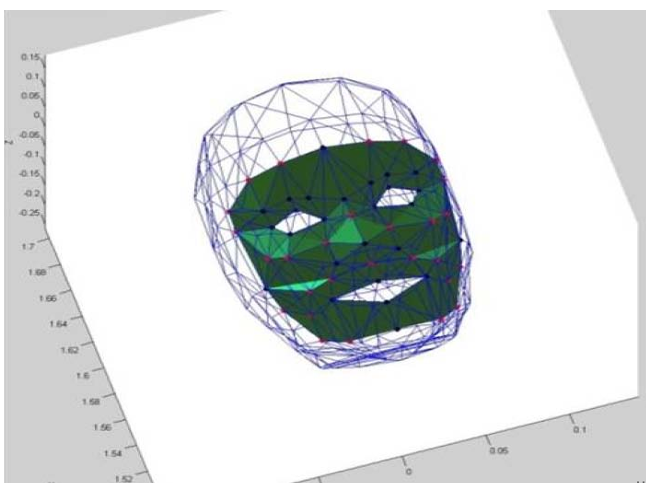
*Fig 1: The mesh architecture utilizing 26 control points (black) and 28 dependent points (red) to capture subtle volumetric changes.*
### 2. D-Isomap: Supervised Manifold Geometry
Raw EBS features have high dimensionality (175D). Isomap is typically used to find the "latent" 2D or 3D space of these expressions. However, standard Isomap is unsupervised—it doesn't know which points belong to "Happy" vs "Sad."
The authors introduce **D-Isomap**, which uses a **weight factor ($\phi$)** to adjust the Euclidean distance matrix:
* **Intra-class**: Points in the same emotion class are "pulled" closer.
* **Inter-class**: Points in different classes are "pushed" further apart.
This modification ensures that the resulting low-dimensional manifold has distinct, non-overlapping clusters for different emotions.
## Experiments and Results
The model was tested on the **RML Emotion** and **Mind Reading DVD** databases. The tracking system proved highly robust (92.45% recall), providing clean inputs for the EBS deformation.
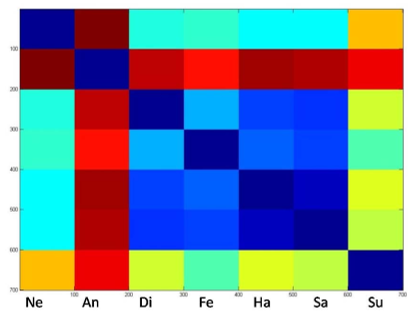
*Fig 2: Visualization of the EBS facial model constructing different expressions (Anger, Sadness, Happiness) by varying Poisson's ratio and muscular force fields.*
### Performance Comparison
Comparing the D-Isomap to other architectures, the results are clear:
* **D-Isomap**: 88.2%
* **Extended Isomap**: 78.4%
* **Original Isomap**: 67.2%
Furthermore, as shown in the comparison below, D-Isomap consistently outperforms classic statistical methods like **PCA** and **FLDA** across all emotion categories, proving that the nonlinear manifold approach is better suited for the complexity of human expressions.
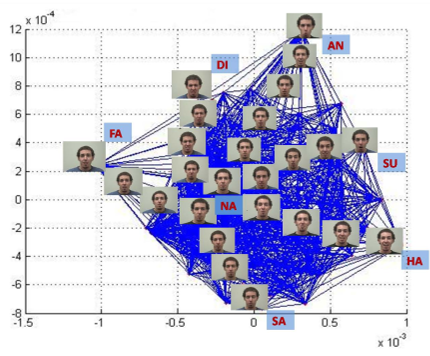
*Fig 3: Recognition rates across various classifiers. D-Isomap maintains a significant lead.*
## Critical Analysis & Conclusion
**Takeaway**: The integration of physical constraints (EBS) with discriminative geometry (D-Isomap) creates a highly efficient pipeline. It avoids the "black box" nature of some deep learning models by grounding the feature extraction in the physics of facial movement.
**Limitations**: The system relies on a constant Poisson's ratio ($\lambda$) across the entire face. In reality, human skin elasticity varies (e.g., the forehead vs. the cheeks). Future work could incorporate spatially-varying lamé coefficients for even higher fidelity.
**Future Prospect**: This approach is ripe for application in **Real-time VR Avatars** and **Driver Monitoring Systems**, where understanding the subtle nuances of emotion from 2D camera streams is critical for safety and immersion.