
Beyond Simple Regression: Mastering Facial Age Estimation with Cost-Sensitive Label Ranking
Human Facial Age Estimation by Cost-Sensitive Label Ranking and Trace Norm Regularization
This paper proposes a novel facial age estimation framework that treats age prediction as a cost-sensitive label ranking task combined with trace norm regularization. By integrating low-rank matrix recovery with ordinal ranking, the method achieves state-of-the-art (SOTA) performance on FG-NET and MORPH datasets while maintaining robustness under small-sample conditions.
TL;DR
Estimating a person's age from a single photo is notoriously difficult due to the "non-stationary" nature of biological aging and the scarcity of labeled data. This paper moves away from traditional classification/regression and introduces a Cost-Sensitive Label Ranking approach. By leveraging Trace Norm Regularization, the authors treat age prediction as a low-rank matrix recovery problem, capturing the hidden correlations between different age labels to achieve superior accuracy and robustness.
The Core Conflict: Why Regression and Classification Fail
Most researchers approach age estimation in one of two ways:
- Classification: Treat "Age 25" and "Age 26" as independent bins. The Problem: It ignores that 25 is closer to 26 than it is to 60.
- Regression: Map features to a continuous scalar. The Problem: It assumes aging is a steady, linear progression, which it isn't—human appearance changes at different rates during puberty vs. middle age.
Furthermore, datasets like FG-NET are tiny. When you have fewer samples than possible age labels, models overfit instantly.
The Insight: Ages as Ranked Correlations
The authors propose a "Label Ranking" perspective. Instead of asking "Is this person 25?", the model asks "Is Age 25 more relevant to this image than Age 30?". To prevent the model from becoming too complex, they introduce a Trace Norm Regularizer.
The intuition is simple: the features that predict Age 25 are likely very similar to those that predict Age 26. In mathematical terms, the matrix of prediction functions should be low-rank.
Identifying the Architecture
The architecture involves aggregating linear (or kernelized) prediction functions for all ages into a single weight matrix .
 The objective function combines a ranking loss (L) with a Trace Norm penalty (λ||W||) to enforce label dependency.
Methodology: From Linear to Kernel Space
The authors go a step further by extending this to Kernel Space. If the relationship between facial features and age is non-linear (as it almost always is), the kernelized trace norm allows the model to map features into an infinite-dimensional space while still enforcing the low-rank constraint on the prediction operators.
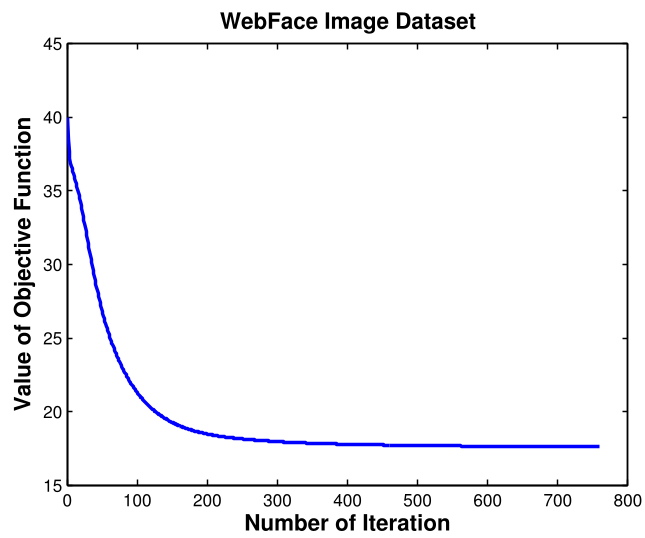 Fig 1: The Accelerated Proximal Gradient (APG) method ensures the objective function converges efficiently across diverse datasets like FG-NET and MORPH.
Experimental Battleground: Performance on Limited Data
The real strength of this paper is revealed in the "Limited Training Samples" experiment.
| Method | MAE (20% Training Data) | MAE (Full Training Data) |
|---|---|---|
| OHRank | 8.45 | 4.48 |
| CPNN | 9.03 | 4.76 |
| Proposed Method | 6.04 | 4.35 |
While other SOTA models see their error nearly double when data is cut, this method remains remarkably stable. This is the power of the Inductive Bias provided by the low-rank assumption.
Cross-Population Challenges
The study also dives into the "Cross-Population" problem—training on one race/gender and testing on another. They found that crossing both race and gender significantly increases error, but their low-rank approach manages these shifts better by capturing global age correlations that transcend specific demographic features.
 Fig 2: Examples of aging sequences from MORPH-II used to validate the method's ordinal ranking capabilities.
Critical Insight & Practical Takeaways
- Low-Rank is Key: If you have a task with many labels that are naturally related (like ages, temperatures, or ratings), don't treat them independently. Trace norm regularization is your best friend.
- Ranking > Classification: For human-centric attributes, our eyes are better at "relative ranking" than "absolute estimation." Designing loss functions that mimic this (ranking relevant labels higher than irrelevant ones) leads to more robust models.
- Kernel Efficiency: The paper provides a mathematical proof that kernelized trace normalization is computationally feasible for large-scale problems, solving the "representer theorem" challenge in the context of matrix norms.
Conclusion
This work provides a mathematically elegant solution to the small-sample problem in age estimation. By blending matrix recovery theory with ordinal ranking, it sets a high bar for traditional non-deep learning methods. While the world moves toward End-to-End CNNs, the structural insights here regarding label correlations remain highly relevant for designing more efficient loss functions in deep architectures.