
Beyond Majority Voting: High-Fidelity Crowdsourcing through Skill and Uncertainty Integration
Leveraging human factors to enhance query answering in crowdsourcing systems
The paper introduces a novel framework for multiple-choice question (MCQ) answer aggregation in crowdsourcing by leveraging two key human factors: worker skill and uncertainty. It utilizes possibility theory and fuzzy logic T-norms (Minimum, Product, Lukasiewicz) to unify these factors, outperforming traditional majority voting and individual-factor methods in answer reliability.
TL;DR
In the world of crowdsourcing, not all votes are equal. This paper presents a sophisticated framework that moves beyond simple majority voting by integrating Worker Skill and Epistemic Uncertainty. By applying fuzzy logic and possibility theory, the authors demonstrate that we can significantly improve answer accuracy (up to 86%) by asking workers not just what the answer is, but how sure they are and how much they know about the topic.
The "Blind Crowd" Problem
Most crowdsourcing systems suffer from a fundamental flaw: they assume the "Wisdom of the Crowd" is a simple statistical average. However, in complex tasks like entity resolution or technical Q&A, a single expert's "uncertain" guess might be more valuable than ten confident amateurs' "wrong" consensus.
The authors identify two neglected dimensions:
- Epistemic Uncertainty: Lack of information about a specific task, leading to a "hunch" rather than a fact.
- Diverse Expertise: Varying levels of domain-specific skill (from "Ignorant" to "Expert").
Prior works often addressed these separately. This paper argues that they must be unified to truly assess the reliability of a response.
Methodology: The Fusion of Logic and Human Intuition
The core innovation lies in treating worker responses as possibilistic logic expressions. Instead of a binary "Right/Wrong," each answer is a tuple where is skill and is certainty.
1. The Skill-Certainty Scale
The authors propose a 5-level granularity for mapping human intuition to mathematical weights:
- Skill (): Ignorant (0) Expert (1.0).
- Certainty (): Uncertain (0) Certain (1.0).
2. Aggregation Strategies
The paper explores three ways to fuse these numbers:
- Cumulative Weighted Voting: A compensatory approach where scores are summed.
- T-Norm Based (Fuzzy Logic): Using operators like Minimum, Product, and Lukasiewicz to bound the reliability.
- Non-Aggregative (Lexicographic): Ranking answers by skill first, then resolving ties using certainty—preserving the raw data purity.
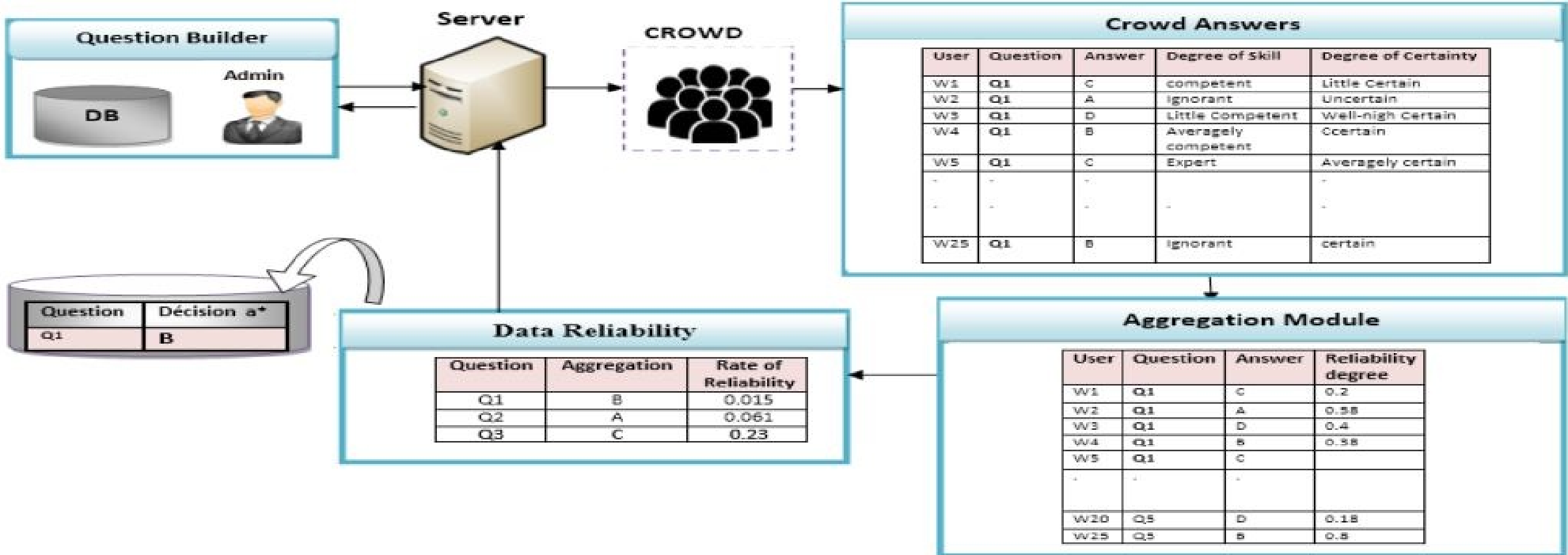 Fig 1: The proposed crowdsourcing architecture, featuring the "Answer Aggregation" and "Data Reliability" blocks as the intelligence engine.
Experimental Insights
The researchers tested their approach against 500 questions and 1000 synthetic workers.
Key Findings:
- Lukasiewicz Wins: The Lukasiewicz T-norm () performed exceptionally well, likely because it is less restrictive than the Minimum operator but more rigorous than a simple sum.
- Efficiency: Execution time scales linearly with the number of questions, making it feasible for real-time web applications.
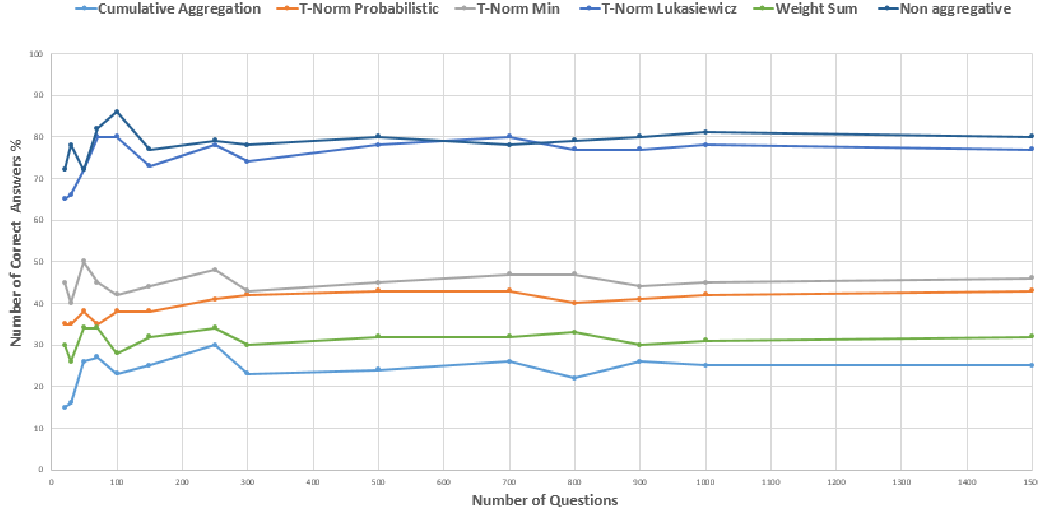 Fig 2: Comparison of different aggregation methods. Notice how the Probabilistic and Weight-Sum methods converge, while Cumulative methods lag.
Critical Analysis & Conclusion
This work represents a vital shift towards Human-Centric AI. By acknowledging that workers are not just "data generators" but agents with different levels of self-awareness regarding their knowledge, we can extract much higher signal-to-noise ratios from the crowd.
Takeaways
- For Designers: Platforms like Amazon Mechanical Turk should include "Certainty" sliders to improve data quality without requiring more workers.
- Limitations: The current study relies on synthetic data and assumes workers can accurately self-report their skill levels—a phenomenon often challenged by the Dunning-Kruger effect.
Future Outlook: The next frontier involves automated skill estimation, where the system learns to weight workers based on their historical performance, rather than just self-reporting.