
Beyond the Resume: How Your Social Media Footprint Redefines Job Suitability
Human judgments in hiring decisions based on online social network profiles
This study investigates the impact of Online Social Network (OSN) profiles on job hiring decisions. By comparing evaluations based on Facebook profiles versus traditional CVs, the research identifies how recruiters form suitability judgments and identifies the specific profile components (e.g., photos, posts) that drive these perceptions.
TL;DR
In the modern hiring landscape, your Facebook profile might carry as much weight as your CV—but for entirely different reasons. This study by Yoram Bachrach (Microsoft Research) reveals that while CVs focus on "what you know," social media screening focuses on "who you are," significantly influenced by visual appearance, communication style, and demographic traits.
Background: The New Digital Background Check
Hiring managers are no longer satisfied with the two-page PDF. Recent surveys show nearly half of employers research candidates on social networks, with some extreme cases involving demands for account passwords. This paper seeks to bridge the gap between two hypotheses: Is OSN screening just a digital resume check, or is it a proxy for the personality-driven "face-to-face" interview?
The Core Conflict: CV vs. OSN
The research highlights a fundamental shift in the Information Space available to a recruiter.
- CVs are sterile, focusing on Skills and Experience.
- OSN Profiles are holistic, exposing Attitude, Personality, and Vices.
The author finds that while recruiters claim to value "Posts" most, their actual judgments are most heavily influenced by the Profile Picture.
Methodology: Measuring Perception vs. Reality
The study employed a rigorous data mining approach:
- LDA Topic Modeling: Identifying what raters actually talk about when they look at profiles.
- Perceived vs. Actual Importance: Using Multiple Linear Regression to see if the factors raters think are important (like offensive content) actually match the statistical drivers of the final score.
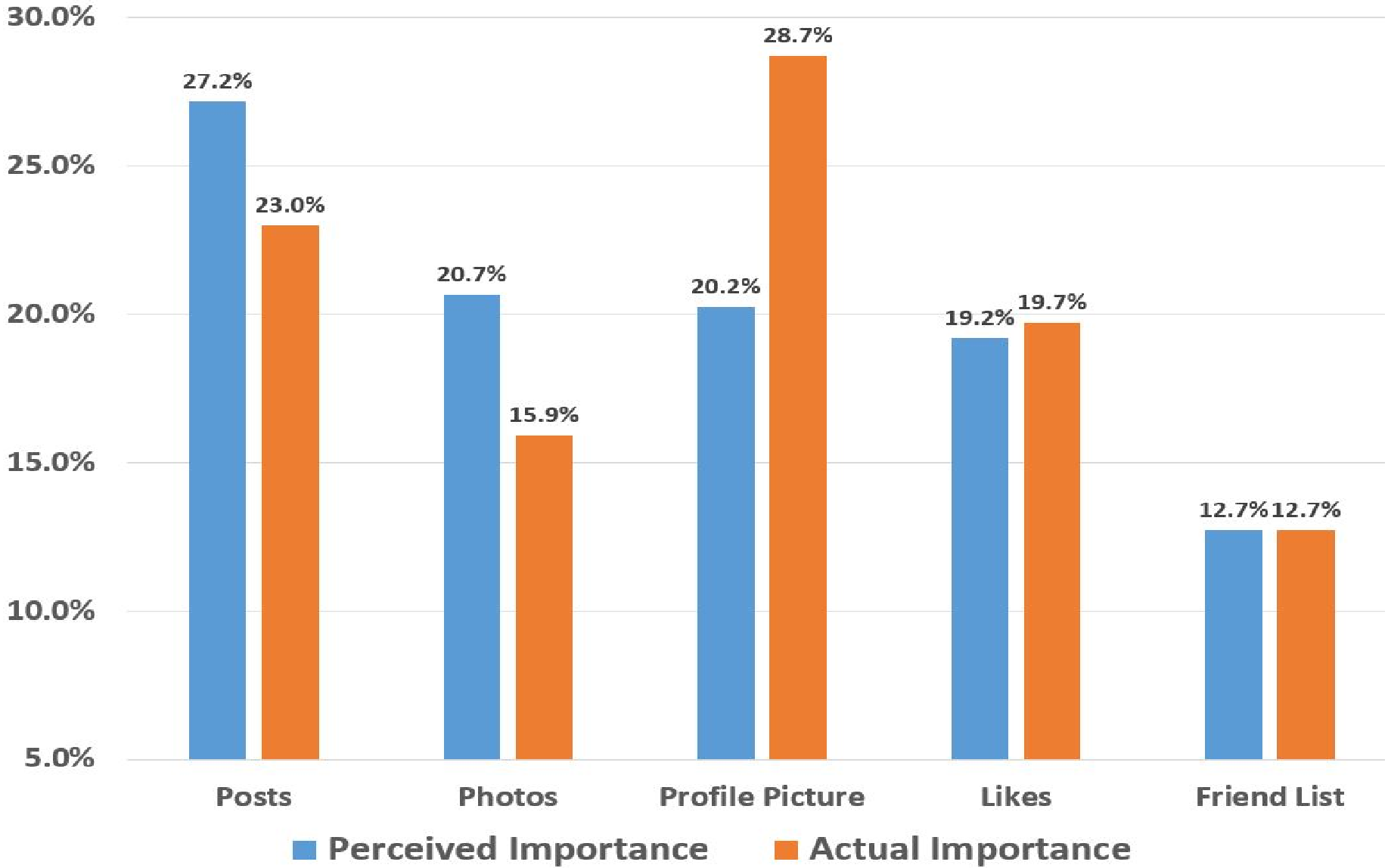 Fig 1: The gap between what raters think matters (Posts) and what actually drives the score (Profile Picture).
Key Findings: The "Visual Bias"
The statistical analysis revealed several "hard truths" about digital screening:
- Appearance Matters: Physical appearance had a significant actual importance (PC=17.1%) in OSN screening, but was almost zero in CV screening.
- The Literacy Proxy: Raters look at grammar and spelling in "Posts" to judge intelligence.
- Demographic Correlations: Women, Caucasian candidates, and those with higher education levels received higher job-suitability ratings on average. This points to a dangerous potential for "unconscious bias" when OSNs are used.
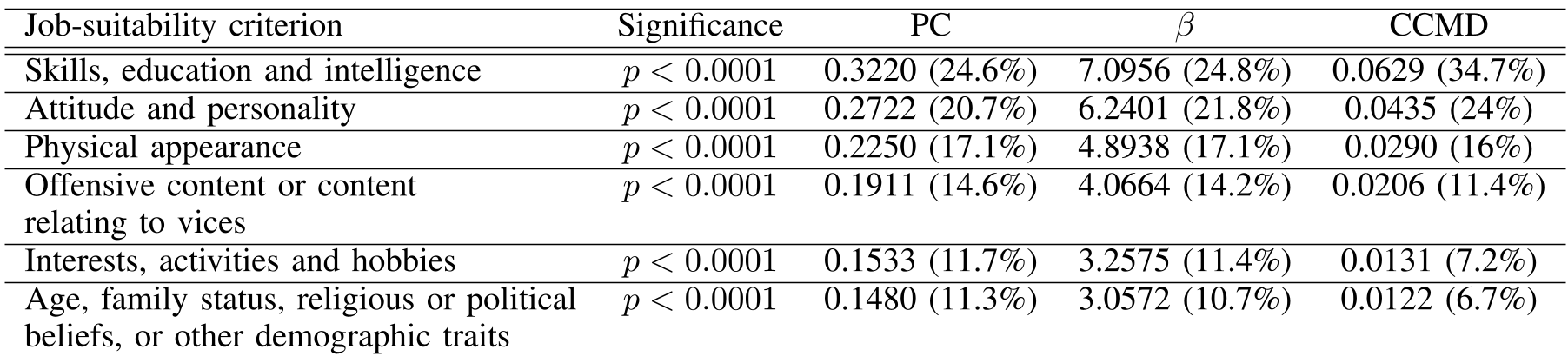 Table VII: Actual importance of criteria—Note how demographic traits and interests become statistically significant in the OSN context.
Critical Insight: The Privacy Paradox
One of the most profound takeaways is that OSN screening grants access to "Protected Traits." It is often illegal to ask a candidate about their religion or family status in an interview. However, when a recruiter browses a Facebook profile, they consume this information passively.
The study proves that even if a rater intends to be objective, these traits correlate with the final suitability score, creating a legal gray area for firms.
Conclusion
The study concludes that OSN screening is not merely an extension of the CV; it is a replacement for early-stage social vetting. For candidates, this means "self-censorship" becomes a necessary professional skill. For companies, it suggests a need for stricter regulation to prevent the "digital image" from overshadowing actual professional merit.
Future Outlook: As AI continues to automate this screening process, the question remains: will algorithms inherit these human visual and demographic biases, or can they be tuned to ignore the "noise" of a user's personal life?