
Simplicity vs. Realism: Deciphering Robot Face Preferences in Geriatric Care
The Impact of Human Likeness on the Older Adults’ Perceptions and Preferences of Humanoid Robot Appearance
This study investigates how older adults perceive and prefer various humanoid robot appearances for healthcare assistance. It compares a simplified, gender-neutral cartoon-like face with a realistic feminine illustrative face through semi-structured interviews and user-centered design techniques like personas and user journeys.
TL;DR
When designing a robot to care for the elderly, should it look like a cartoon or a human? This study reveals a fascinating paradox: while older adults prefer realistic feminine faces due to cultural familiarity and gender stereotypes in nursing, they actually understand emotions better through simplistic, cartoon-like designs. Furthermore, a user’s trust in a robot is deeply tied to their trust in the human medical system of their specific culture.
The "Familiarity" Trap: Why Realism Isn't Always Better
In the field of Human-Robot Interaction (HRI), designers often rush toward high-fidelity anthropomorphism. The logic seems sound: if it looks human, we will know how to talk to it. However, this study highlights a critical gap. For older adults (ages 40-70), the preference for a realistic face is often a defense mechanism against the "unknown" nature of technology.
The Motivation: Older adults often lack frequent exposure to robotics. Consequently, they lean toward what they know—real human features. But as the researchers discovered, high-fidelity faces bring "technical noise" that can make subtle emotional cues (like the difference between mild and high anger) harder to read.
Methodology: The "Medibot" Interface
The research team at Galatasaray University utilized a user-centered design (UCD) process to develop "Medibot." They tested two specific facial paradigms:
- The Feminine Realistic Model: Designed to align with the "nursing" persona.
- The Cartoon-Like Model: A gender-neutral, high-contrast simplistic design.
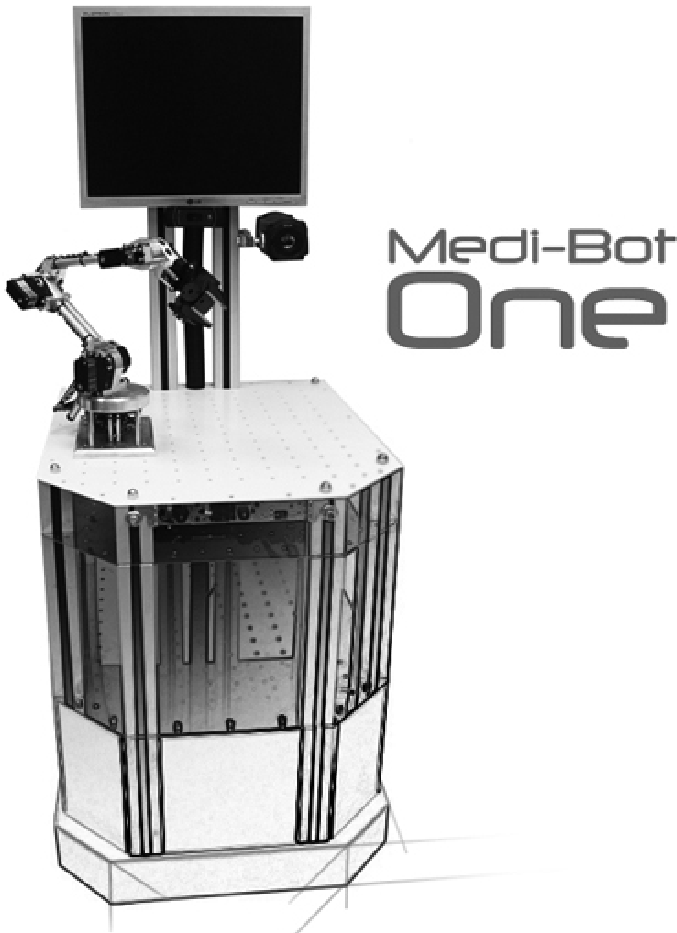 Figure 1: The physical Medibot prototype alongside the tablet-based facial interfaces.
Key Insights from the Laboratory
1. The Gender Stereotype Effect
There was a near-unanimous association between the female model and the healthcare task. Participants didn't just see a "face"; they saw a "nurse." This suggests that Inductive Bias—our preconceived notions about social roles—is a more powerful driver of robot acceptance for older generations than the actual technical capabilities of the robot.
2. Emotion Intensity: The "Less is More" Principle
While participants liked the human face more, they understood the cartoon face better.
- The Problem: Detailed realistic faces can be ambiguous when expressing the "intensity" of an emotion.
- The Solution: Simplistic faces (caricatures) strip away the noise, making the "geometry of emotion" (the curve of an eyebrow, the widening of a mouth) much clearer to an eye that might have declining visual acuity.
 Figure 2: Comparisons of "Happiness" and "Anger" across different intensities for both models.
3. The Cultural Trust Barrier
One of the most profound findings was the "Trust Spillover." Participants who distrusted the Turkish medical system (preferring, for instance, the German healthcare model) were instinctively more skeptical of a healthcare robot. This indicates that robot acceptance is not a vacuum; it is an extension of the user's trust in the institution the robot represents.
Critical Analysis & Future Outlook
Takeaway for Developers: If you are building for the silver economy, don't just hire a better 3D artist.
- Functional Clarity over Aesthetics: Use stylized faces to ensure emotional cues aren't missed.
- Context is King: A robot’s appearance must match the user’s internal "map" of social roles (e.g., the feminine-nursing link).
Limitations: The sample size (n=6) is small and culturally specific to Turkey. However, it serves as a vital "first step" in shifting HRI research away from general populations and toward the nuanced needs of older adults.
Future Work: We need to explore "Hybrid" designs—faces that possess the comforting familiarity of human proportions but the high-contrast clarity of 2D animation.
Disclaimer: This analysis is based on the paper "The Impact of Human Likeness on the Older Adults’ Perceptions and Preferences of Humanoid Robot Appearance" by Rızvanoğlu et al.