
Deciphering the Digital Soul: Metapopulation Identification via Online Fingerprints
Human Metapopulation Identification Based on Online Fingerprint
The paper introduces a method for Human Metapopulation Identification in cyberspace using an "Online Fingerprint" constructed from click-software behavior data. By leveraging Feedforward Neural Networks (FNN), the study successfully identifies user demographics (e.g., age, gender, social strata) with high precision, achieving a SOTA average accuracy of 89.93%.
TL;DR
Researchers have developed a way to identify your social class, age, and even hometown with nearly 90% accuracy simply by looking at the list of software you click on your PC. By treating software usage as an "Online Fingerprint," this study proves that our digital habits are not random but are deeply tied to our real-world demographic identities.
Human Metapopulations: From Entity Space to Cyberspace
In the physical world, "metapopulations"—groups sharing specific traits like age or profession—behave predictably. Marketers and doctors have used these patterns for decades. However, the "Wild West" of the internet raised a critical question: Does your digital behavior actually reflect who you are?
Prior works often focused on what people search for (keywords) or what websites they visit. This paper dives deeper into the operational layer: the specific executable files (.exe) users interact with. The core insight is that a lawyer's software sequence (Excel, Word, Outlook) differs fundamentally from a teenager's (QQGame, Music Players, Task Manager) in a way that is mathematically quantifiable.
Methodology: Building the Fingerprint
The researchers utilized a massive dataset from CNNIC, tracking the "focus window" of 30,000 volunteers every 2 seconds.
1. Information Entropy & Consistency
To prove that individuals in a group behave similarly, they used Information Entropy. High entropy in this context means a metapopulation has a highly "universal" or consistent click behavior on specific software.
2. The Identification Pipeline
The authors converted raw software logs into a Word-Bag Model. Each user's software list was transformed into a binary matrix, which served as the input for a three-layer Feedforward Neural Network (FNN).
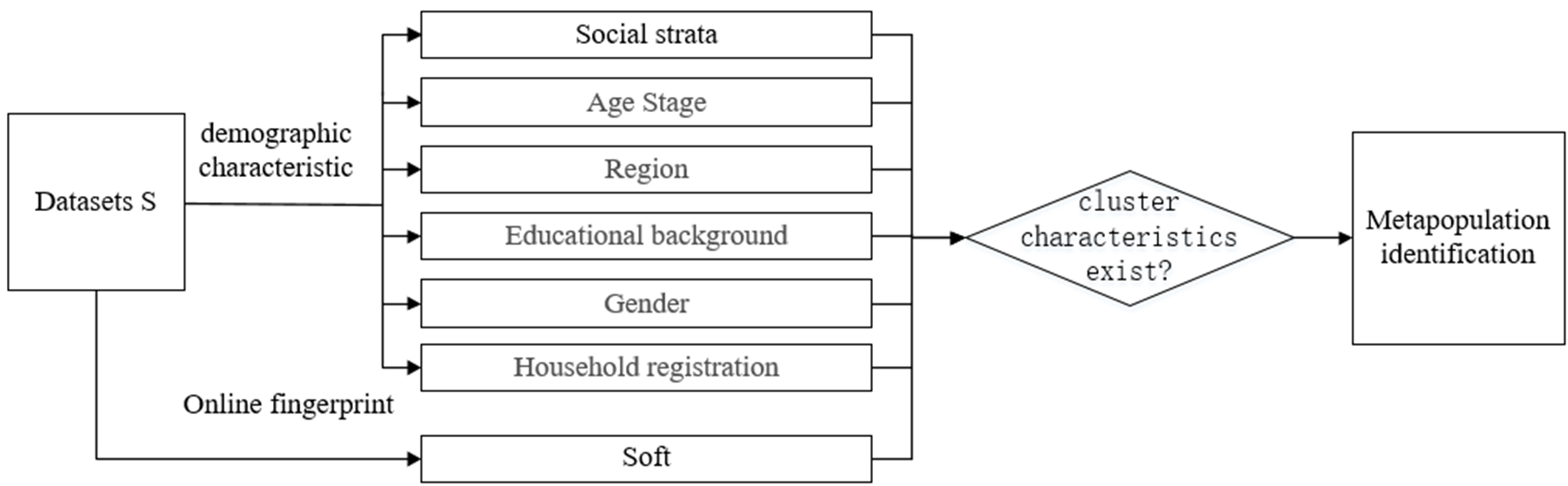 Figure 1: The systematic flow from raw log data to metapopulation classification.
Experimental Results: High-Precision Profiling
The experiment tested six dimensions: Social Strata, Age, Region, Education, Gender, and Household Registration.
- The Power of Two: Identification was most effective for binary categories. Gender reached 95.69% accuracy, suggesting distinct "software signatures" between men and women.
- Consistency across Regions: Interestingly, users in Eastern China showed more consistent software behavior than those in Western regions, leading to higher identification accuracy in those cohorts.
 Table 1: FNN (Algorithm 2) consistently outperformed traditional SVM and sequential LSTM models across all demographic dimensions.
Beyond Research: Real-World Impact
The implications of 89.93% accuracy are profound:
- Advertising: Companies can push targeted ads to "Middle-aged, Highly-educated, Urban" users without ever knowing their names or email addresses, purely based on their software "fingerprint."
- Security (Anomaly Detection): If a computer registered to a "Top Echelon" professional suddenly starts exhibiting the "Software Fingerprint" of an "Adolescent" gamer, the system can flag it as a potential account hijack or unauthorized use.
Critical Analysis
While the results are impressive, the study acknowledges a "shallow" analysis—it looks at software names but not the duration or intensity of use. Furthermore, as the world moves toward web-based SaaS and mobile apps, the reliance on .exe files might need to evolve into "API Fingerprints" or "App-Usage Fingerprints."
Conclusion
This paper successfully bridges the gap between sociology and data science. It proves that our "Online Fingerprint" is a robust, unique identifier of our social identity. As we navigate cyberspace, we leave behind a trail of clicks that—when viewed through the lens of neural networks—tells a surprisingly accurate story of who we are in the real world.