
Habit: Bridging Social Interests and Human Mobility for Efficient DTN Routing
Habit: Leveraging human mobility and social network for efficient content dissemination in Delay Tolerant Networks
Habit is a multi-layered content dissemination protocol for Delay Tolerant Networks (DTNs) that combines human mobility patterns (physical layer) with social network interests (application layer). It utilizes source-based routing to identify efficient delivery paths, achieving high reliability while minimizing the burden on uninterested relay nodes.
TL;DR
Habit is a sophisticated routing framework for Delay Tolerant Networks (DTNs) that solves the "uninterested relayer" problem. By merging social network data with periodic colocation patterns, it ensures that high-bandwidth content (like video or music) reaches the right people without spamming the entire network. Under long-duration scenarios, it matches the effectiveness of flooding while maintaining nearly the same efficiency as direct delivery.
Background & Positioning
In the era of decentralized "Web 2.0 on the move," we face a paradox: users create more content than ever, but mobile devices remain resource-constrained. In a DTN—where stable end-to-end paths don't exist—how do we share a 100MB video without killing the battery life of every stranger you pass on the street? Habit positions itself as a socially-aware middleware that moves away from "blind" opportunistic forwarding toward "informed" source-based routing.
The Problem: The Cost of Being a Good Samaritan
Existing DTN protocols generally fall into two extremes:
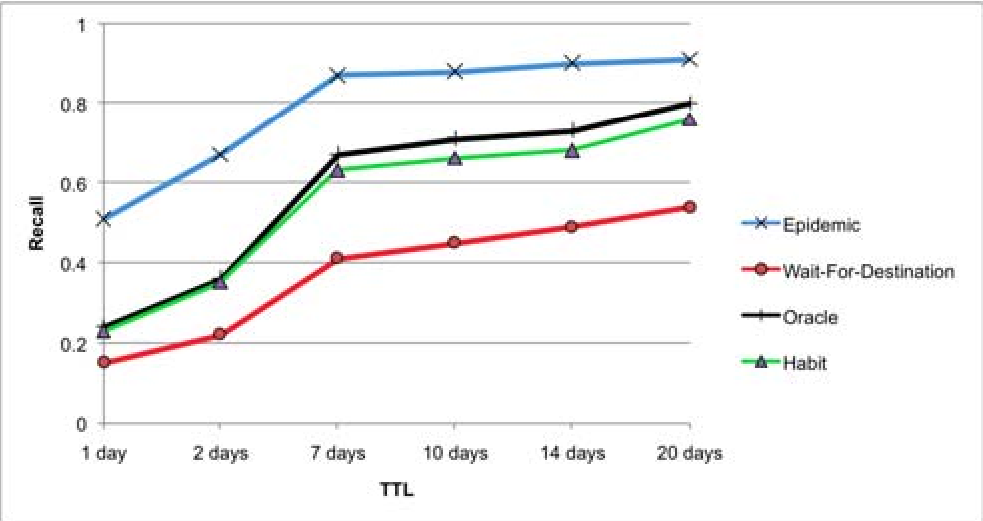
- Epidemic Routing: High Recall (everyone gets everything) but near-zero Precision. It wastes massive bandwidth on uninterested nodes.
- Wait-For-Destination: 100% Precision but abysmal Recall, as it relies on the producer accidentally bumping into the consumer.
The authors argue that relying on uninterested intermediaries to carry heavy chunks of data is unsustainable. If a node is forced to carry data it doesn't care about, the user is likely to turn off the service altogether.
Methodology: The Multi-Layer Synergy
Habit operates by constructing and reasoning over two distinct graphs:
1. The Physical Layer: Regularity Graph
Instead of assuming mobility is random, Habit captures the periodicity of human life. It tracks "Familiar Strangers"—people you don't know but meet regularly (e.g., on the 8:00 AM bus).
- Regularity Weight: If A meets B in 4 out of the last 5 Monday 10:00 AM slots, the probability is 0.8.
- Regularity Table: A local map of these probabilities, exchanged with neighbors to build a multi-hop view.
2. The Application Layer: Interest Graph
Nodes propagate their "Network of Interest" (who they want to receive content from). This creates a social overlay.
3. Source-Based Routing Logic
When a node publishes content, it performs a three-step optimization:
- Determine Recipients: Check who is interested in its content.
- Find Cheapest Paths: Identify routes that cross the minimum number of uninterested nodes.
- Select Highest Probability: Among the "cheap" paths, pick the one where the product of regularity weights is highest.

Experimental Insights
Using the MIT Reality Mining dataset (Bluetooth traces of 100 students), the authors proved that "social hops" are short. 94% of users are within 4 physical hops of their social connections.
Performance Metrics
- Recall (Effectiveness): For content with a TTL of 7+ days, Habit delivers over 70% of relevant messages, approaching the performance of the resource-heavy Epidemic routing.
- Precision (Efficiency): Habit maintains >70% precision, meaning most receivers actually wanted the data they got. In contrast, Epidemic's precision drops to nearly 0% as message volume increases.
The "Media Content" Advantage
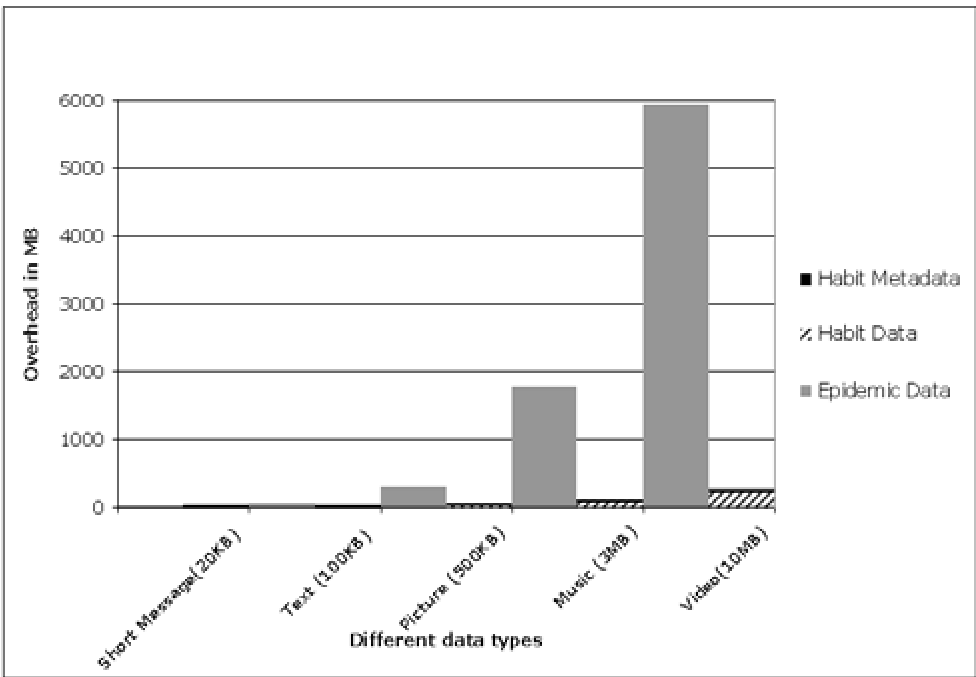
The most striking result is found in communication overhead. As the content size grows from text to video, the overhead of Epidemic routing explodes. Habit's overhead grows linearly and remains significantly lower because it refuses to use uninterested nodes as "dumb" relays.
Critical Analysis & Conclusion
Habit succeeds by acknowledging that human mobility is not nomadic, but algorithmic. By tapping into the "habits" of our daily schedules, we can treat the physical world as a predictable delivery network.
Limitations:
- The protocol assumes nodes are honest about their interests and regularity.
- Privacy is a concern: sharing your regularity table effectively shares your daily schedule with "familiar strangers."
Future Outlook: As we move toward Edge Computing and localized AI, protocols like Habit provide a blueprint for "Sovereign Networking," where content moves based on social trust and physical reality rather than centralized cloud servers.