
Decoding the Language of the Body: An LMA-Inspired Approach to Motion and Emotion Recognition
Human motions and emotions recognition inspired by LMA qualities
This paper introduces an expressive human motion descriptor inspired by Laban Movement Analysis (LMA) to recognize both basic physical actions and underlying emotional states. Utilizing 3D skeleton data from Kinect sensors, the method employs a machine learning framework (RDF, MLP, SVM) to achieve SOTA performance on motion datasets like MSRC-12 and UTKinect, while effectively classifying emotions (Happy, Angry, Sad, Calm).
TL;DR
This research presents a comprehensive framework for recognizing not just what a person is doing, but how they feel while doing it. By translating the professional dance language of Laban Movement Analysis (LMA) into a mathematical descriptor vector, the authors achieved SOTA results in motion classification and high accuracy in identifying emotions like anger and sadness, bridging the gap between biomechanics and affective computing.
Problem & Motivation: Beyond X, Y, Z Coordinates
Most traditional motion recognition systems treat the human body as a collection of moving points. While this works for recognizing a "wave," it fails to distinguish between a "happy wave" and a "frantic wave." The core limitation of prior work is the neglect of Qualitative Aspects.
The authors argue that the "Effort" and "Shape" of a movement are the keys to human intent. The difference between a punch and a reach isn't just the final hand position—it's the acceleration, the tension, and the directness of the path. To capture this, they turned to LMA, a formal language used by therapists and dancers to describe every nuance of movement.
Methodology: The Four Pillars of Laban
The system extracts 85 features from Kinect 3D skeleton data, categorized into the four LMA components:
- Body: Physical organization (angles between joints, symmetry, and distances).
- Space: The "territory" of the movement (length of trajectories).
- Shape: How the body changes its silhouette.
- Innovation: The authors used the 3D Convex Hull volume to quantify how "expansive" or "shrunken" a pose is over time.
- Effort: The dynamic energy (Time, Weight, Space, Flow).
- Innovation: They mapped physical metrics to LMA factors—e.g., Straightness Index for "Direct vs. Indirect" space effort, and acceleration variability for "Strong vs. Light" weight.
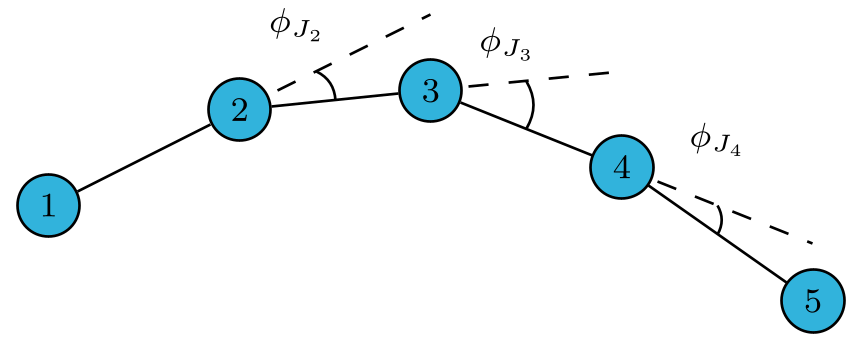 Fig 1: Detailed Body features and skeletal joint relationships used to build the descriptor.
Experiments & SOTA Results
The descriptor was put to the test across multiple public datasets (MSRC-12, MSR Action 3D, UTKinect) and a custom "CMKinect-10" dataset.
- Motion Prowess: In the MSRC-12 dataset, the framework achieved a nearly perfect 99% accuracy for iconic gestures.
- Emotional Intelligence: The system classified four basic emotions (Happy, Angry, Sad, Calm) using an RDF (Random Decision Forest) classifier, reaching an F-score of 0.89.
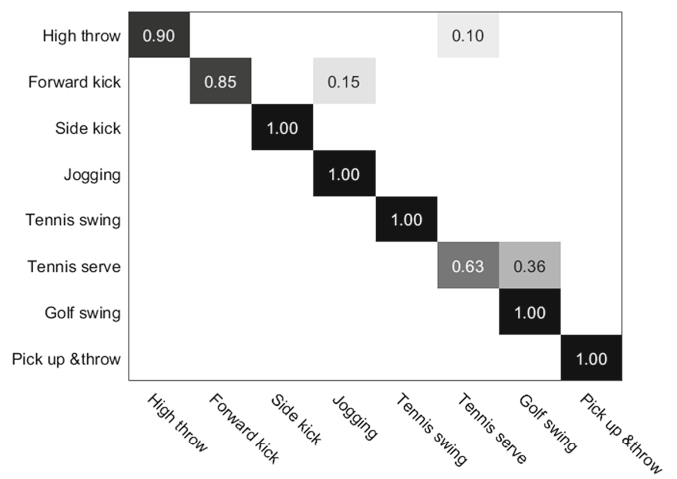 Fig 2: Confusion matrices for the MSR Action 3D dataset, showcasing high performance across various action subsets.
Human Perception vs. Machine Learning
A fascinating part of this study involved comparing the AI's performance with human judgment. Using a 3D virtual avatar to strip away facial biases, humans rated the emotions of the gestures.
- Findings: Both humans and the AI occasionally confused "Happy" and "Angry" (both high-arousal emotions) or "Sad" and "Calm" (both low-arousal).
- Correlation: The study confirmed that "Angry" motions are statistically characterized by Abrupt Time, Strong Weight, and Free Flow, whereas "Sad" motions are Sustained, Light, and Bound.
Critical Analysis & Conclusion
Takeaway
This work demonstrates that LMA is not just for dancers; it is a powerful computational tool. By focusing on the qualitative energy of movement, we can create robots that don't just see a human as a moving object, but as an emotional being.
Limitations & Future Work
The study noted that "Directional Movement" (Curvilinear vs. Rectilinear) was the hardest feature for both humans and machines to distinguish in short, controlled gestures. Future research will expand the database to include more complex, nuanced emotions and deploy this framework onto social robots like NAO to enable empathetic human-robot teleoperation.
Senior Editor's Note: This paper stands out because it doesn't just throw more layers of deep learning at the problem; it uses a grounded, semantic theory (LMA) to engineer features that actually mean something in the real world.