
Beyond Passive Nodes: Decoding the Human Psychology of SNS Message Diffusion
An Analysis with Dynamics Between Human Motivation and Messaging on Social Networking Services
This paper introduces an active node mathematical model for Social Networking Services (SNS) that incorporates human motivation, information reliability, and inter-personal trust. Moving beyond passive network theory, the researchers demonstrate how "personalization" factors—specifically modification intensity () and psychological thresholds—replicate the complex information diffusion patterns seen in real-world social dynamics.
TL;DR
Most network theories treat us like mindless routers—if a message hits us, it passes through. This paper challenges that "Passive Node" dogma by introducing a mathematical model where nodes have intent and motivation. By simulating trust, reliability, and human modification, the authors reveal why some rumors explode like wildfire while others die instantly: it’s not just the network; it's the gatekeeper's mind.
The "Passive Node" Fallacy
In the world of complex networks, researchers often treat information flow like water in a pipe. But humans aren't pipes. Previous studies using percolation or transfer function models couldn't answer the fundamental question: Why do we choose to click 'Share'?
The authors point out that traditional models ignore the Motivation behind messaging. Without accounting for whether a person trusts the source or wants to modify the story (gossip), we can’t accurately predict or control the spread of rumors, advertisements, or fake news.
Methodology: The Active Node Framework
To bridge the gap between behavioral psychology and quantitative IT, the researchers proposed a model where every message is a vector of three critical components:
- Modification (): The degree to which a user edits or adds their opinion.
- Reliability (): How much the user believes the content.
- Trust (): The level of relationship strength with the sender.
The "magic" happens in the integration of Motivation Factors (). Every node has a personalized threshold. If the incoming information doesn't meet the user's internal threshold for trust or interest, the message chain ends.
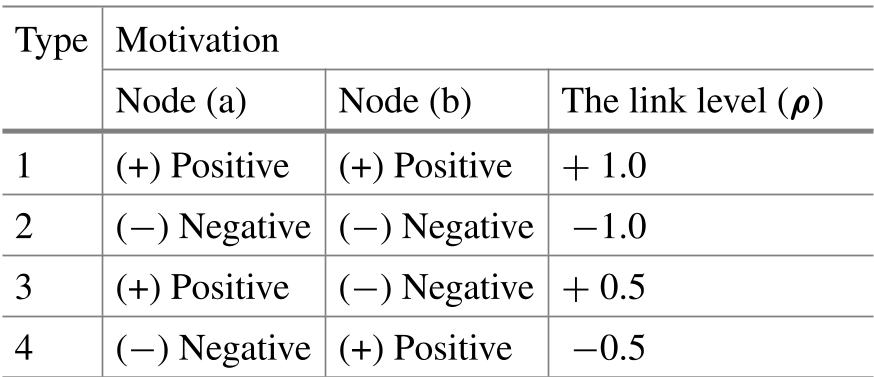 Table: Categorizing links based on positive/negative motivation between nodes.
Simulation: From Constant Growth to Human Chaos
The researchers conducted several levels of simulation to move from "idealized" transmission to "human" reality.
1. The Gossip Effect (High )
When modification factors are set high () and trust is 100%, we see an explosive growth in information quantity. This simulates the "wildfire" spread of sensationalist news where everyone adds their own "spin."
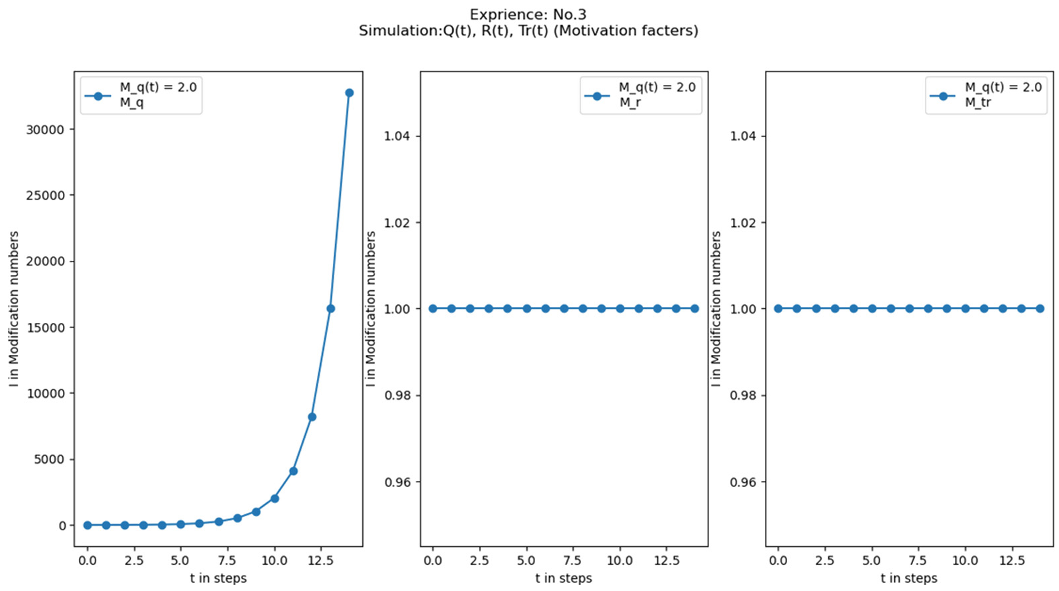 Fig 6: Rapid diffusion when modification intensity is high ().
2. The Personalization "Speed Break"
In real life, we aren't all equally excited to share. By introducing Random Variations in motivation and thresholds, the researchers observed an "Early Termination" phenomenon. Most nodes actually act as resistors, slowing down the spread because the information fails to meet their individual criteria for reliability.
3. The Gatekeeper Logic
When Positive/Negative (P/N) opinions were introduced alongside random thresholds, the information flow became "vibrational"—meaning it fluctuates and often converges (dies out) rapidly. This is the closest simulation to a healthy, diverse social network where conflicting views prevent a single rumor from dominating the entire field.
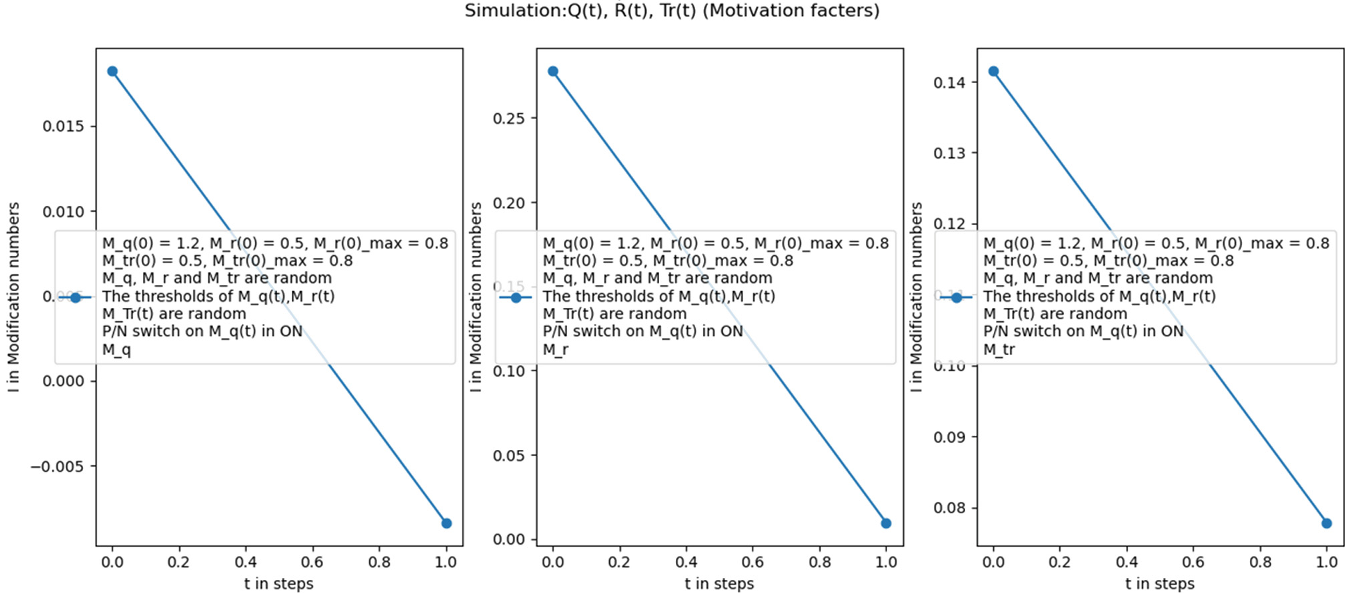 Fig 24: Simulation of the most complex state, incorporating random thresholds and P/N opinions.
Critical Insight & Takeaways
The paper’s most profound insight is the role of the Influencer. To keep a message spreading in a world of picky, high-threshold humans, a node must maintain a modification factor near (neutral but steady transmission).
Key Takeaways:
- Rumor Control: To stop a rumor, you don't just cut the link; you lower the trust () or reliability () perception of the source.
- Marketing Strategy: Effective campaigns must account for "Gatekeeper thresholds"—if content isn't personalized enough to exceed a user's motivation threshold, the diffusion dies at the first hop.
- Future Work: The authors plan to apply this to Scale-Free networks (like Twitter/X) where a few hubs have massive influence, making the "Active Node" motivation even more critical to simulate.
Conclusion
By moving from "What is the network shape?" to "What is the node thinking?", this research provides a vital blueprint for understanding our increasingly polarized and rumor-prone digital society. It proves that the most powerful firewall in an SNS is not an algorithm, but the human threshold for trust.