
Deciphering the Emotional Hierarchy: Why the Voice Rules in Human-Avatar Interaction
3714_Human Perception of Audio-Visual Synthetic Character Emotion Expression in the Presence of Ambiguous and Conflicting Information.
This paper investigates human perception of emotion through synchronized emotional audio (natural human voice) and video (synthetic facial animation). It identifies how observers integrate multimodal cues in congruent and conflicting scenarios, establishing that natural audio heavily biases perception particularly in high-expressivity contexts.
TL;DR
When an animated character smiles but sounds angry, which signal do you believe? This study reveals that in the complex dance of audio-visual perception, the human ear often outvotes the eye. By analyzing how we perceive "mismatched" emotions in synthetic characters, researchers found that while we integrate both channels when they agree, we pivot almost entirely to the voice when signals conflict.
The "Expressivity Gap" in Robotics
The core challenge in Affective Computing isn't just making a robot "feel" an emotion internally; it's the interface. Most synthetic characters—from social robots to tutors—suffer from a hardware limitation: their faces lack the hundreds of subtle micro-expressions a human face possesses. Conversely, a recorded human voice carries immense "affective bandwidth."
This study explores this expressivity mismatch. If a robot's face is simple but its voice is rich, how does a human observer make sense of the combined signal? This is critical for avoiding "emotional design missteps" where a user misinterprets a robot's empathy for sarcasm or indifference.
Methodology: Beyond "Happy" and "Sad"
Unlike previous studies that asked users to pick a single emotion label, this research used the Valence-Activation-Dominance (VAD) framework.
- Valence: How positive or negative?
- Activation: How calm or excited?
- Dominance: How submissive or influential?
By creating "Conflicting" (e.g., Happy Voice + Sad Face) and "Congruent" (e.g., Angry Voice + Angry Face) stimuli using the CSLU toolkit, the authors could mathematically map which specific features—like pitch range or eyebrow angle—actually shifted a human's internal VAD rating.
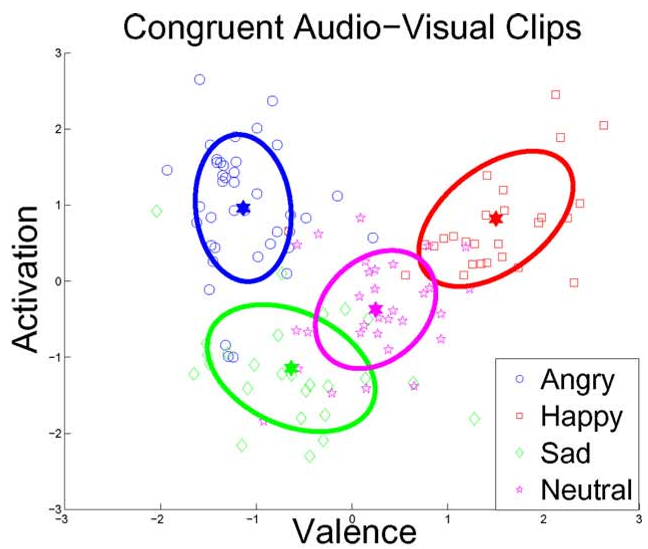 Fig 1: The study utilized a web-based evaluation interface to capture dimensional ratings across different facial animations.
The Core Finding: Audio Bias
The results were striking. In the "Activation" dimension (excitement levels), the audio was the absolute king. In 10 out of 12 conflicting presentations, the user's perception followed the voice, regardless of what the face was doing.
However, "Valence" (positivity) proved more democratic. Users tried to integrate both the facial smile/frown and the vocal tone to decide how "good" or "bad" the character felt.
Feature Salience: What Matters?
Using Information Gain, the researchers identified the "MVP" features:
- In Congruent Displays: Users looked at Eye Shape, Eyebrow Timing, and Lip Position alongside vocal Intensity and Pitch.
- In Conflicting Displays: The face was largely ignored. The decision-making was driven by Pitch quartiles, Vocal Intensity, and MFCCs (spectral features of speech).
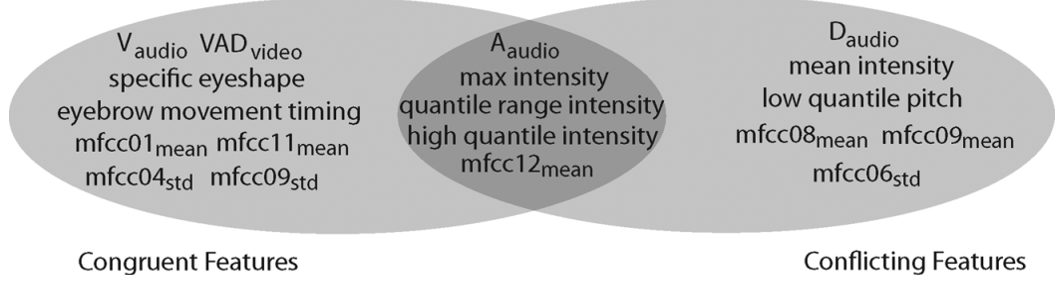 Fig 2: Comparison of feature sets shows that video features (highlighted in the diagram) disappear from the decision-making process when emotions conflict.
Why Does This Happen?
The authors suggest an "Emotional Bit Allocation" theory. Our brains treat emotion as information being transmitted across channels. If the voice has a higher "bandwidth" (more modulation and nuance), we naturally allocate more "bits" of our attention to it. When the face is a simple animation (low bandwidth), it serves as a secondary check rather than a primary source.
Critical Insight & Conclusion
For developers of AI avatars and humanoid robots, the takeaway is clear:
- Voice is the Anchor: If your budget is limited, invest in high-fidelity expressive speech synthesis. A high-quality voice can "carry" a simple face, but a realistic face cannot easily overcome a flat, robotic voice.
- Consistency is Stability: Mismatched signals increase user variance. If the character's modalities don't align, the user's confidence in their own perception drops, leading to a breakdown in the social interaction.
The Limitation: This study used a very simple synthetic face. Future work using high-fidelity 3D rendering (like Unreal Engine's MetaHumans) or motion-capture data may find that as facial bandwidth increases, the "eye" might finally catch up to the "ear."
Reference: Mower, E., Matarić, M. J., & Narayanan, S. (2009). Human Perception of Audio-Visual Synthetic Character Emotion Expression in the Presence of Ambiguous and Conflicting Information. IEEE Transactions on Multimedia.