
Digital Paws: Why Cat Owners and Rural Users Rule the "Petworks"
On the internet, everybody knows you're a dog: the human-pet relationship in online social networks
This paper explores the human-pet relationship in online social networks (Dogster and Catster), analyzing behavioral differences between dog and cat owners across urban and rural environments. It identifies that cat owners and rural users are unexpectedly more active in forming digital "friendships" than their counterparts.
TL;DR
In the world of pet-themed social networks like Dogster and Catster, the usual rules of human sociability are flipped. While dog owners are more social in the real world, cat owners are the social butterflies of the internet. This research reveals that pet owners who are more isolated in "real life"—particularly rural cat owners—use online communities to bridge the social gap, creating a sanctuary for the human-animal bond.
Background Positioning
Published in 2009 by Jennifer Golbeck, this work sits at the intersection of Human-Computer Interaction (HCI) and Anthrozoology. It moves beyond seeing social networks as mere mirrors of reality, positioning them instead as compensatory environments where users fulfill social needs that the physical world fails to provide.
Problem & Motivation: The Real-World vs. The Digital Reflection
We usually assume that if someone is social in person, they are social online. Previous studies (the UIUC study) showed that urban users generally have more friends on sites like MySpace. However, pet-oriented networks ("petworks") are unique because they are anonymous; the human is invisible, and the pet is the avatar.
The author hypothesized that:
- Dog owners (who go to parks and walks) would have more online friends.
- Urban users would be more connected than rural ones.
The results proved these intuitions entirely wrong.
Methodology: Sampling the "Petworks"
The study analyzed:
- 4,000 Random Profiles: Equal split between Dogster and Catster.
- Geography: Urban vs. Rural classification based on the University of Washington’s research database.
- Breed Homophily: A mathematical approach to see if owners prefer their own pet's breed.
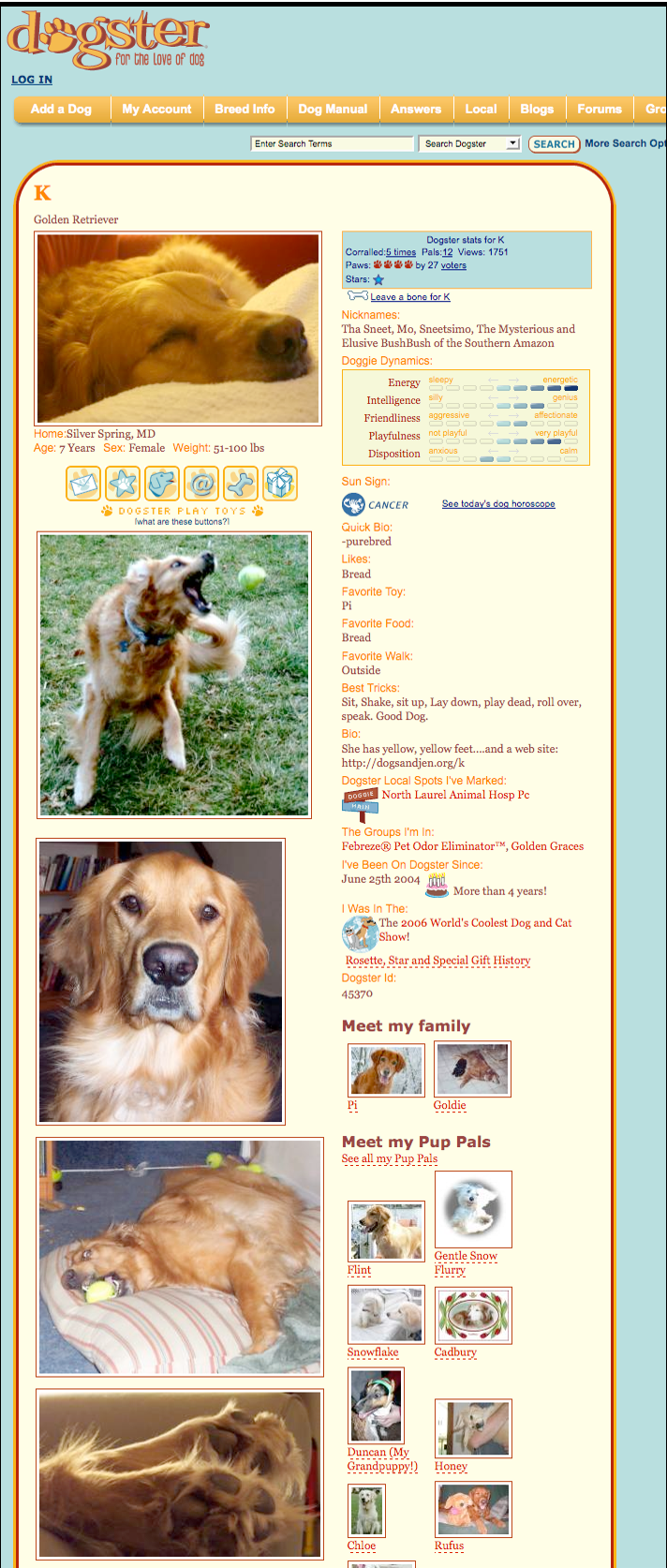 Above: A typical profile where the pet, not the human, is the central identity.
The "Isolation" Theory: Where Method Meets Insight
The core of the methodology lies in the comparison between expected and actual friendship distributions. The author used the following formula to determine if users were choosing friends based on breed or just random chance:
This allowed the study to prove that dogs are highly tribal: they make friends with the same breed at 12 times the expected rate.
Results: The Rural Cat Paradox
The most striking discovery was the "Rural Cat" phenomenon.
- Cats > Dogs: Cats had significantly more digital friends.
- Rural > Urban: Rural cat owners had nearly double the friends of urban cat owners.
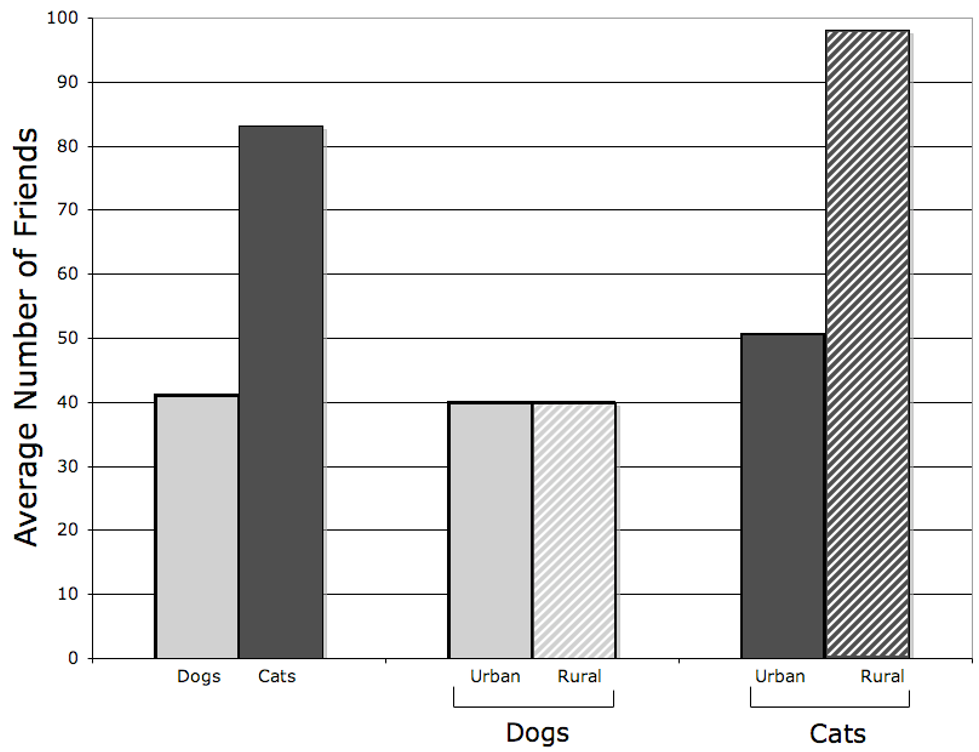 Figure 2: Data showing the massive lead in friend counts held by cat owners, particularly in rural areas.
Deep Insight: Why Isolation Breeds Connection
The author proposes a powerful theory: The Social Isolation Hypothesis.
- Dog owners meet people at dog parks and on walks; they don't need a website to find a community.
- Cat owners (especially in rural areas) are physically isolated. There are no "cat parks." Consequently, they turn to Catster to build the community they lack in physical space.
Critical Analysis & Conclusion
Takeaway
Pet-oriented networks aren't just for cute photos; they are vital community-building tools for people who are otherwise marginalized from physical social circles. The pet acts as a "social intermediary" that lowers the barrier to making new connections.
Limitations
The study relies on 2009 data. In the age of Instagram and TikTok, "petworks" have largely been absorbed into mainstream social media. However, the underlying psychological driver—using a pet's identity to seek community—remains highly relevant.
Future Outlook
This work paves the way for understanding how niche anonymous communities provide mental health benefits. Future studies should investigate whether these "virtual" communities provide the same blood-pressure-lowering benefits as physical pet ownership.
Editor's Note: This paper reminds us that on the internet, if everybody knows you’re a dog (or a cat), it might just be because you're looking for a pack you can't find at home.