
Crowdsourcing vs. BPM: Bridging the Human Resource Management Gap
Exploring Human Resource Management in Crowdsourcing Platforms
This paper presents an empirical study comparing Human Resource Management (HRM) in Business Process Management (BPM) versus Crowdsourcing platforms. It introduces a taxonomy for resource management (Assignment, Allocation, Prioritization) and evaluates the current support for these features across 55 "Marketplace" and "Broker" platforms through a systematic survey.
TL;DR
While Business Process Management (BPM) has long mastered the art of managing known employees, Crowdsourcing operates in a "wild west" of unknown workers. This paper systematically evaluates whether modern crowdsourcing platforms (Marketplaces and Brokers) have adopted mature BPM resource management techniques. The result? The lines are blurring, but there is still a significant journey ahead for standardized Resource Management in the crowd.
The Core Friction: Control vs. Freedom
In a standard corporate setting, a manager knows exactly who is available (Resource Assignment) and tells them what to do (Resource Allocation). In Crowdsourcing, the power dynamic shifts:
- Resource Assignment: Usually an open call, but increasingly filtered by skills.
- Resource Allocation: Workers often pick the tasks they want, rather than being "assigned."
- Quality Assurance: A massive pain point in the crowd due to potential cheating/misbehavior, which is a non-issue in traditional internal BPM.
The author's insight is that despite these differences, the underlying logic of finding the right person for the right job remains identical.
Methodology: Mapping the Crowdsourcing Workflow
The research breaks down resource management into three pillars and tests them against two types of platforms: Marketplaces (like Amazon Mechanical Turk) and Brokers (like CrowdFlower).
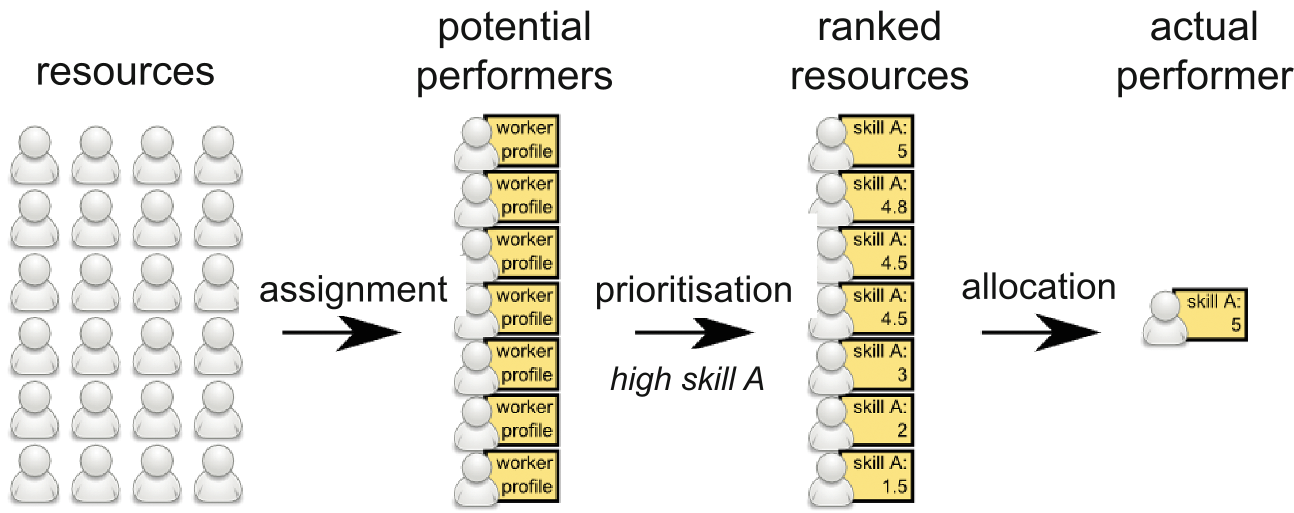
The study utilized a 5-point Likert scale to measure:
- Helpfulness (H): Does the feature actually provide value?
- Usage (U): Is it frequently used?
- Necessity (N): Do platforms without the feature feel they need it?
Key Findings: Myths vs. Reality
1. The Death of the "Broker" Distinction
Surprisingly, the hypothesis that Brokers would offer more advanced features than Marketplaces (H1) was rejected (p=0.2496). Both types of platforms are evolving into a "middle ground," offering similar tools for filtering workers and managing skills.
2. What Actually Works?
The data shows a "Virtuous Cycle" for quality-related features. If a platform provides Quality Rankings or Skill Tests, requesters use them almost exclusively.
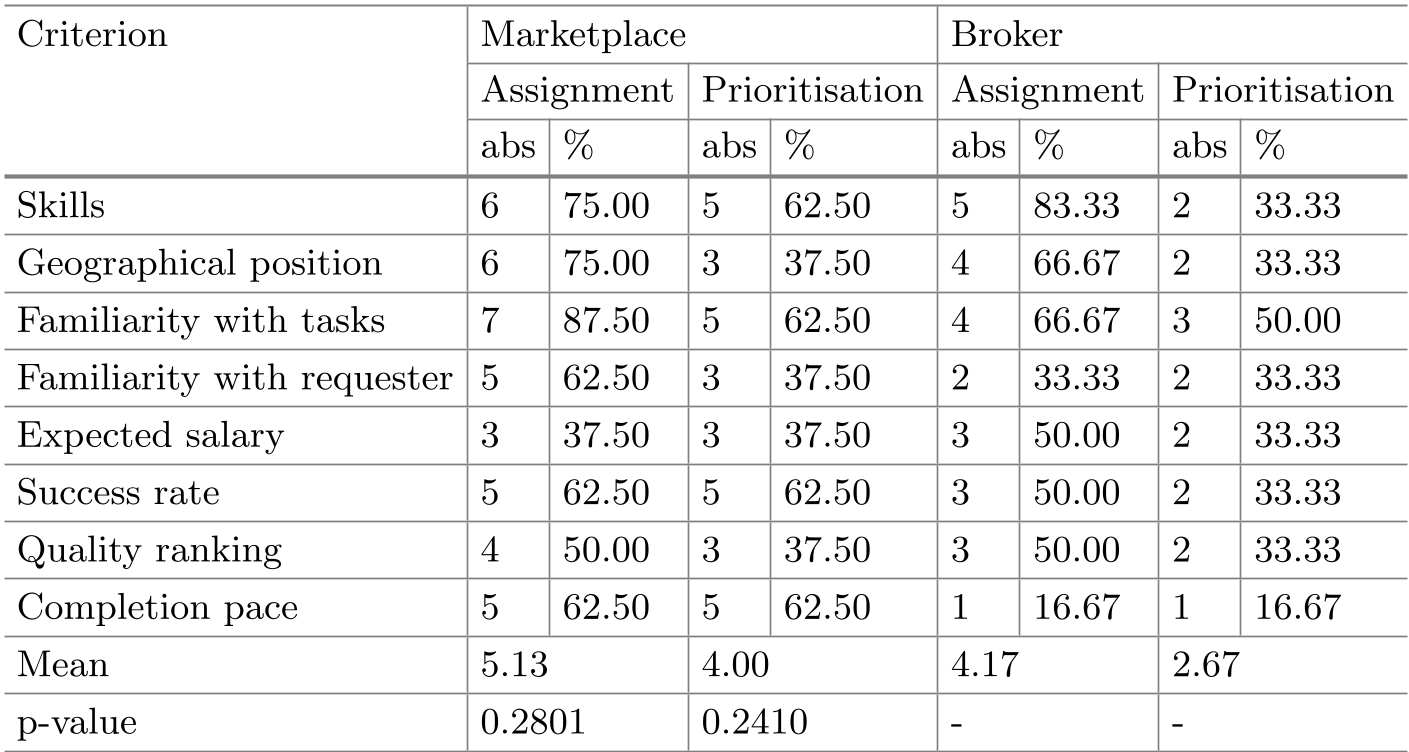
Key Takeaway from the Table: Familiarity with tasks and Skills are the most supported criteria for assignment, while "Expected Salary" is surprisingly less prioritized in the selection logic than one might think.
3. The Usage/Helpfulness Correlation
The study validated (H4) that there is a strong correlation between how helpful a feature is perceived and how often it is used. For instance, Feedback on Performance had a mean helpfulness of 4.40 and a perfect correlation (1.000) with usage.
Critical Analysis & Professional Perspective
The paper reveals a maturation of the crowdsourcing industry. We are seeing the "BPM-ification" of the crowd. As tasks move from simple image tagging to complex software development, platforms are forced to adopt the rigorous resource management patterns (like RACI matrices) used in traditional enterprise work.
Limitations: The study suffered from a low response rate (25%), likely because crowdsourcing companies treat their resource allocation algorithms as "trade secrets" in a highly competitive market.
Conclusion
For researchers and platform architects, the message is clear: Quality is the currency of the crowd. The most successful platforms in the future won't just be the ones with the most workers, but the ones with the best BPM-inspired tools to filter, rank, and allocate those workers effectively.
Takeaway for the Future: Expect to see more "Team Composition" and "Accountability" features (like the RACI model) appearing in crowdsourcing APIs as the complexity of outsourced work increases.