
Human Service Ecosystems: Unlocking the Evolutionary Patterns of Gig Work
When Human Service Meets Crowdsourcing: Emerging in Human Service Collaboration
This paper introduces a three-layer time-aware heterogeneous network model to analyze the evolution of human service ecosystems. By conducting an empirical study on Fiverr.com data, the authors quantify how service provision, orchestration capabilities, and collaboration patterns emerge and mature over time.
TL;DR
The "Human as a Service" (HaaS) market is exploding, yet we often treat it like a static catalog of APIs. This paper proves that human service ecosystems are living entities. By analyzing millions of transactions on Fiverr, the researchers uncovered that both providers and consumers follow distinct "learning curves," and that service collaboration is driven by human cognition rather than rigid interfaces.
Background: Beyond Web Services
In the traditional Service-Oriented Architecture (SOA), a service is a piece of code with a fixed API. In the modern gig economy, the service is the person. This shift introduces two complexities:
- Dynamic Capability: Humans learn. A logo designer might eventually offer web programming.
- Flexible Orchestration: Humans don't "connect" via RESTful calls; they collaborate through communication and managerial skills provided by the consumer.
Methodology: The Three-Layer Heterogeneous Network
To quantify this, the authors modeled the ecosystem as a time-aware heterogeneous network.
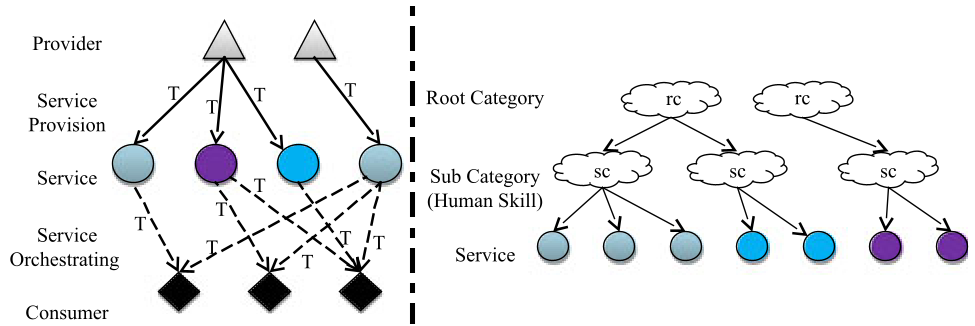
The model tracks three specific entities:
- Providers (): Those offering skills.
- Services (): The specific "gigs" offered (e.g., "I will translate 1000 words").
- Consumers (): Those orchestrating these services to solve problems.
The functionality is organized into a hierarchy: Root Category (e.g., Graphics & Design) Sub-category (e.g., Logo Design) Specific Skill.
Insight 1: The 8-Month Provision Learning Curve
One of the most striking findings is the "diminishing marginal utility" at the start of a provider's lifespan. When a provider joins, they list everything they already know. Then, they hit a wall. It takes an average of eight months for a provider to develop and list a truly new skill.
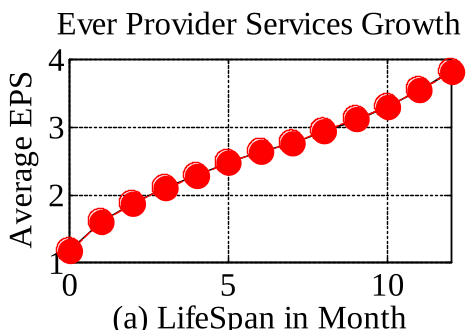
The progression follows a logical path:
- 0-6 Months: Focus on the same sub-category.
- 6-8 Months: "Cross-sub-category" expansion (neighboring fields).
- 9-12 Months: "Cross-root-category" expansion (entirely new domains).
Insight 2: The Consumer's Orchestration Struggle
Consumers grow their "managerial muscle" faster than providers grow skills. They quickly learn how to hire multiple people for one project. However, the data shows a paradox: while they get better at managing similar tasks (redundancy to ensure quality), they struggle to develop complex, multi-domain requirements over time.
Insight 3: Emerging Collaboration Patterns
Is service collaboration random? No. By analyzing co-occurrence, the researchers found that certain skills "cluster" naturally through human orchestration.
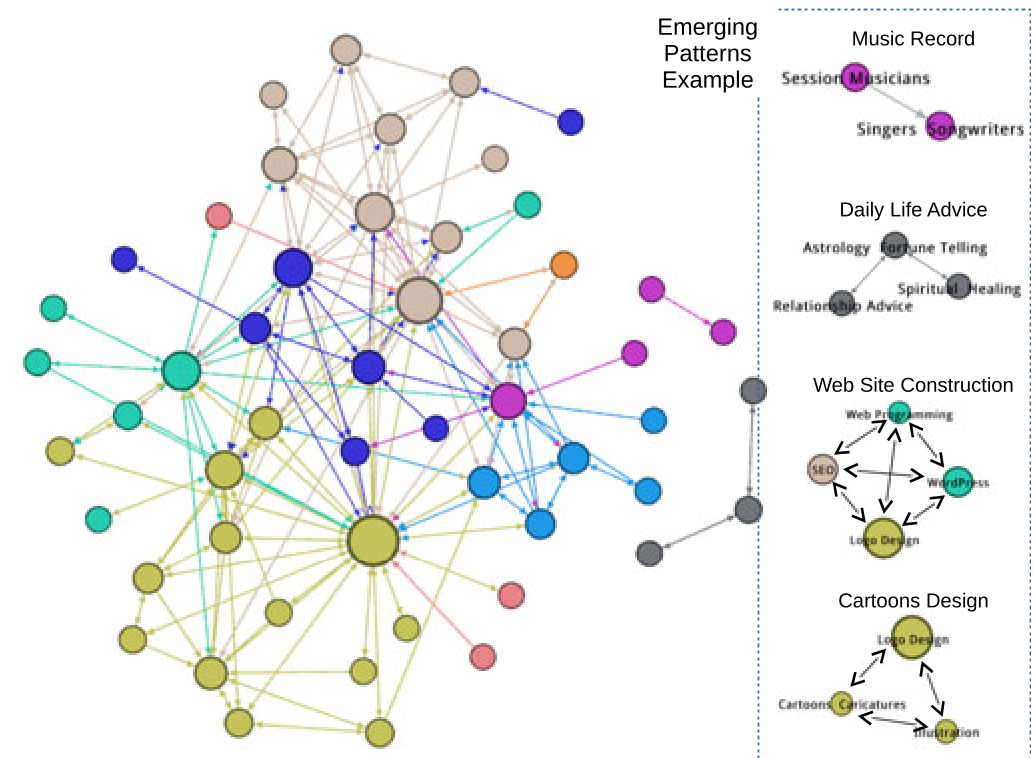
For example, "Logo Design" (Graphics) and "SEO" (Marketing) often emerge together in the context of "Web Construction." These aren't hard-coded dependencies; they are the result of humans recognizing that these skills complement each other to solve a higher-level problem.
Critical Analysis & Future Outlook
Takeaways for Platforms:
- Reduce the Learning Curve: Platforms should provide "skill expansion suggestions" to help providers diversify faster than the current 8-month lag.
- Support Complex Task Decomposition: Since consumers struggle to orchestrate across domains, AI-driven tools could help them break down a big goal (e.g., "Launch a Startup") into a sequence of human services.
Limitations: The study relies on Fiverr's specific $5-entry model (though Fiverr now allows higher prices). The "one-month window" for project grouping is an assumption that might catch unrelated gigs for high-volume buyers.
Conclusion: This research moves us from seeing crowdsourcing as a "commodity market" to seeing it as a "collaborative ecosystem." The real value of the next generation of gig platforms won't just be finding a freelancer—it will be facilitating the growth of human capability and the emergence of collective intelligence.