
The Sentience Gap: Why We Care More About a Human's Smile Than an AI's Regret
Humans versus Computers: Impact of Emotion Expressions on People's Decision Making
This study investigates how the perceived agency of virtual humans—whether they are seen as computer-controlled "agents" or human-controlled "avatars"—impacts the effectiveness of their emotional expressions in social dilemmas and negotiations. The authors demonstrate that while computers can influence human behavior through emotion, the social impact is significantly amplified when participants believe a human is behind the virtual display.
TL;DR
Even when a computer and a human behave identically, our brains treat them differently. This study reveals that emotional expressions—like a smile of cooperation or a scowl of anger—have a much more powerful impact on our financial decisions when we believe they are controlled by a human (an Avatar) rather than an algorithm (an Agent). The "social influence" of AI emotions is real, but it struggles to cross a psychological threshold of perceived "mindfulness."
Background: Are Computers Just Social Actors?
For years, the "Computers are Social Actors" (CASA) paradigm suggested that if a machine shows social cues, humans will respond socially. But this paper challenges that "mindless" assumption. By looking through the lens of Neuroeconomics, the authors argue that we reserve certain cognitive processes—specifically Mentalizing (inferring others' intentions)—for entities we believe have a "mind."
The Dilemma of the Digital Face
The researchers set up two distinct experimental frameworks to test how "Agency" (who is in control) changes the weight of "Affect" (emotion).
Experiment 1: The Social Dilemma
Participants played the Prisoner's Dilemma. Some were told their opponent was a "computer agent," others were told it was a "human-controlled avatar."
- Cooperative UI: Shows Joy after mutual cooperation; Regret after exploitation.
- Competitive UI: Shows Joy after exploiting the player; Regret after mutual cooperation.
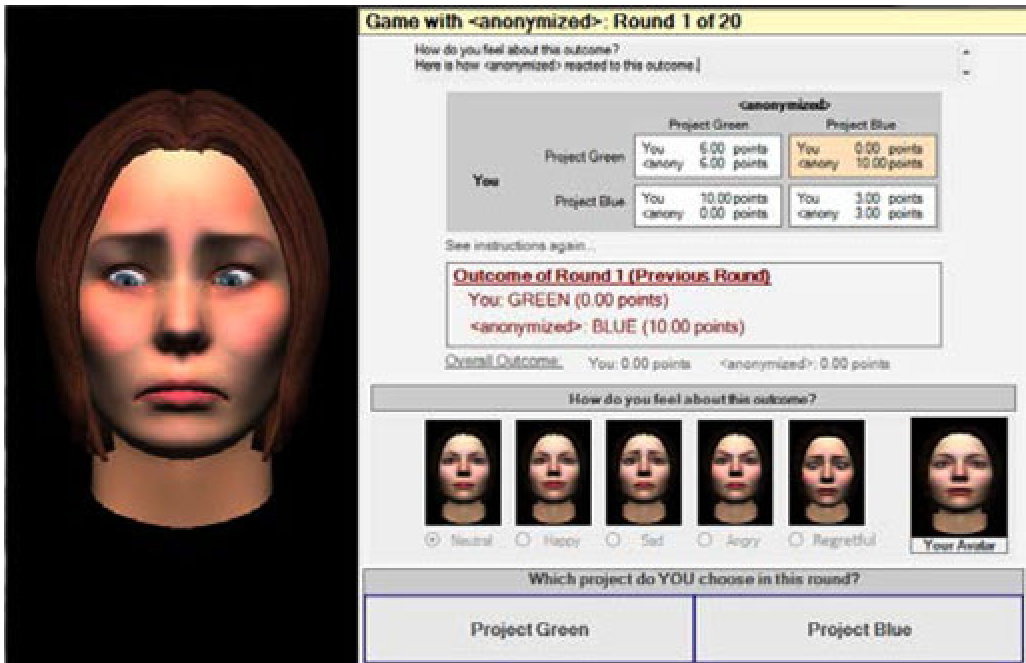
The Insight: While both groups cooperated more with "cooperative" faces, the effect was drastically stronger when they thought a human was feeling that joy or regret. We forgive humans more easily and align with their joy more readily.
Experiment 2: Negotiation Intensity
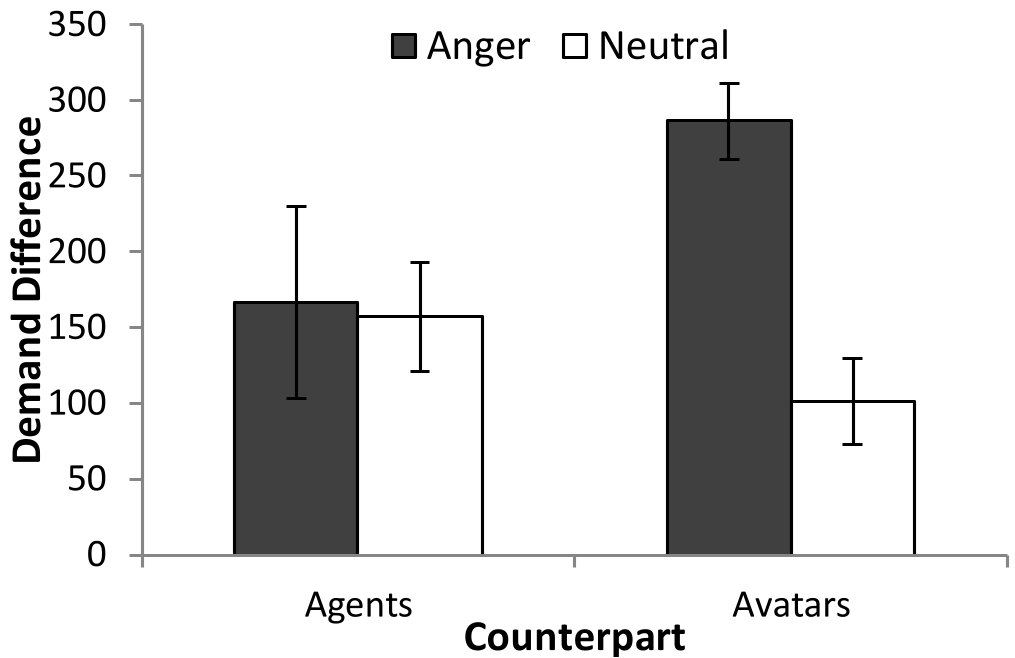
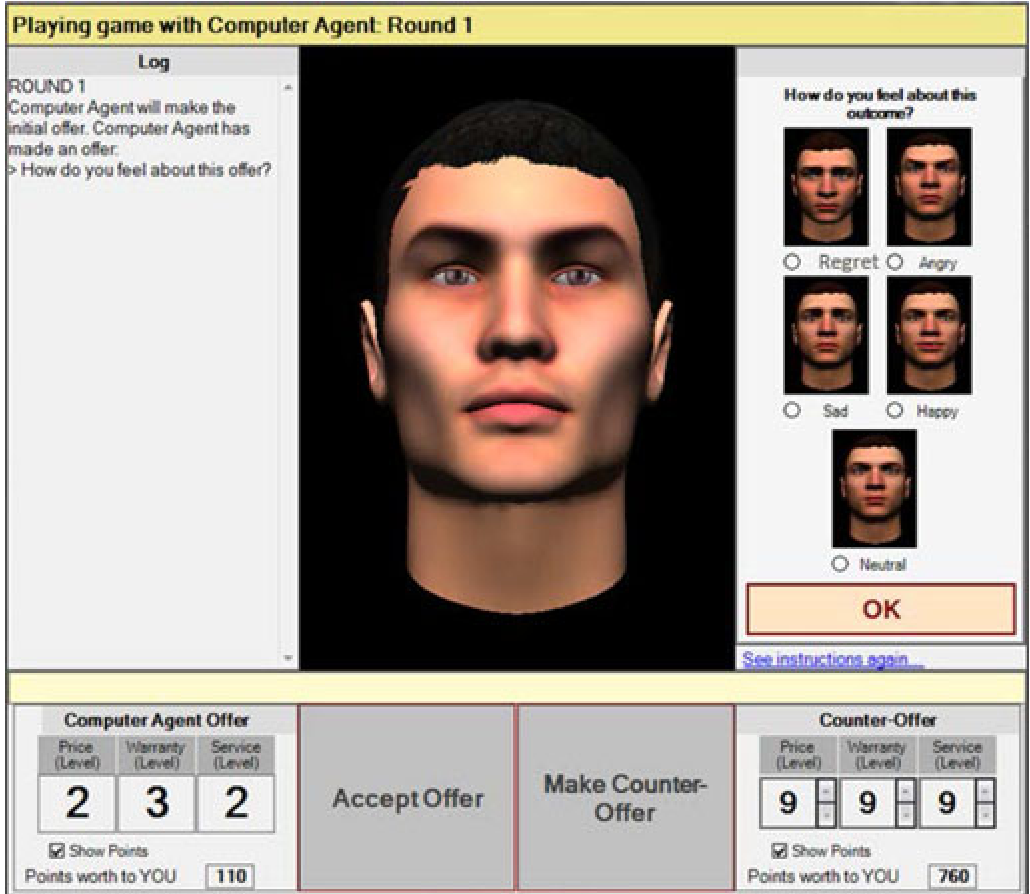
In a multi-issue negotiation (price, warranty, etc.), an "Angry" counterpart usually forces people to concede to avoid a deadlock.
- The Finding: This tactic worked brilliantly for Avatars (Effect size d = 1.162). However, when the "Agent" showed anger, participants basically ignored it (d = 0.066). Anger without a "mind" behind it feels like a hollow algorithm, not a threat.
Methodology: The Illusion of Choice
The brilliance of the study lies in its Deception Architecture.
- Fixed Strategy: All virtual humans used the same "Tit-for-Tat" or scripted negotiation offers.
- Identical Visuals: The same high-quality 3D virtual characters were used for both conditions.
- The Server Trick: To make the "Avatar" group believe they were playing with humans, a server "matched" them in real-time, though they were actually playing a bot.
Deep Insight: Why Does the "Human" Label Change the Math?
The authors suggest that when we face a human, we activate brain regions like the medial prefrontal cortex (MPFC). We try to read their "beliefs, desires, and intentions." When we face a "computer agent," we often shut down this mentalizing system, treating the emotion as a mere "feature" of the software rather than a signal of a future social relationship.
Furthermore, people showed In-group Bias. They were less angry toward "human" avatars even when the avatar exploited them, compared to "computer" agents doing the exact same thing. We are inherently more empathetic to our own species, even when that species is represented by a 3D model.
Critical Analysis & Conclusion
Takeaway for AI Design
If you are designing a customer service bot or a negotiation AI:
- Transparency Matters: If there is a human "in the loop," make it known—it boosts the social influence of the interface.
- The Limits of Affect: Simply adding "angry" or "happy" faces to an AI isn't a silver bullet. Without the user's belief in the AI's "capacity to sense and feel" (Experience), the emotions are just pixels.
Limitations
The study focused on 3D virtual humans. It remains to be seen if these findings hold for Textual LLMs (like ChatGPT), where the "voice" of the AI is becoming increasingly human-like, potentially blurring the lines of agency more than a 3D model ever could.
Final Thought: The future of Human-Computer Interaction is not just about better graphics; it's about closing the "Sentience Gap" in the mind of the user.