
HVI-CIDNet+: Beyond Extreme Darkness with a Novel Color Space and VLM Priors
HVI-CIDNet+: Beyond Extreme Darkness for Low-Light Image Enhancement
This paper introduces HVI-CIDNet+, a state-of-the-art low-light image enhancement (LLIE) framework that utilizes a novel HVI (Horizontal/Vertical-Intensity) color space. By integrating latent semantic priors and degraded representations from pre-trained vision-language models (VLMs), the method significantly outperforms 20+ competitors across 10 benchmark datasets, achieving top-tier PSNR and SSIM scores.
TL;DR
Enhancing images captured in extreme darkness is a battle against noise and information loss. HVI-CIDNet+ wins this battle by departing from traditional sRGB/HSV color spaces in favor of a new HVI (Horizontal/Vertical-Intensity) space. By leveraging semantic knowledge from pre-trained Vision-Language Models (VLMs) and an adaptive region-refinement strategy, it sets a new SOTA across 10 benchmarks, proving particularly effective at removing nasty red and black artifacts that plague other methods.
Problem & Motivation: The Curse of HSV and Extreme Dark
Most low-light enhancement (LLIE) tools fail in two specific ways:
- Color Sensitivity: In the sRGB space, brightness is tightly coupled with color. Adjusting one often ruins the other.
- Color Space Noise: Methods that switch to HSV to decouple brightness often encounter "Red Discontinuity" (where red exists at both ends of the hue spectrum, causing edge artifacts) and "Black Plane Noise" (where low-intensity areas amplify sensor noise into visible clusters).
- Information Scarcity: In "total dark" scenarios, pixel values are near zero. Without high-level "understanding" of what should be in the image, the network just enhances the noise.
Methodology: The HVI Revolution
The core innovation is the HVI Color Space. The authors apply polarization to the Hue/Saturation plane to ensure that similar red shades have small Euclidean distances, effectively "closing the loop" on the hue circle. Simultaneously, a trainable intensity collapse function () compresses the radius of low-light regions, effectively squashing black noise before the enhancement begins.
Architecture: PAB and RRB
The HVI-CIDNet+ architecture is a dual-branch U-Net (one for HV color, one for Intensity) featuring two crucial modules:
- Prior-guided Attention Block (PAB): This module injects Latent Semantic Priors (contextual data from VLMs) into the Intensity branch to reconstruct shapes and Degraded Representations into the HV branch to guide denoising.
- Region Refinement Block (RRB): Not all parts of a dark image are equally degraded. The RRB uses a mask predictor to separate "information-scarce" regions (processed via Window Attention for long-range context) from "information-rich" regions (processed via dynamic convolutions for detail enhancement).
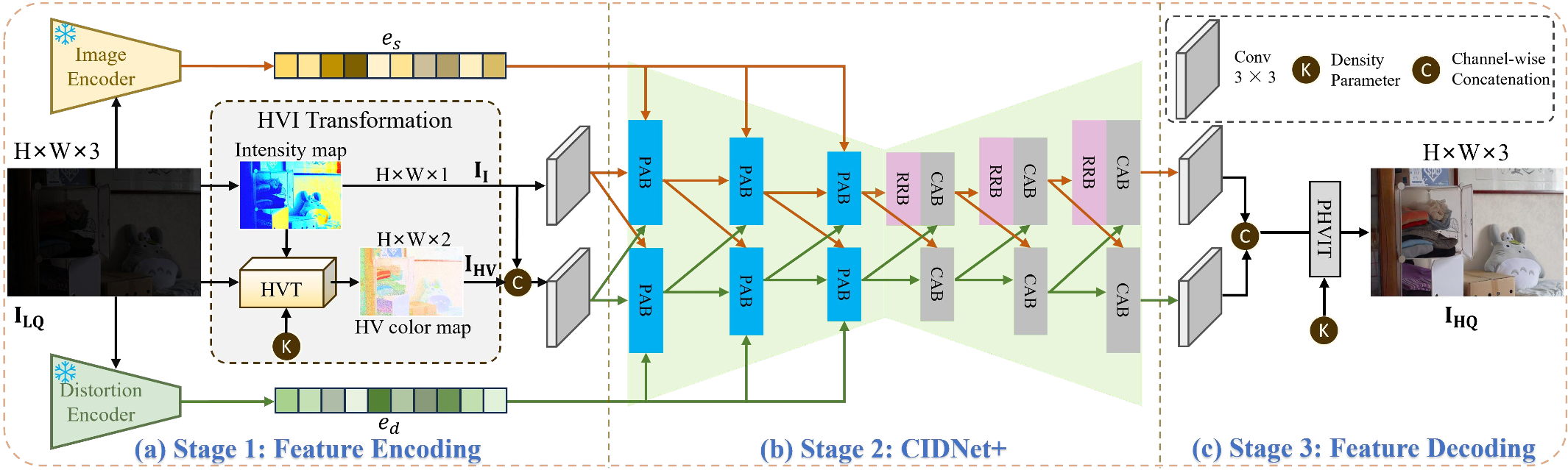
Experiments & Results: Crushing the Benchmarks
The performance of HVI-CIDNet+ is dominant. On the Sony-Total-Dark dataset, which represents extreme real-world challenges, the model achieved a PSNR of 23.482 dB, massively outperforming traditional methods like ZeroDCE and RetinexNet.
Ablation Insights: Why HVI works
The authors proved that HVI isn't just for their model. When used as a "plug-and-play" color space for other SOTA models like GSAD, it boosted PSNR by over 3.5 dB. This suggests that the HVI color space itself is a superior representation for any light-enhancement algorithm.
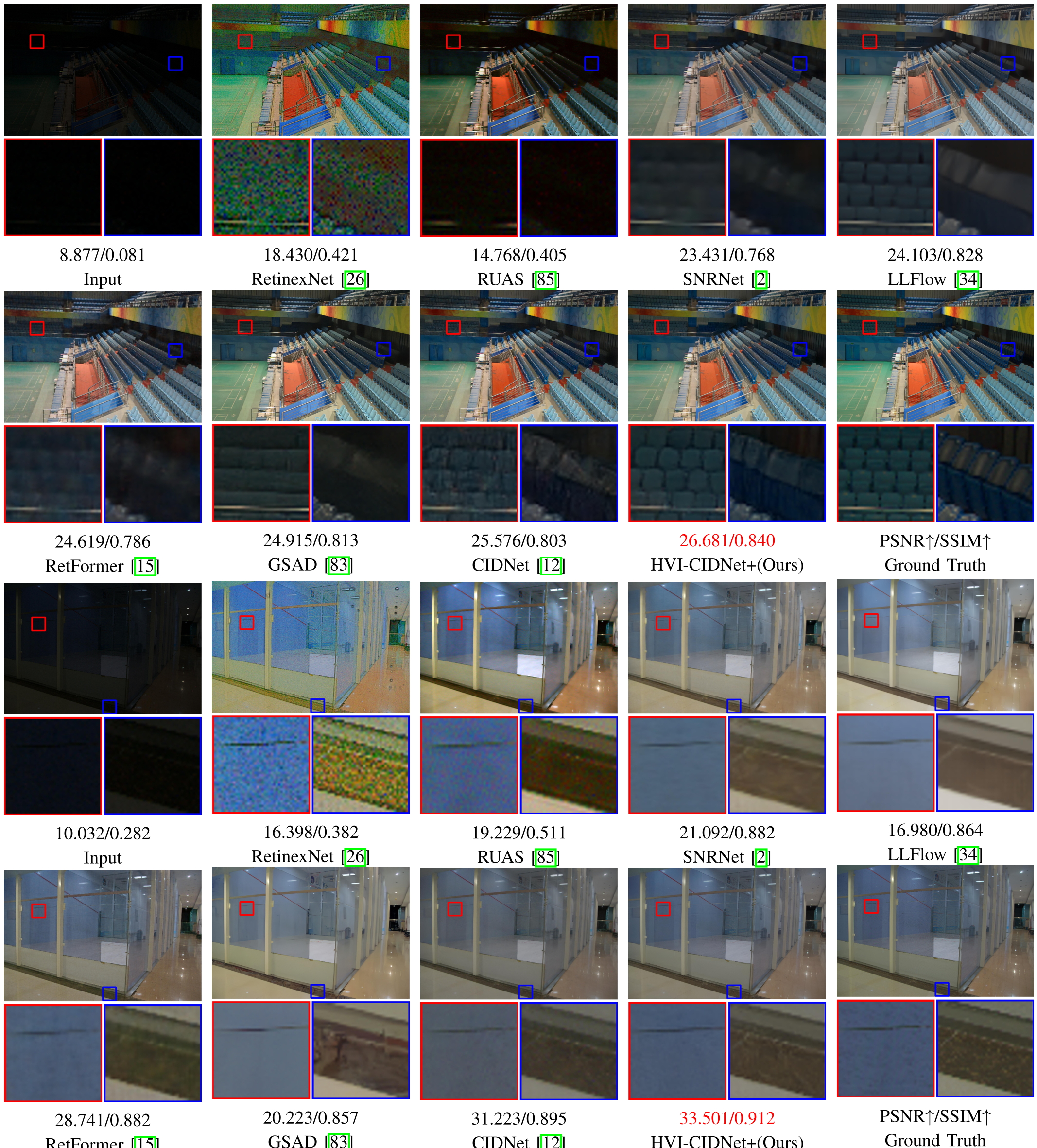 Visual results show that HVI-CIDNet+ (far right) maintains natural color and sharp structural details while competitors often suffer from "washed out" colors or heavy noise artifacts.
Critical Analysis & Conclusion
Takeaway
HVI-CIDNet+ demonstrates that LLIE is moving beyond simple pixel-mapping. By combining physical color theory (HVI) with large-scale semantic knowledge (VLMs), we can now recover images from conditions that were previously considered "digitally dead."
Limitations & Future Work
While the results are impressive, the model is architecturally complex (300M+ parameters). Future research might focus on distilling this semantic "knowledge" into more lightweight mobile-controllable models. Furthermore, extending this "Intensity Collapse" logic to video enhancement while maintaining temporal consistency remains an open challenge.
Final Verdict: A landmark paper for anyone working on computational photography or high-end image restoration.