
Hybrid AI: Solving the Diagnostic Bottleneck for Adult ADHD
A hybrid AI approach for supporting clinical diagnosis of attention deficit hyperactivity disorder (ADHD) in adults
This paper introduces a hybrid AI system designed to support the clinical diagnosis of Adult Attention Deficit Hyperactivity Disorder (ADHD) within the UK National Health Service (NHS). By combining a Decision Tree machine learning model with a rule-based knowledge model captured from medical experts, the system achieves a diagnostic accuracy of 95.7% when allowing for expert referrals.
TL;DR
To combat growing waiting lists for ADHD assessments in the UK’s NHS, researchers have developed a hybrid AI system that combines Machine Learning (Decision Trees) with Expert Knowledge Modeling. The system doesn't aim to replace doctors; instead, it identifies "clear-cut" cases with 95.7% accuracy and flags complex cases for human review, potentially doubling clinical efficiency.
Background: The Specialist Dearth
ADHD affects approximately 2.5% of adults worldwide. However, because ADHD was only recently accepted as a condition that persists into adulthood, there is a severe shortage of trained clinicians. This "bottleneck" results in delayed treatment, leading to higher rates of unemployment, accidents, and social dysfunction. The core challenge for AI here isn't just prediction; it's interpretability and safety.
The Problem: Why Pure ML Isn't Enough
Medical diagnosis is rarely a simple binary classification. In ADHD, symptoms overlap significantly with anxiety (GAD-7), depression (PHQ-9), and personality disorders. A pure Machine Learning model might find patterns in data but lacks the "clinical intuition" to know when a case is too ambiguous to decide safely—a critical failure in high-stakes healthcare.
Methodology: The Hybrid "Safety-First" Architecture
The researchers proposed a dual-track system:
- The Machine Learning (ML) Track: Utilizing data from 69 patients (27 baseline variables and 66 risk assessment variables), they tested several algorithms. The Decision Tree emerged as the winner due to its inherent interpretability and high performance (85.5% accuracy).
- The Knowledge Representation (KR) Track: Through interviews with international ADHD experts, they encoded clinical experience into prioritized "If-Then" rules. These rules explicitly account for "indicators" like substance abuse or brain injury that might confound an ADHD diagnosis.
Core Architecture
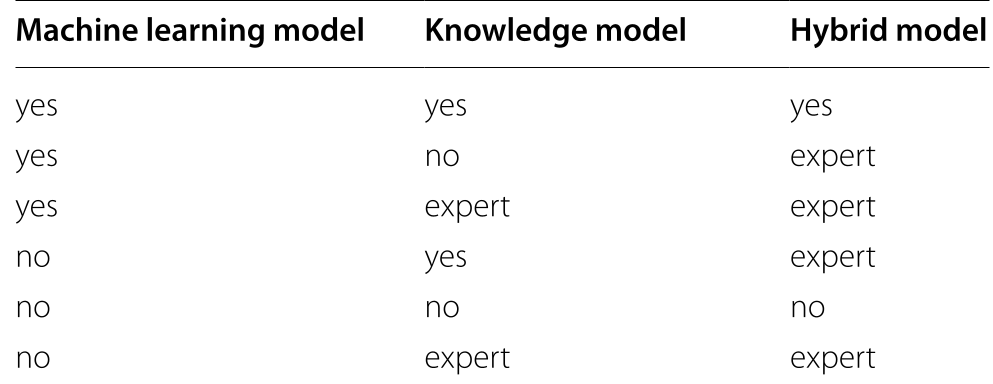
The "Hybrid" logic acts as a consensus mechanism. If the ML model says "Yes" and the Rule-Base says "Yes," the output is "Yes." If they disagree—or if the Rule-Base detects complexity—the system outputs "Expert Referral."
Experimental Results: Accuracy vs. Coverage
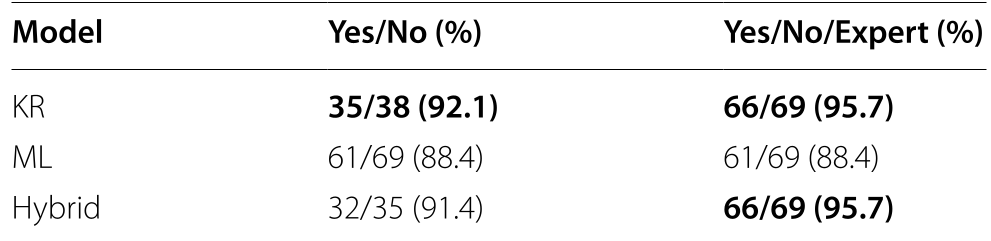
The study highlights a fascinating trade-off. While the ML model tries to classify everyone, it makes more mistakes. The Hybrid model is more "conservative"—it only classifies about 50% of the cases as Yes/No, but it is much more accurate on those specific cases.
- Stand-alone ML Accuracy: 88.4%
- Hybrid Model Accuracy: 95.7% (when factoring in Expert Referrals as a valid outcome).
The Decision Tree proved to be the most robust ML backbone, likely because clinical symptoms are often categorical and hierarchical, matching the tree structure's inductive bias.
Critical Insight: Efficiency without Replacement
The value of this work lies in its Clinical Utility. By automating 50% of the cases (the "clear-cut" ones), clinicians can double their focus on the 50% of patients who actually require specialist expertise. This "triage" approach is much more likely to be adopted in bureaucratic health systems like the NHS than an "AI Doctor" that attempts to do everything.
Conclusion & Future Work
The study proves that in specialized medical domains where data is scarce (N=69), Hybrid AI—the marriage of data-driven learning and symbol-driven expertise—is the most viable path forward. Future iterations plan to utilize Fuzzy Logic to better handle the "linguistic imprecision" of how patients describe their symptoms, moving beyond rigid thresholds to a more nuanced, "human-like" reasoning system.
Reference: Tachmazidis, I., Chen, T., Adamou, M., & Antoniou, G. (2020). A hybrid AI approach for supporting clinical diagnosis of ADHD in adults. Springer, Health Information Science and Systems.