
PANDA: Bridging the Gap in Academic Search through Hybrid Knowledge Extraction
Using hybrid algorithmic-crowdsourcing methods for academic knowledge acquisition
This paper introduces PANDA, a hybrid algorithmic-crowdsourcing framework designed to identify and extract "Knowledge Cells" (figures, tables, algorithms, etc.) from scientific literature to build an Academic Knowledge Graph. It combines automated machine learning for scalability with human intelligence via crowdsourcing for high-precision boundary detection and semantic relationship extraction.
TL;DR
The PANDA (Platform for Academic kNowledge Discovery and Acquisition) framework addresses the inefficiency of traditional paper-level search by extracting specific "Knowledge Cells"—figures, definitions, and algorithms—from PDFs. By combining automated filtering with crowdsourced human precision, it constructs a multi-level Academic Knowledge Graph that allows researchers to search for specific content rather than just bibliography metadata.
Background: The "Needle in a Haystack" Problem
Academic search engines like Google Scholar or arXiv have transformed research, yet they remain limited to the "document level." When a researcher searches for a specific algorithm or an experimental figure, they are greeted with a list of PDFs that must be manually downloaded and scanned.
The core difficulty lies in the PDF format itself. PDFs are designed for rendering, not for structural data extraction. They lack semantic tags, making it hard for machines to distinguish between a figure caption, a table, or a body of text—especially when layouts shift across thousands of different conference proceedings.
Methodology: The Hybrid Human-Algorithm Synergy
PANDA moves away from "machine-only" solutions. Instead, it treats knowledge acquisition as a crowd-sourced database problem.
1. The Knowledge Cell & Graph
The authors define a Knowledge Cell as any meaningful information object within a paper. Collectively, these form an Academic Knowledge Graph (AKG), which maps relationships like "Algorithm A is an extension of Algorithm B" or "Figure X illustrates Definition Y."
2. High-Efficiency Filtering
To save costs, PANDA doesn't send every page to human workers. It employs an automated Algorithmic Layer:
- Page Filtering: Binary classifiers discard pages unlikely to contain the target cell (e.g., cover pages).
- Confidence-Aware Switching: Using active learning strategies like Uncertainty and MinExpError, the system calculates the "confidence" of its prediction. Only low-confidence or high-impact pages are pushed to the crowdsourcing layer.
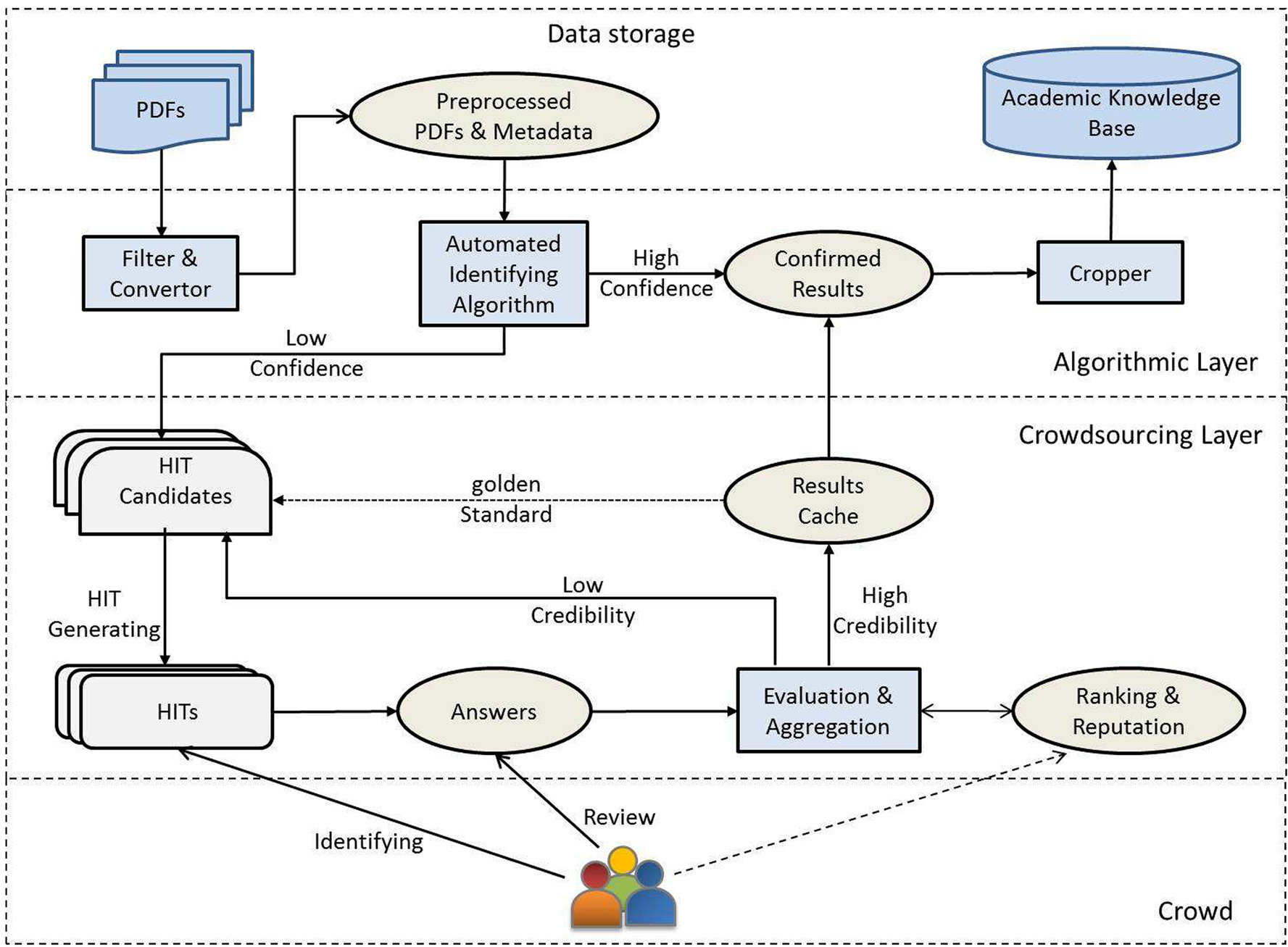 Figure 1: The PANDA Architecture, showing the flow from PDF repository through algorithmic filtering to crowdsourced human intelligence.
3. Crowdsourcing Workflow
Human workers on platforms like Amazon Mechanical Turk (AMT) perform tasks that are "easy for humans but hard for machines":
- Boundary Identification: Manually cropping the exact rectangle of a complex figure.
- Review Tasks: Using a Majority Vote system to validate the work of other humans, ensuring high-quality data.
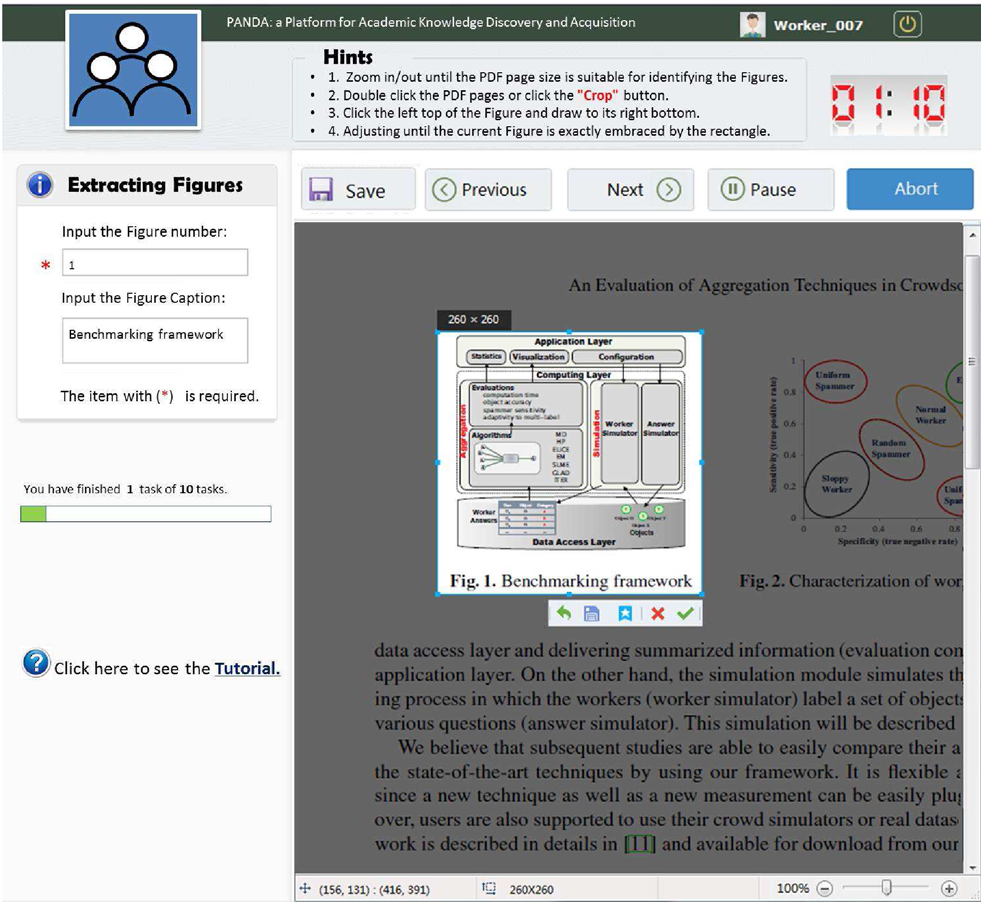 Figure 2: The Crowdsourcing interface where workers "drag and draw" to identify knowledge cell boundaries.
Experiments and Results
The system was tested on massive datasets, including 2.9 million papers.
- Human Accuracy: Crowdsourced workers reached 93-95% accuracy in boundary detection and review.
- Algorithm Performance: The automated boundary detector for figures showed a significant performance jump in papers published after 1990, as older scanned PDFs (1980s) presented a major challenge for OCR and layout analysis.
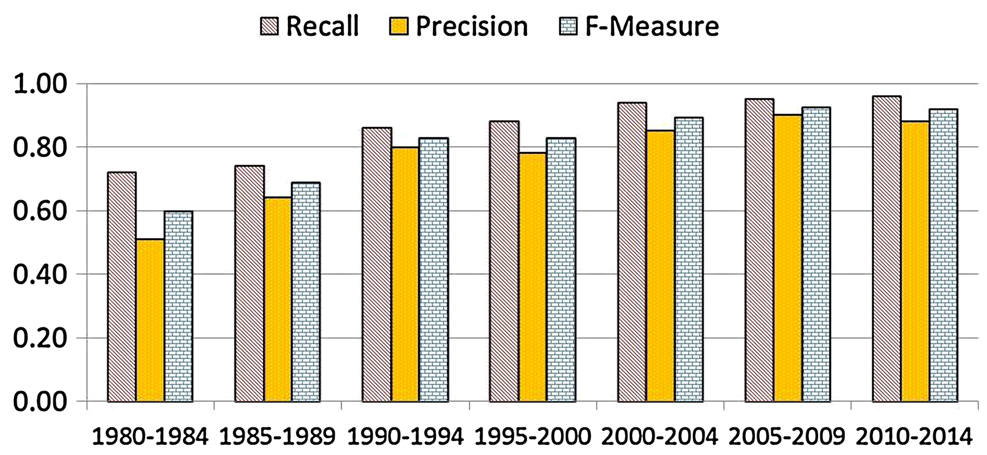 Figure 3: Efficiency of algorithmic figure extraction over different decades.
Critical Insight: Why This Matters
The true value of PANDA is not just the "cells" themselves, but the Academic Knowledge Graph. By linking disparate Knowledge Cells across papers, PANDA can answer complex queries that traditional search engines cannot, such as "Find all variants of the Hash Join algorithm proposed across different journals."
Limitations & Future Work
- Scalability of Cost: While hybrid workflows reduce costs, processing millions of papers via paid crowdsourcing remains expensive. The authors propose moving toward "Incentive Crowdsourcing"—inviting researchers themselves to label their own papers.
- Relationship Complexity: Basic relationships are easy to extract, but nuanced links (e.g., "this theorem simplifies that lemma") still require high-level domain expertise beyond the capability of the average AMT worker.
Conclusion
PANDA demonstrates that the future of academic knowledge management isn't just about better OCR or bigger Language Models—it’s about the intelligent distribution of work between automated speed and human logic.