
[ArXiv 2025] Hybrid Associative Memories: Bridging the Gap Between Efficient Compression and Precise Recall
Hybrid Associative Memories
The paper introduces the Hybrid Associative Memory (HAM), a sequence-mixing layer that integrates Recurrent Neural Networks (RNNs) and self-attention in a complementary manner. By using a data-dependent routing mechanism, HAM stores only "surprising" tokens—those difficult for the RNN to predict—in a sparse KV cache, achieving SOTA performance while significantly reducing memory and compute costs.
TL;DR
The Hybrid Associative Memory (HAM) layer is a novel architectural primitive that combines the efficiency of Gated RNNs with the precision of Self-Attention. Unlike prior hybrids that stack layers, HAM uses a complementary strategy: the RNN handles predictable context, while the KV cache only stores "surprising" tokens. This achieves Transformer-level performance with 50% less KV cache usage and provides a continuous "knob" to trade off memory for accuracy.
The Core Conflict: Compression vs. Resolution
In the current LLM landscape, we are forced to choose between two orthogonal memory models:
- Transformers (Self-Attention): High-resolution but expensive. The KV cache grows linearly with sequence length, leading to a "memory wall" in long-context applications.
- RNNs (SSMs/Linear Attention): Efficient but "forgetful." They compress history into a fixed-size state, which inevitably leads to noise and interference (retrieval degradation) as the sequence length exceeds the hidden dimension .
The authors argue that current hybrids (like Jamba or Samba) are redundant. If an RNN layer can perfectly predict the next token, why store that token in a KV cache in the subsequent attention layer?
Methodology: The "Surprise" Router
HAM treats the sequence-mixing problem as a Complementary Learning System (CLS).
- The RNN Path: A Gated DeltaNet acts as the "neocortex," learning regularities and patterns.
- The KV Cache Path: Acts as the "hippocampus," storing episodic details that the RNN fails to capture.
How Routing Works
The system calculates a routing score for every token. If exceeds a threshold , the token is saved to the KV cache. Otherwise, it is only processed by the RNN.
The paper explores two main routing metrics:
- Prediction Error: The cosine distance between the RNN's predicted state and the actual token value.
- Learned Router: A 3-layer MLP that learns to predict which tokens are "important" for future retrieval.
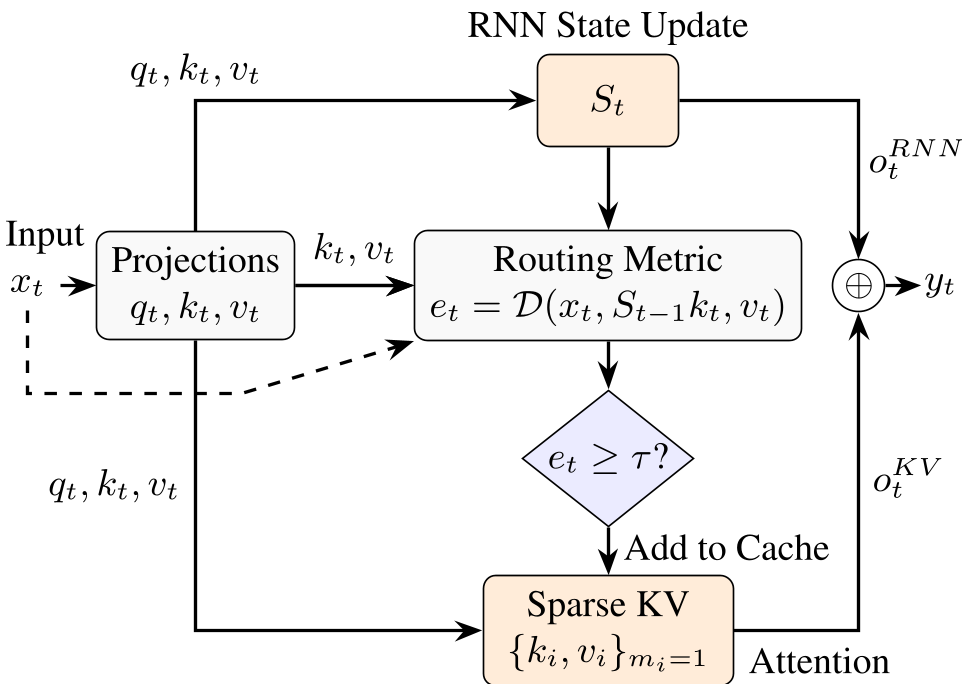 Figure 1: The HAM Architecture. The RNN and KV cache operate in parallel, but the KV cache is sparse and data-dependent.
The "Performance Dial": Controllable Memory
One of HAM's most significant contributions is the learnable threshold. By using a synthetic gradient approach, the model can be targeted to reach a specific KV cache fraction (e.g., exactly 25% or 50% of the total tokens).
This creates a smooth memory-performance Pareto frontier. Unlike traditional models where the KV cache size is a fixed hardware constraint, HAM provides a "knob" for inference-time optimization.
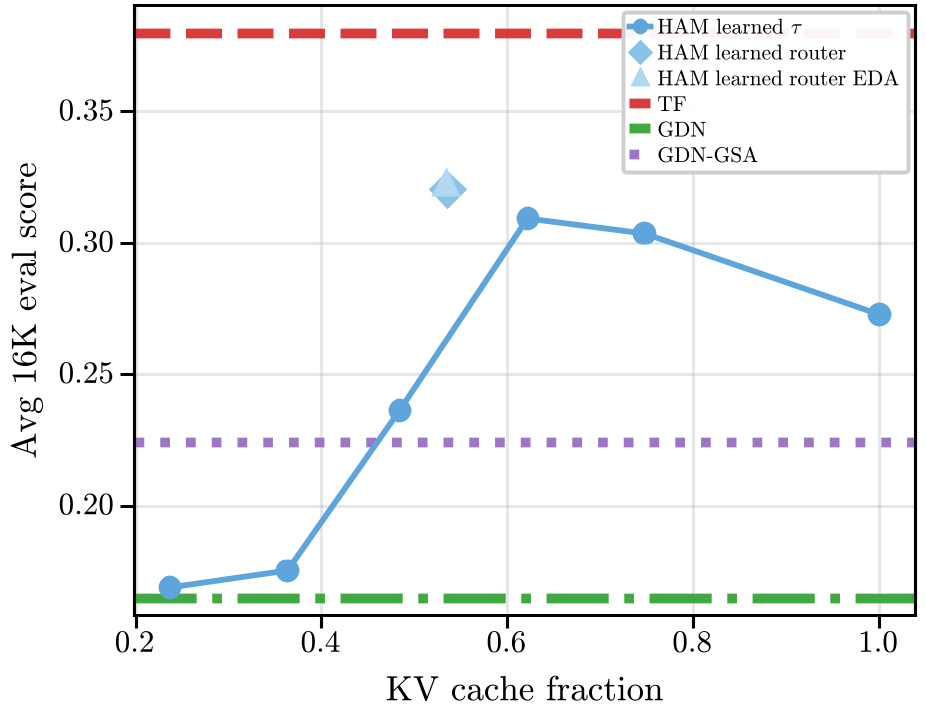 Figure 2: Performance as a function of KV cache usage. Note the smooth interpolation between RNN-only (0%) and Transformer-like (100%) performance.
Experimental Highlights
The authors tested HAM on the RULER benchmark (16K context) and standard zero-shot tasks (HellaSwag, ARC, etc.).
- Retrieval Superiority: In multi-query and multi-value tasks, HAM with a learned router handily outperformed standard Transformers. This suggests that by filtering out "boring" tokens, HAM actually reduces the signal-to-noise ratio in the attention mechanism.
- Efficiency: Training a HAM model with 50% KV cache requires roughly 30% fewer FLOPs than a parameter-matched Transformer, while achieving lower perplexity on datasets like WikiText.
| Model | Avg. Reasoning ↑ | Long-Context (16K) | KV Usage |
|---|---|---|---|
| Transformer | 48.8 | 19.0 | 100% |
| GDN (RNN) | 47.2 | 8.8 | 0% |
| HAM (Learned Router) | 49.1 | 23.0 | 50% |
Critical Insight: Why it Works
The visual analysis of the routing scores (Figure 3 in the paper) reveals a fascinating "spike" whenever the model encounters a Needle-in-a-Haystack. When the text shifts from repetitive patterns to a specific "magic number," the prediction error jumps, forcing that specific number into the KV cache. This mimics human focus—we don't memorize every word of a lecture, only the points that surprise us or break the established pattern.
Conclusion & Future Outlook
HAM represents a shift from static architectures to dynamic, data-dependent ones. By acknowledging that not all tokens are created equal, HAM allows for models that are in memory for most "predictable" data while retaining the precision of attention for critical information.
Limitations: The data-dependent sparsity can lead to random memory access patterns, potentially increasing latency on certain hardware (TLB misses). However, the authors suggest block-based routing as a future optimization to maintain hardware affinity.
The Takeaway: High-resolution long-context modeling doesn't require storing the whole past—it just requires knowing what to forget.