
Modeling the High: A Hybrid Automata Perspective on Social Network Addiction
A Hybrid Automata model of social networking addiction
This paper presents a computational framework utilizing Hybrid Automata to model social networking addiction by simulating the neurological Dopamine System. It maps the biological feedback loops of stimulus and tolerance onto network topologies, demonstrating how scale-free structures significantly accelerate addictive behaviors.
TL;DR
This study introduces a rigorous computational framework that combines the neurological mechanics of the Dopamine System with the structural properties of Social Networks. By using Hybrid Automata, researchers successfully demonstrated why scale-free networks (like Facebook or X) are inherently more "addictive" than random networks, particularly when a few highly active "hubs" drive the interaction.
Background: The Neuro-Social Loop
Addiction is fundamentally a "computational process gone awry." Neurobiologically, it revolves around the Dopamine System, where a desired stimulus triggers pleasure, eventually leading to tolerance (reduced effect) and withdrawal. While we understand how nicotine or cocaine hijacks this system, the digital equivalent—social media—operates through a complex interplay of peer interaction and network topology.
The authors position this work as a bridge between computational neuroscience and social network analysis, moving from a single-subject perspective to a multi-agent system of individuals whose dopamine levels fluctuate based on the messages they send and receive.
Problem & Motivation: Why is Social Media Different?
Prior models of the Dopamine system were often static or only considered constant chemical intake. However, Internet addiction is:
- Discrete and Stochastic: Stimuli come from notifications, likes, and replies.
- Topological: Your "dose" depends on who you are connected to.
- Dynamic: Your propensity to interact increases the more you stay online (social imitation).
The core insight is that the interaction propensity of a user is not just a personal trait but a variable that evolves within a specific network architecture.
Methodology: From Neurons to Graphs
1. The Dopamine Automaton
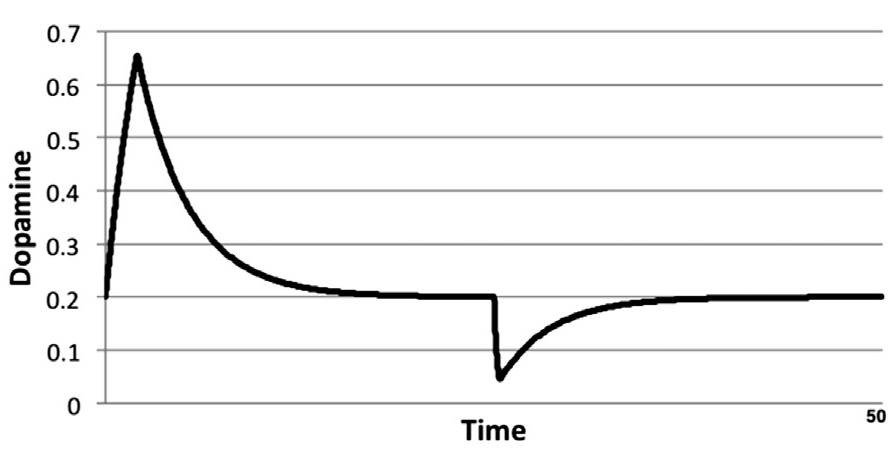
The authors simplified the complex differential equations of Gutkin et al. into a Hybrid Automaton. This model tracks two variables:
- D (Dopamine concentration): Spikes with stimuli, decays over time.
- M (Memory/Tolerance): Grows slowly as stimuli repeat, eventually counterbalancing and leading to a "crash" (withdrawal) when the stimulus stops.
2. The Network Topology
The model was tested across three main architectures:
- Random (ER): Nodes connected with a fixed probability.
- Scale-Free (BR & BA): Characterized by "hubs"—a few nodes with massive numbers of connections.
Communications are modeled using Probabilistic Hybrid Automata, where a user's "propensity factor" defines the likelihood of initiating or replying to a message.
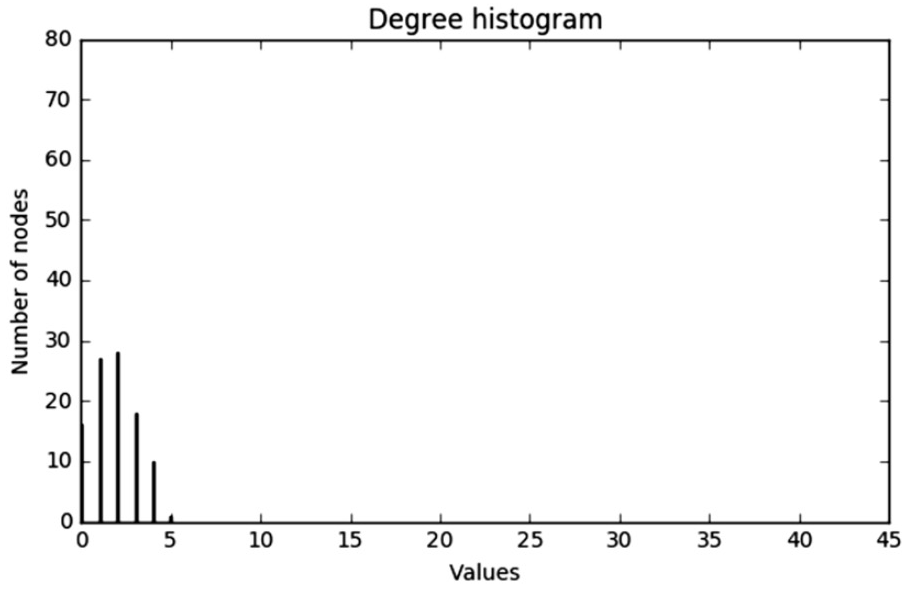 Left: Bollobás–Riordan (BR) Scale-free; Right: Barábasi–Albert (BA) Scale-free. Red nodes indicate addiction.
Experimental Insights: The Power of Hubs
Topology Matters
The results were striking: addiction spreads more efficiently in scale-free networks than in random ones. In a network of 100 nodes where all users had a low starting propensity (0.2), the BR scale-free model saw 52% of users become addicted, compared to only 38.2% in the random model.
The "Overdose" of Interaction
When the "propensity factor" of the hubs (the most connected users) was increased, the addiction rate across the entire network spiked. This confirms that a few hyper-active users can "infect" the system by constantly providing stimuli (responses/messages) to their neighbors, triggering the dopamine-memory feedback loop in others.
Dynamic Propensity and Social Sitters
The authors added a realistic layer: Dynamic Propensity. As users interact, their propensity to interact further increases—a digital imitation effect. To counter this, they introduced "Social Sitters"—a probability-based intervention that reduces a user's propensity once they reach a critical threshold of addiction.
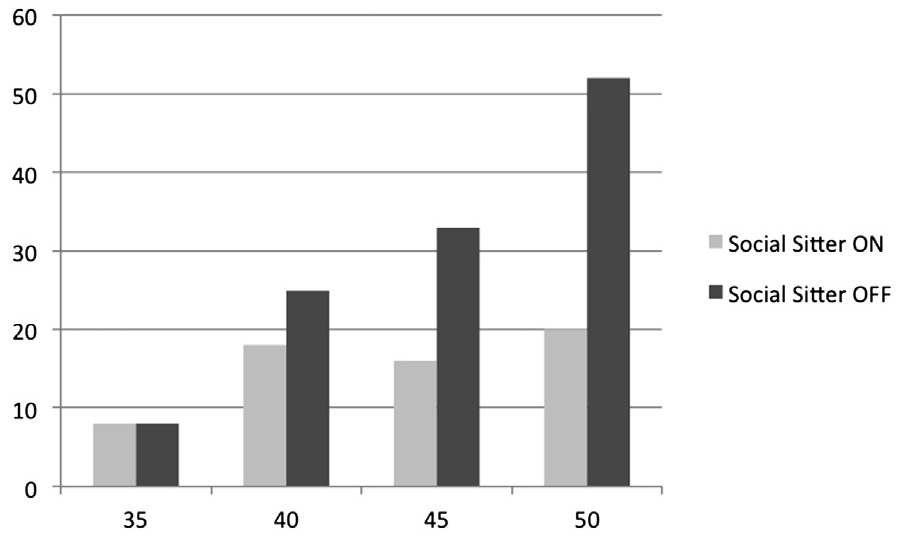 The graph shows the reduction in addicted nodes when social sitters are present.
Critical Analysis & Conclusion
The value of this paper lies in its formalism. By using Hybrid Automata, the authors provide a modular way to swap out different stimulus models (e.g., changing from text messages to "infinite scrolls") without rebuilding the core neural model.
Takeaways:
- Scale-free structures are a "favouring factor" for addiction. The very architecture that makes social media viral also makes it compulsive.
- Intervention works best at the hub level. If we can modulate the interaction frequency of highly connected individuals, the overall "dopamine load" of the network decreases.
Limitations: The model assumes a fixed "stimulus intensity" for all messages. In reality, the dopamine reward of a "Like" from a close friend vs. a stranger differs significantly. Future work incorporating weighted edges and non-deterministic stimuli could refine these findings further.