
Bridging the Geographical Gap: Hybrid Semantic Recommendation for the Traveling User
A Hybrid Collaborative Filtering System for Contextual Recommendations in Social Networks
The paper introduces a hybrid collaborative filtering (CF) system for context-aware recommendations in social networks, specifically targeting geographical context (e.g., travelers). By combining traditional user-based CF with a semantic-based (taxonomy-driven) approach, the system significantly improves recommendation availability when user profiles are uncorrelated across different cities.
TL;DR
When you travel to a new city, traditional recommendation systems often fail because you haven't rated anything there, and you don't "match" the locals. This paper introduces a hybrid collaborative filtering approach that uses a semantic taxonomy to "decontextualize" your tastes. By understanding that you like "Sushi" generally—not just one specific restaurant in Madrid—the system can find similar sushi-lovers in Tokyo and give you high-quality recommendations in a new context.
Problem & Motivation: The "Traveler's Blind Spot"
Standard Collaborative Filtering (CF) operates on a simple premise: if User A and User B liked the same movies in the past, they will likely agree in the future. But what happens when User A (from Madrid) travels to Beijing?
In local service networks like 11870.com, users rate specific local businesses. Because the traveler has never been to Beijing, they have zero items in common with Beijing locals. To the algorithm, the traveler is a "ghost"—a profile with no correlations, resulting in a total failure to provide recommendations. This is the Sparsity Problem intensified by geographical boundaries.
Methodology: The Power of Decontextualization
The authors solve this by breaking the recommendation process into two parallel pipelines coordinated by a Context Handler.
1. Dual-Branch Architecture
- The CF Branch: Standard Pearson correlation. Excellent for "inner-city" recommendations where data is dense.
- The Semantic Branch: This is the secret sauce. Instead of a User-Item matrix, it builds a Decontextualized User Profile (DUP) using a User-Category matrix. Items are mapped to a taxonomy (e.g., "Spanish Restaurant" -> "Category: Dining").
2. The Context-Aware Workflow
The system doesn't just recommend everything. It follows a rigorous process:
- Decontextualization: Abstracting item ratings into category scores.
- Matching: Finding "semantic neighbors" who share category interests.
- Contextual Filtering: Using an ontology-based reasoner (Block 4 in the diagram) to ensure the final list actually exists in the user's current destination.
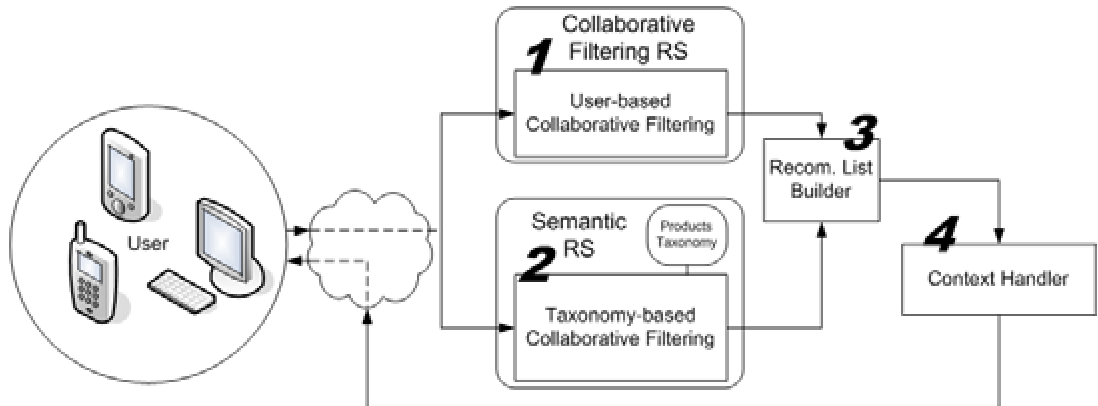 Figure 1: The recommendation process showing the parallel CF and Semantic branches.
Experiments: Real-World Impact
The system was tested on 11870.com, a social network where context is paramount.
The "Xiaomei" Case Study
In a controlled experiment with users across Madrid and Beijing, a user named "Xiaomei" had no product overlaps with others.
- Standard CF Result: 0 Recommendations.
- Hybrid Semantic Result: Successfully identified her interest in specific categories (via the taxonomy) and provided a curated list of recommendations in her new location.
Scalability on 11870.com
When testing with real-world data, the authors found that the taxonomy-based branch was far more "prolific." As the number of similar users (Top-M) considered increases, the semantic branch consistently finds more valid recommendations than the user-based branch, especially for international travelers.
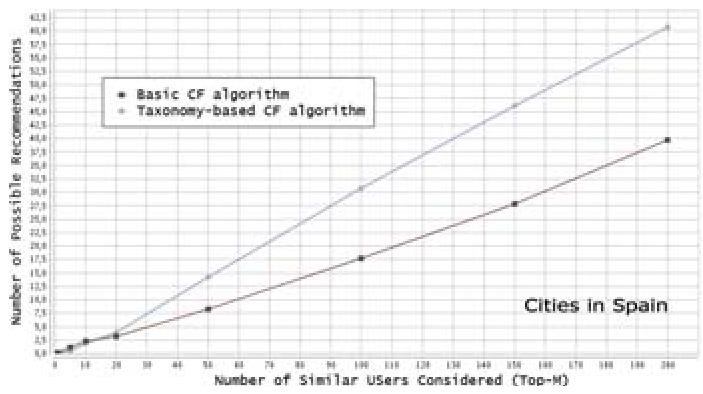 Figure 3: Comparison of the number of recommendations provided by the user-based vs. taxonomy-based CF. The taxonomy-based approach (Semantic) clearly dominates in providing options.
Critical Insight & Conclusion
The genius of this work lies in the Semantic Layer. By moving from Identity (this specific shop) to Description (this type of shop), the authors inject "Common Sense" into the recommendation engine.
Takeaway: For any product platform where users move between distinct clusters (geographical, departmental, or topical), a pure CF approach will eventually hit a "sparsity wall." Hybridizing with a semantic taxonomy is not just an "extra feature"—it is a necessity for maintaining utility in low-correlation scenarios.
Limitations: The system relies heavily on the quality of the taxonomy. If the taxonomy is too coarse (e.g., all restaurants are just labeled "Food"), the recommendations lose precision. If it is too fine, we return to the sparsity problem. Future work in this area now naturally gravitates toward using LLMs to automatically generate these taxonomies dynamically.