
HCARS-EHC: Redefining Private E-Health Recommendations via Merkle Trees and Evolutionary AI
Hybrid Context Aware Recommendation System for E-Health Care by merkle hash tree from cloud using evolutionary algorithm
The paper introduces HCARS-EHC (Hybrid Context Aware Recommendation System for E-Health Care), a framework combining cryptographic privacy with evolutionary algorithms and collaborative filtering. It utilizes a Merkle Hash Tree and Bilinear Pairing to allow patients to search encrypted medical reports and receive doctor recommendations while maintaining SOTA performance in computation speed.
Note: This article analyzes a retracted publication; the technical architecture remains a subject of study regarding its theoretical framework for secure healthcare recommendations.
TL;DR
The HCARS-EHC framework addresses the critical conflict between data privacy and personalized medical recommendations. By merging Merkle Hash Trees for secure indexing, Bilinear Pairing for encrypted searching, and Evolutionary Algorithms for optimization, the system achieves a significant reduction in latency. Specifically, it achieves a trapdoor generation time of just 6ms for 10k keywords while ensuring doctors' reports remain encrypted in the cloud.
Motivation: The Privacy-Efficiency Paradox
In the E-Health era, outsourcing patient reports to the cloud is a double-edged sword. While it enables mobility, storing sensitive data on untrusted servers requires encryption. Traditional searchable encryption methods face a "bottleneck":
- Search Latency: Conventional tree structures (Binary, B+, AVL) become slow as data scales.
- Metadata Leakage: Simply searching for a keyword can leak information to cloud providers.
- Static Recommendations: Most systems suggest doctors based on static ratings, ignoring the patient's dynamic context (e.g., urgency, specific satisfaction metrics).
Methodology: The Technical Core
1. Merkle Hash Tree Indexing
Unlike B-trees or Red-Black trees, the Merkle Hash Tree (MHT) provides logarithmic time complexity for integrity verification. Every leaf node represents a fragment of a report, and the parent nodes are hashes of their children. This ensures that any unauthorized modification to a patient's data immediately changes the root hash, making the system highly tamper-resistant.
2. Evolutionary Search Optimization
The paper employs an Evolutionary Algorithm to tackle complex optimization in the index generation phase. By using crossover and mutation operations, the system efficiently breeds "offspring" elements for the index, allowing it to adapt to new data entries without re-calculating the entire structure.
3. Encrypted Cloud Matching (The "Why" it Works)
The system utilizes Bilinear Pairing () to perform matches on encrypted data.
- Doctor's Keyword:
- Patient's Trapdoor: ,
The cloud verifies the match using the equation:
This allows the cloud to confirm a match without ever knowing the actual keyword or the doctor's private key.

Experiments and Metrics
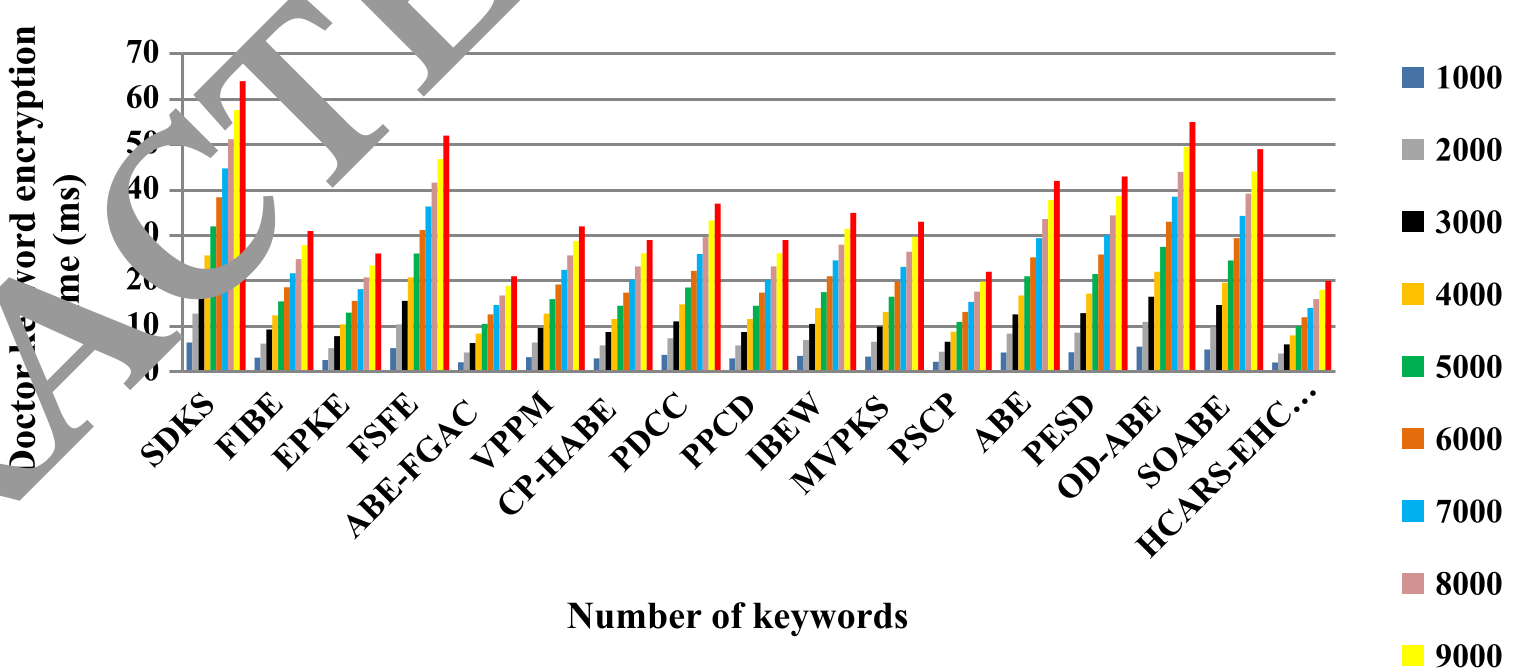
The authors benchmarked HCARS-EHC against 16 other protocols (including SDKS, FIBE, and CP-ABE).
Key Performance Wins:
- Trapdoor Generation: HCARS-EHC (6ms) vs. FIBE (63ms) for 10,000 keywords.
- Encryption Speed: Doctor keyword encryption was reduced to 20ms, making it suitable for real-time updates.
- Recommendation Accuracy: By using Mean Absolute Error (MAE) and RMSE, the hybrid collaborative filtering proved to align predicted doctor ratings (based on medicine satisfaction and fees) closely with true patient satisfaction.
Critical Analysis & Conclusion
Takeaway
The integration of computational intelligence (Evolutionary Algorithms) with cryptographic structures (Merkle Trees) is a potent recipe for E-Health. It moves the needle from "mathematically secure but unusable" to "secure and production-ready."
Limitations
Despite the impressive speed, the paper was retracted, which usually suggests issues with the peer-review process, data integrity, or overlapping content in the original publication. Theoretically, while the use of Merkle Trees is efficient, the Evolutionary Algorithm's overhead in dynamic high-frequency updates (e.g., thousands of new reports per second) could be a challenge.
Future Outlook
Future iterations should focus on implementing these protocols in decentralized hospital networks where no single authority manages the administration server, potentially integrating Blockchain for the root-hash ledger.