
Beyond the Screen: World of Warcraft and the Hybrid Cultural Ecology of China
A hybrid cultural ecology: world of warcra in China
This paper presents an ethnographic study of World of Warcraft (WoW) in China, defining the gaming experience as a "hybrid cultural ecology." It explores how collaborative play transcends the digital-physical divide, specifically focusing on the role of Internet cafés (wang ba) as vital social hubs.
TL;DR
Is a virtual world truly "virtual"? This seminal CSCW paper argues that in China, World of Warcraft (WoW) is not an escape from reality but a hybrid cultural ecology. By examining the wang ba (Internet café) culture, the researchers show how sociality, trust, and even political resistance are woven into a seamless fabric of digital pixels and physical smoke-filled rooms.
Breaking the "Cyberspace" Myth
For decades, the tech industry viewed "cyberspace" as a separate dimension—a "metaverse" where one leaves their physical self behind. This paper shatters that illusion. The authors argue that gaming in China is a "digital-physical assembly."
The researchers observed that players don't just "log in"; they sit in specific seats to be near mentors, they trade phone numbers to verify trust, and they interpret game-code changes (like the removal of skeletons) through the lens of national political "harmony." The problem with prior work was its focus on the tool rather than the ecology in which the tool lives.
Methodology: The Ethnography of the Wang Ba
The team conducted a multi-city ethnographic study in 2007, interviewing 80 gamers. They didn't just look at the game interface; they looked at the Infrastructure:
- The Wang Ba: Why play in a noisy café when you have a PC at home? For the "atmosphere," for relief from parental supervision, and for the high-speed bandwidth that shared apartments lacked.
- The Assembly: Interaction didn't stay within the game. It spanned QQ (Instant Messaging), mobile phone calls, and face-to-face negotiations over seating.
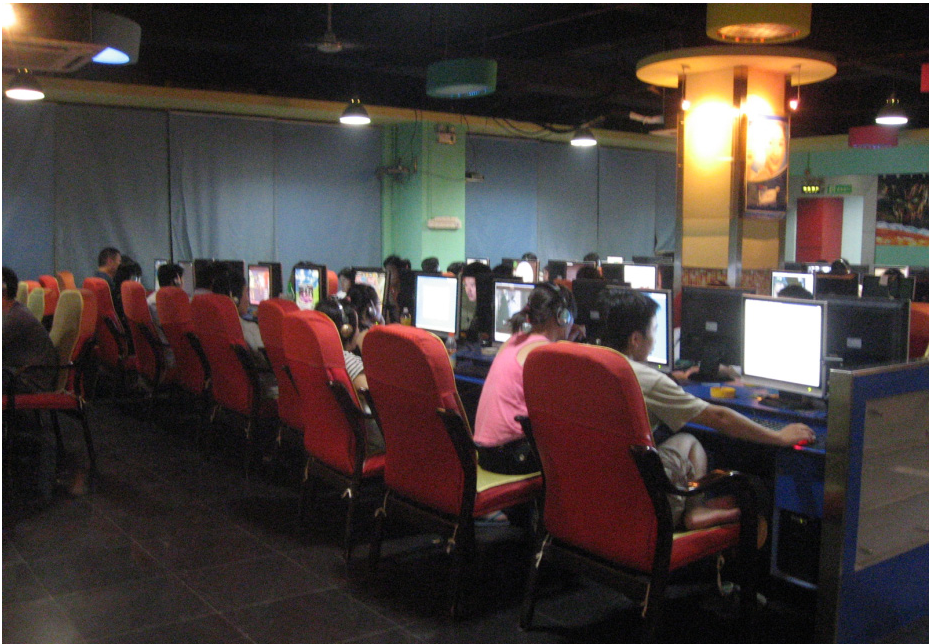 Figure: Players in a typical wang ba, representing the physical nodes of the hybrid ecology.
Key Insights: Trust, Learning, and "Harmony"
1. Collaborative Learning
In a wang ba, learning is spatial. Players intentionally sit next to high-level players to "peek" at their equipment and strategies. This physical proximity bypasses the social risk of asking "noob" questions in a formal guild chat.
2. Expressing Trust through "Seams"
How do you trust a stranger in a virtual world? The study found that Chinese players bridged the digital-physical "seams" by:
- Exchanging Account ID's: A massive sign of trust, allowing another to inhabit your digital identity.
- Face-to-Face Transactions: Preferring to buy "point cards" from a café owner they know personally rather than a faceless telephone company.
3. The Socio-Political Hybrid
One of the most striking findings involves the Chinese government's "Harmony" campaign, which forced the "fleshing out" of skeletons in WoW.
- Design as Discourse: Players didn't just see a missing skeleton; they saw a visible "seam" of government intervention.
- Political Reflection: The game became a playground for political critique, where players used the changed graphics as a jumping-off point to discuss state censorship.
 Figure: The juxtaposition of leisure (wang ba) and service (foot massage) at a train station highlights the integrated nature of these spaces.
Critical Analysis & Conclusion
This paper is a masterclass in Value-First research. It reminds us that technology is never neutral; it is always "domesticated" by the culture it enters.
The Takeaway: As we move toward a world of "Mixed Reality" and "Ubiquitous Computing," we must stop designing for a "user and a screen" and start designing for the Ecology.
Limitations: The study is a snapshot of 2008 China. The rise of mobile gaming (WeChat/TikTok era) has likely shifted the "wang ba" from a necessity to a specialized luxury. However, the core insight—that the digital and physical are two sides of the same coin—remains the gold standard for understanding global tech adoption.