
CNN–ELM: Fusing Deep Feature Extraction with Fast Extreme Learning for Biometrics
14254_A hybrid deep learning CNN-ELM for age and gender classification.
This paper introduces CNN–ELM, a hybrid deep learning architecture that combines Convolutional Neural Networks (CNN) for feature extraction with an Extreme Learning Machine (ELM) for classification. The approach achieves state-of-the-art results in age and gender classification on the MORPH-II and Adience Benchmark datasets.
TL;DR
Predicting age and gender from "in-the-wild" facial images is notoriously difficult due to lighting, blurs, and varied expressions. This paper presents CNN–ELM, a hybrid model that utilizes a Convolutional Neural Network (CNN) to "see" features and an Extreme Learning Machine (ELM) to "decide" the class. This synergy results in faster training and superior accuracy on benchmark datasets like MORPH-II and Adience.
Problem & Motivation: The High Cost of Decision-Making
While CNNs excel at extracting hierarchical features (edges, textures, facial components), their final decision layers—usually fully-connected layers trained via Back-Propagation (BP)—often suffer from two issues:
- Slow Convergence: BP requires many iterations to fine-tune high-level weights.
- Local Minima: The optimization can get stuck, leading to sub-optimal generalization.
The authors observed that while the "feature extraction" part of a CNN is essential, the "classification" part could be replaced by something more efficient. They turned to Extreme Learning Machine (ELM), a single-hidden-layer feedforward neural network known for its extremely fast learning speed and good generalization.
Methodology: The Hybrid Architecture
The proposed CNN–ELM architecture splits the task into two distinct phases:
- Feature Extraction (The CNN Core): The model uses multiple convolutional layers, contrast normalization, and max-pooling. These layers are trained to reduce the error through standard stochastic gradient descent until the features are sufficiently discriminative.
- Fast Classification (The ELM Head): Once features are extracted, they are passed as 1-D vectors into the ELM. Unlike traditional layers, the ELM's input weights are randomly assigned, and its output weights are calculated analytically using the Moore-Penrose generalized inverse.
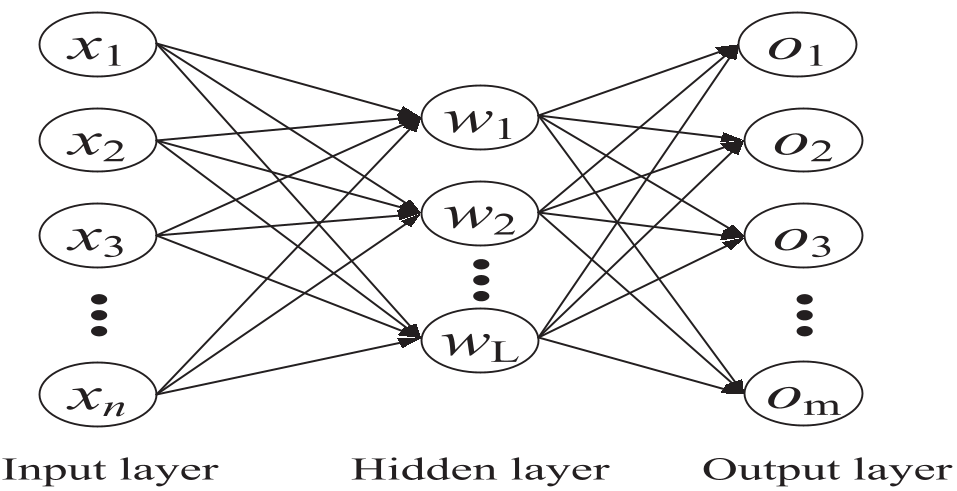
Why This Works
By utilizing the ELM as the final classifier, the network avoids the "over-training" risk of deep fully-connected layers. The ELM provides a "closed-form" solution for the output layer, which significantly accelerates the final stage of training.
Experiments & Results
The authors validated their model on Two major datasets: Adience Benchmark (unfiltered, real-world photos) and MORPH-II (large-scale controlled database).
Performance Highlights:
- Age Classification (Adience): The CNN-ELM reached an accuracy of 52.3%, surpassing standard CNN approaches.
- Age Estimation (MORPH-II): Achieved a Mean Absolute Error (MAE) of 3.44, which is a notable improvement over the plain CNN baseline (3.81).
- Gender Classification: Reached an impressive 88.2% accuracy on the Adience dataset.
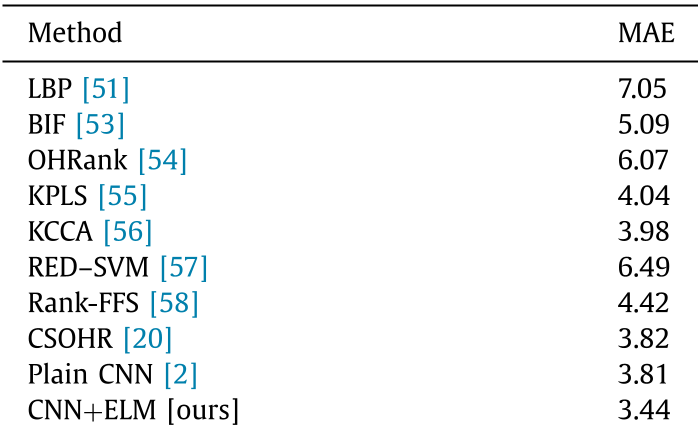
The study also explored the impact of the number of hidden nodes in the ELM. The research found that around 3500-4000 nodes provided the optimal balance; exceeding this caused overfitting, where accuracy began to degrade.
Critical Analysis & Conclusion
The CNN–ELM demonstrate that we don't always need "end-to-end" BP to achieve SOTA results. By combining the strong inductive bias of CNNs for images with the mathematical efficiency of ELM for classification, the authors created a model that is both faster to train and more accurate.
Limitations
- Memory Usage: ELM requires storing large intermediate matrices (Hidden layer output matrix H) to calculate the generalized inverse, which can be memory-intensive for extremely large datasets.
- Sensitivity: The random initialization of ELM input weights means that multiple runs might be needed to find the optimal average performance.
Future Prospect
This hybrid approach opens doors for real-time biometric systems on edge devices, where the high-speed inference of an ELM head can be combined with lightweight CNN backbones (like MobileNet) to provide robust, on-device intelligence.
Takeaway: The synergy of CNN and ELM effectively mitigates the local minima problem of traditional back-propagation, providing a fast and highly accurate pipeline for unconstrained face analysis.