
CNN–ELM: A Hybrid Approach to Robust Age and Gender Classification
A hybrid deep learning CNN–ELM for age and gender classification
This paper introduces CNN–ELM, a hybrid deep learning architecture for age and gender classification. By replacing the traditional Softmax/Fully-Connected layers of a CNN with an Extreme Learning Machine (ELM) classifier, the model achieves state-of-the-art performance on the Adience and MORPH-II datasets.
Executive Summary
Age and gender classification from facial images are cornerstone tasks for human-computer interaction and surveillance. However, real-world "in-the-wild" images pose significant challenges due to occlusions, poor resolution, and complex lighting. This paper presents CNN-ELM, a hybrid architecture that leverages the powerful representation capabilities of Convolutional Neural Networks (CNN) and the rapid, robust classification of Extreme Learning Machines (ELM). By fundamentally changing how the network "decides" on the final class, the authors achieve superior accuracy and faster convergence than standard CNNs.
The Bottleneck of Standard CNNs
While CNNs excel at extracting hierarchical features (from edges to semantic face parts), their classification head—usually a series of fully connected layers followed by a Softmax—often becomes a bottleneck. These layers are prone to:
- Overfitting: Especially when training data is noisy or limited.
- Slow Convergence: Back-propagation through the entire network for every iteration is computationally expensive.
- Local Minima: The optimization landscape of deep fully connected layers is notoriously difficult to navigate.
The authors' key insight was to treat the CNN as a "frozen" feature extractor once a certain accuracy threshold is reached, and then utilize an ELM to find the optimal global solution for classification analytically.
Methodology: Synergy of Feature and Speed
The architecture consists of two primary stages:
- CNN Feature Extraction: Two layers of convolution, followed by Contrast Normalization and Max-Pooling. This stage transforms the 227x227 input image into high-level, discriminative 1-D feature vectors.
- ELM Classification: Instead of a standard BP-trained layer, the 1-D vectors are fed into an ELM. The ELM randomly assigns input weights and biases and calculates the output weights () using the Moore-Penrose generalized inverse.

The Adaptive Training Process
Unlike static hybrid models, this system uses a threshold-based activation. The network initially tunes the CNN layers via standard Back-Propagation. Once the training accuracy reaches a critical threshold (e.g., 70%), the ELM classifier is invoked to finalize the mapping, ensuring that the features are sufficiently mature before the ELM builds the decision boundary.
Experimental Results
The authors evaluated the hybrid model on the Adience Benchmark (unfiltered, real-world photos) and the MORPH-II dataset.
Age Estimation: A New SOTA
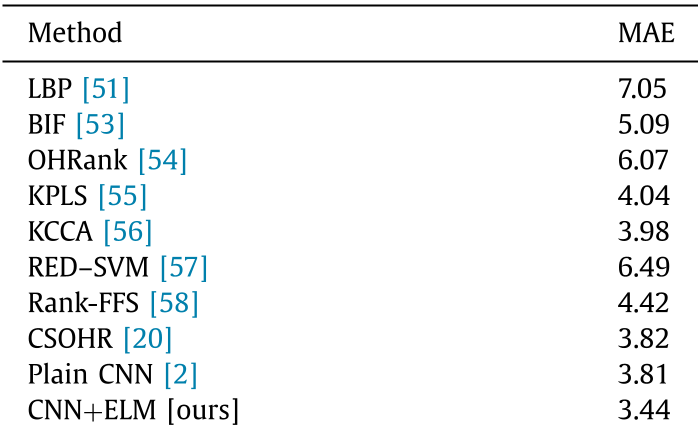
On the MORPH-II dataset, the Mean Absolute Error (MAE) is the gold standard metric. The hybrid CNN-ELM achieved a remarkable MAE of 3.44, significantly lower than the baseline CNN (3.81) and specialized ranking approaches like CSOHR (3.82).
Gender Classification
Gender classification is treated as a binary task. On the challenging Adience dataset, the model achieved 88.2% accuracy when combined with a 0.7 Dropout ratio, proving that the hybrid structure is highly resistant to the noise inherent in "in-the-wild" datasets.
Critical Analysis & Takeaways
The success of CNN-ELM lies in the synergy of Inductive Bias and Analytical Optimization. The CNN provides the necessary inductive bias to handle spatial hierarchies in faces, while the ELM provides a closed-form solution for the final classification, which acts as a regularizer against the over-fitting often seen in deep fully-connected layers.
Key Strengths:
- Reduced Complexity: The ELM stage requires no iterative tuning for its specific parameters.
- Robustness: Superior performance on unconstrained images.
Limitations:
- Memory Overhead: Calculating the Moore-Penrose inverse () can be memory-intensive as the number of hidden nodes increases (optimized at 3500-4000 nodes in this study).
- Two-Stage Dependence: The quality of the ELM classification is still strictly capped by the quality of features extracted by the initial CNN layers.
Conclusion
This work demonstrates that "deep learning" doesn't have to mean "end-to-end back-propagation." By strategically integrating Extreme Learning Machines, researchers can create models that are not only more accurate but also reach optimal performance faster. For practitioners working on edge-device biometrics or real-time surveillance, the CNN-ELM framework offers a compelling alternative to traditional heavy-weight architectures.