
Decoding the Digital Soul: A Hybrid CNN+LSTM Approach to Personality Classification
A Hybrid Deep Learning Technique for Personality Trait Classification From Text
The paper introduces a hybrid deep learning model, CNN+LSTM, designed for personality trait classification using textual data from social media. It specifically targets the four dimensions of the Myers-Briggs Type Indicator (MBTI) and achieves state-of-the-art performance by combining local feature extraction with long-term dependency modeling.
TL;DR
Researchers have developed a hybrid deep learning architecture, CNN+LSTM, that pushes the boundaries of automated personality detection. By processing MBTI traits from social media text, the model achieves up to 91% accuracy, outperforming both traditional machine learning and individual neural network components by capturing the subtle interplay between local word choices and long-term context.
The Challenge: Why Personality is Hard to "Read"
Detecting personality from text isn't just about counting keywords; it's about understanding flow and intent. Traditional methods use a "Bag-of-Words" approach, which effectively treats a sentence like a blender treats a salad—all the ingredients are there, but the structure is gone.
The authors identified two major technical gaps in previous SOTA works:
- Structural Blindness: Conventional ML ignores the sequence of words.
- Memory Decay: Standalone CNNs are great at spotting "local" patterns (like phrases) but "forget" the beginning of a sentence by the time they reach the end.
Methodology: The Fusion of Perception and Memory
The proposed solution is a two-stage hybrid pipeline that mimics a more human-like reading process.
1. The Tactical Scanner (CNN)
The Convolutional Neural Network (CNN) layer serves as the "eyes." It slides filters across the text to pick up on specific linguistic markers and local feature maps. Through Max-Pooling, the model discards noise and keeps only the most salient signals.
2. The Contextual Engine (LSTM)
Once the CNN identifies what is being said locally, the Long Short-Term Memory (LSTM) layer figures out how it fits into the broader narrative. By using "Gates" (Forget, Input, and Output), the LSTM preserves critical context from the start of the post, allowing the model to understand complex personality cues that span across multiple clauses.
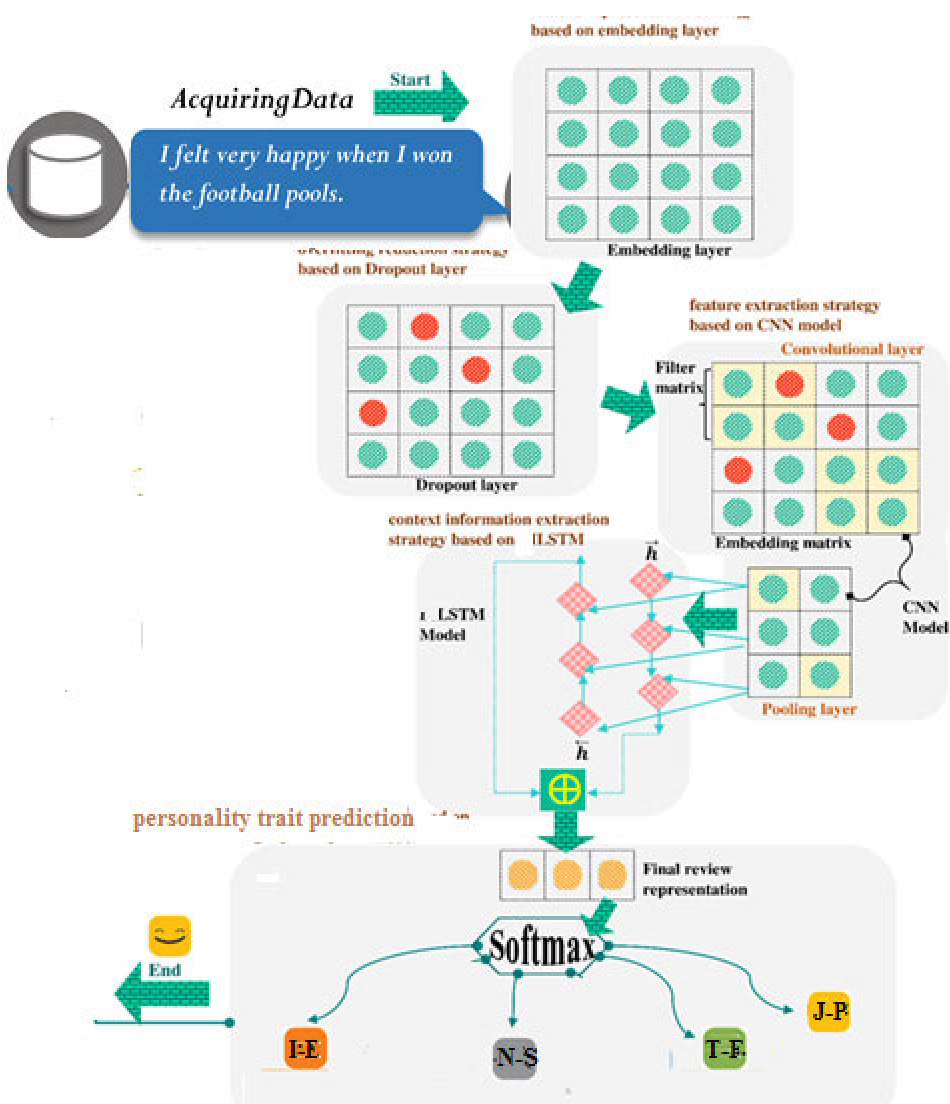 Figure 1: The detailed structure of the CNN+LSTM model showing the flow from word embeddings to the final softmax classification.
Experimental Results: Breaking the Benchmarks
The model was tested on the MBTI (Myers-Briggs Type Indicator) dataset. The results were not just an incremental improvement; they were a significant leap over classical classifiers like SVM and XGBoost.
| Personality Trait | Accuracy | Precision |
|---|---|---|
| Intuition-Sensing (N-S) | 91% | 91% |
| Introversion-Extroversion (I-E) | 88% | 88% |
| Thinking-Feeling (T-F) | 85% | 85% |
| Judging-Perceiving (J-P) | 80% | 80% |
The study utilized McNemar’s Significance Test to prove that these gains were statistically significant and not just a result of lucky data partitioning.
 Figure 2: Performance comparison table highlighting the superiority of the hybrid model over traditional ML baselines.
Critical Insight: The "Why" Behind the Success
Why does this hybrid work so well?
- Automated Feature Engineering: Unlike old-school SVMs that require manual lexicon building, the CNN+LSTM learns which words matter through training.
- Deltas in Data Sparsity: By using continuous Word Embeddings instead of one-hot encoding, the model understands that "Sunday" and "Monday" are semantically related, helping it generalize better on smaller datasets.
Future Outlook and Limitations
While the results are impressive, the authors note several frontiers yet to be crossed:
- Language Barrier: The current study is limited to English.
- Static Embeddings: The use of random initializations for embeddings could be replaced by pre-trained models like GloVe or BERT for even higher precision.
- Attention Mechanisms: Future iterations could benefit from self-attention to weight specific emotional "bursts" in a text more heavily.
Conclusion
This hybrid deep learning technique marks a significant milestone in Cognitive-based Sentiment Analysis. By moving away from "word counting" and toward "contextual understanding," it provides organizations with a robust tool for everything from recruitment optimization to high-resolution customer behavior modeling.