
HEDM: Elevating Student Performance Evaluation through Hybrid Data Mining
Towards developing hybrid educational data mining model (HEDM) for efficient and accurate student performance evaluation
This paper introduces the Hybrid Educational Data Mining (HEDM) model, a two-stage classification framework designed to assess and categorize student academic performance. By sequentially combining Naive Bayes and J48 Decision Tree classifiers, the model achieves a high classification accuracy of 98.6%, significantly outperforming standard baselines like SVM and ANN.
Executive Summary
TL;DR: The "Towards developing hybrid educational data mining model (HEDM)" paper presents a robust framework that merges the probabilistic strengths of Naive Bayes with the hierarchical precision of the J48 algorithm. This synergy allows educational institutions to not only predict passing rates but to granularly categorize student potential with a remarkable 98.6% accuracy.
In the landscape of Educational Data Mining (EDM), this work positions itself as a high-performance optimization of classical machine learning workflows, shifting the focus from simple binary prediction to multi-tier quality assessment.
Problem & Motivation: Beyond the Test Score
Predicting academic success is notoriously difficult because a student's performance isn't just a product of exam scores—it is a complex derivative of attendance, library usage, class participation, and socio-economic background.
The authors identified that existing SOTA (State-of-the-Art) models like SVM or Neural Networks often overfit on small educational datasets or fail to provide interpretable "rules" that teachers can actually use. The motivation was clear: build a model that is both highly accurate and operationally transparent.
Methodology: The Power of Hybridization
The core innovation of HEDM lies in its two-stage logical pipeline:
Stage 1: Probabilistic Filtering (Naive Bayes)
The model first applies Naive Bayes to handle the initial uncertainty of the dataset. It calculates the probability of a student falling into the 'Pass' or 'Fail' category. This stage acts as a high-speed filter, identifying students who need immediate, intensive support (the 'Fail' group) before deeper analysis.
Stage 2: Hierarchical Refinement (J48 Classifier)
Students who pass the initial filter are then processed by the J48 algorithm (a Java implementation of the C4.5 decision tree). By calculating the Gain Ratio and applying Pruning, the J48 stage identifies the most significant specific attributes (like Seminar performance or Attendance) to sort students into four distinct tiers:
- Excellent (Top Performers)
- Good
- Average
- Low (Passed, but underachieving)
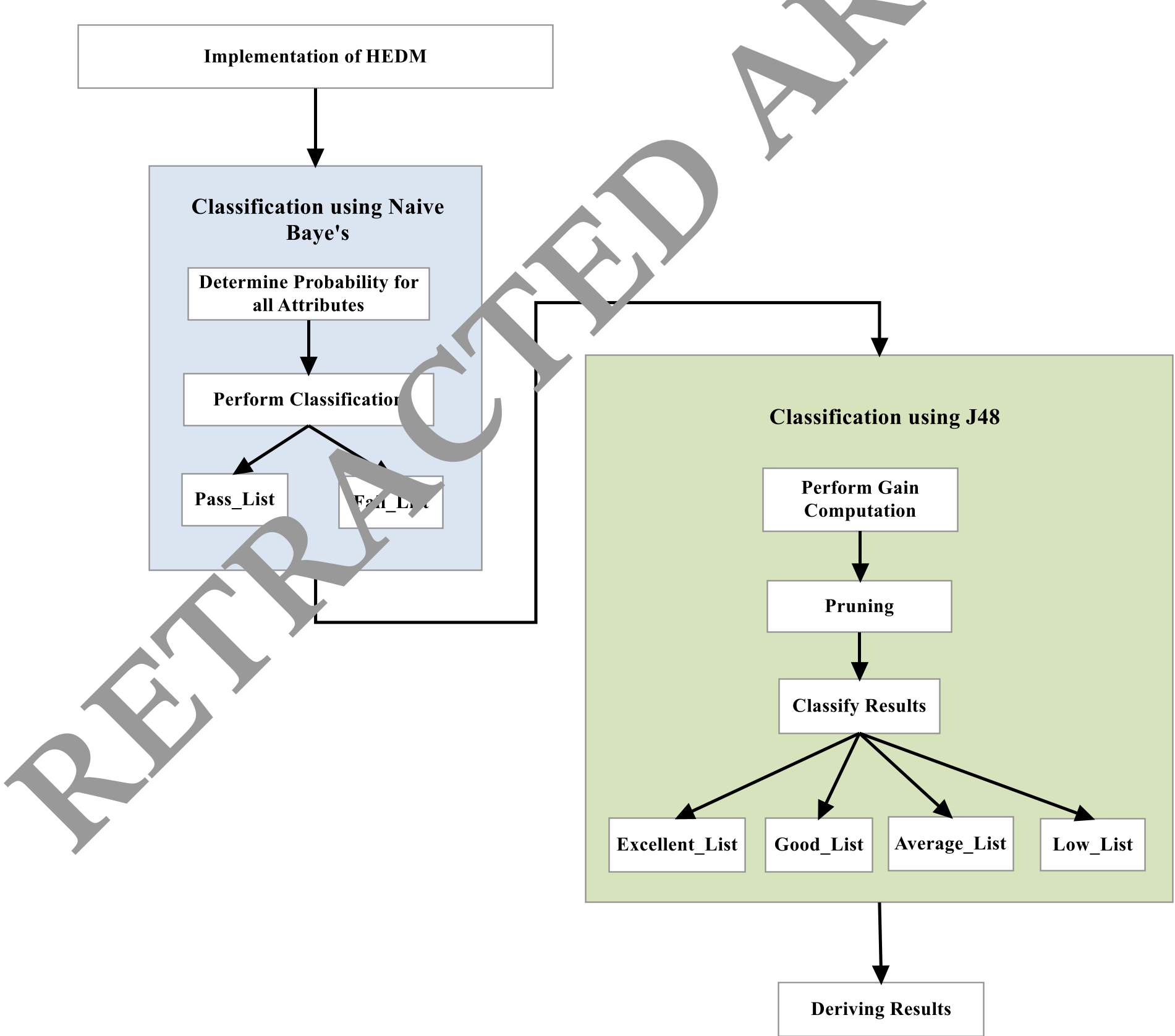 The dual-stage classification logic of the HEDM model.
Experiments & Results
The authors tested HEDM against Artificial Neural Networks (ANN), Multi-Layer Perceptrons (MLP), and Support Vector Machines (SVM) using the WEKA benchmark environment.
Key Metrics Comparison:
- Accuracy: HEDM achieved 98.6%, outperforming SVM (92.1%) and ANN/MLP significantly.
- Error Rate: The hybrid model reduced the average error rate to 0.6, proving its stability across different student profiles.
- Precision and Recall: With a Precision of 0.983 and an F-measure of 0.963, the model demonstrated an exceptional ability to minimize both False Positives and False Negatives.
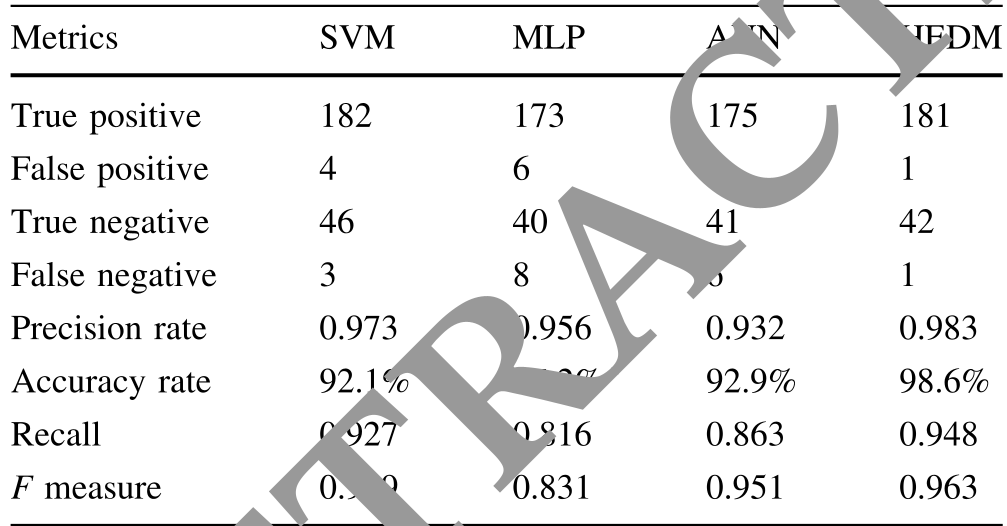 Comparative analysis showing HEDM (referred to as TFDM/Targeted Framework in results) vs. traditional classifiers.
Critical Insight: Why It Works
The "secret sauce" of this paper is the Information Gain calculation used in the J48 stage. While Naive Bayes provides a broad probabilistic baseline, the Entropy-based decision tree structure focuses on the "Inherent Information" of specific behavioral markers. By pruning the tree, the authors removed the "noise" (like irrelevant demographic data), allowing the model to focus on what truly drives academic success.
Conclusion & Future Outlook
The HEDM model provides a clear blueprint for "Precision Education." By identifying the specific nature of a student's performance early, institutions can move from reactive grading to proactive mentoring.
Limitations: The model currently relies on static historical data. The next frontier for this research lies in Association Rule Mining—discovering hidden patterns between disparate factors (e.g., how library visit frequency correlates with seminar presentation skills).
Future iterations could also benefit from Ensemble methods like Random Forests or Boosting to further harden the model against the variance found in larger, multi-national educational datasets.