
Hybrid Emotion Detection: Bridging Theoretical Models and Machine Learning
A Hybrid Approach at Emotional State Detection: Merging Theoretical Models of Emotion with Data-Driven Statistical Classifiers
The paper introduces a hybrid, two-layer framework for emotional state detection (Arousal and Valence) in interactive environments like video games. By combining participant-specific regression models with machine learning classifiers (Neural Networks, Random Forests), the system achieves up to 97% accuracy for Arousal and 91% for Valence using skin conductance, heart rate, and facial EMG.
TL;DR
Researchers have developed a robust, two-layer hybrid system designed to detect emotional states in real-time during interactive media like video games. By using participant-specific regression to handle physiological differences and machine learning to fuse the results, the system achieved staggering accuracies: 97% for Arousal and 91% for Valence.
Background: The "Personal Activation" Problem
The field of Affective Computing has long struggled with a core truth: my "calm" is not your "calm." Our heart rates and skin conductance levels react to stress and joy in unique rhythms. Most systems try to fix this with simple normalization, but this assumes everyone hits the same emotional peaks. If you don't scream at a horror game, the old models assume you aren't scared.
The authors of this paper argue that we need a system that balances interpretability (the physics of the body) with generalization (the power of ML).
Methodology: The Two-Layer Architecture
The core innovation lies in a split-brain approach to data processing.
Layer 1: The Personal Calibrator (Regression)
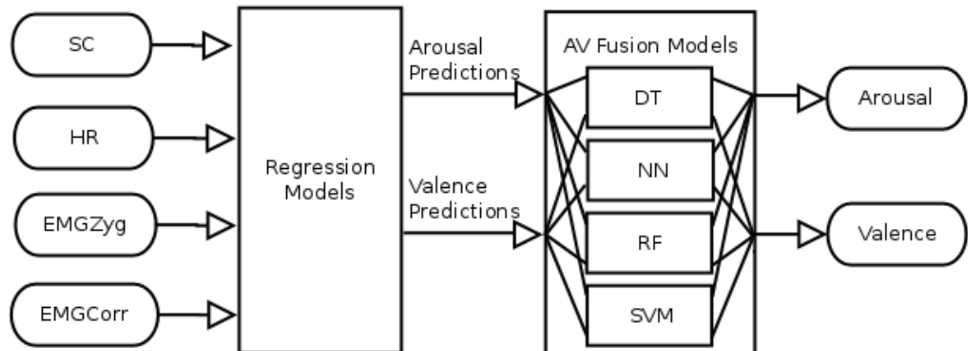
Instead of dumping raw sensor data into an AI, the authors use Linear and 3rd-degree Polynomial Regression. Each participant gets their own "activation function" that maps:
- Skin Conductance (SC) → Arousal
- Heart Rate (HR) → Valence/Arousal
- Facial EMG (Cheek/Brow) → Valence
Layer 2: The Fusion Engine (Machine Learning)
Once the data is "scaled" by the regression layer, it becomes participant-independent. This clean, regressed data is fed into a Neural Network (NN) or Random Forest (RF). The ML's job isn't to learn the person, but to learn how to weight the different sensors based on their inherent error margins.
Experimental Rigor: From IAPS to Slenderman
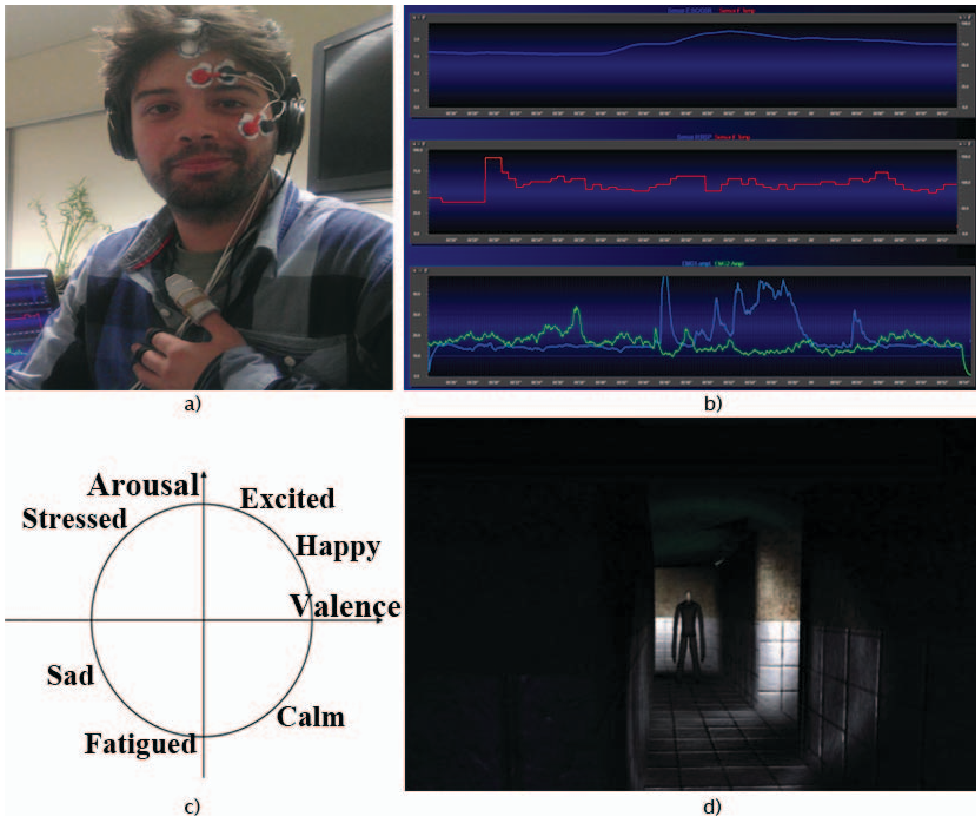
To train this system, the researchers didn't just show people photos. They created a spectrum of elicitation:
- Relaxing Music: To find the physiological baseline.
- IAPS Images: Standardized "mild" emotional triggers.
- Slenderman (Horror Game): To trigger extreme spikes in Arousal and negative Valence.
Key Results & Findings
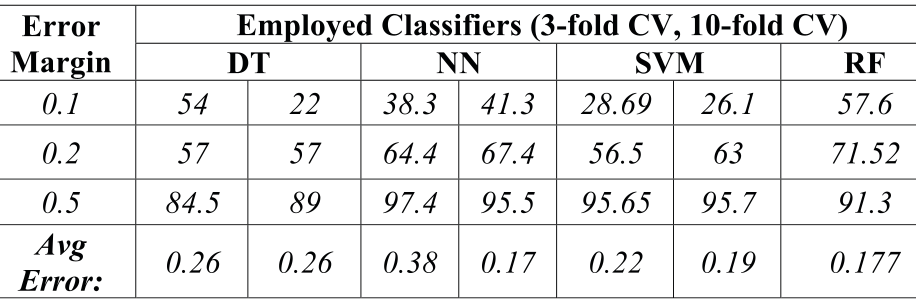
- Unrivaled Accuracy: As seen in the tables below, using a Neural Network with a 0.5 error margin (on a -5 to 5 scale) yielded 97.4% for Arousal.
- The HR Valence Paradox: The authors found that Heart Rate is a great predictor of Valence during high-stakes gameplay, but almost useless for static image viewing. This proves that "Context is King" in affective computing.
- Non-Linearity Matters: While Skin Conductance correlates linearly with Arousal, almost every other metric follows a polynomial curve, justifying the use of complex regression in Layer 1.
Academic Insight & Future Outlook
This paper serves as a vital bridge. It validates the Theoretical Models (Arousal/Valence) while utilizing the power of Statistical Classifiers.
The Takeaway? You can't skip the "Bio" in Biometrics. By respecting the individual physiological activation functions through regression, we can build ML models that work for everyone. The next frontier will be moving this from "wired" sensors to "wearable" tech, enabling games that adapt their narrative in real-time based on your literal heartbeat.
Limitations
- The sample size (12 final participants) is small.
- The "Black Box" nature of the Layer 2 NN makes it hard to reverse-engineer exactly which physiological triggers are driving the final score.