
Hybrid Filtering in Telegram: Bridging the Gap Between Messaging and Social Discovery
User recommendation based on Hybrid filtering in Telegram messenger
The paper introduces a hybrid filtering recommendation system for Telegram users by integrating a User Membership Graph with content-based profiles. It achieves target audience identification at scale, utilizing a massive dataset of 120 million users and 900,000 supergroups, focusing on minimizing RMSE in specialized group contexts.
TL;DR
This study presents a robust hybrid recommendation framework for Telegram, a platform historically lacking user-discovery features. By combining Collaborative Filtering (via a Membership Graph of users and groups) and Content-Based Filtering (using NLP on group metadata), the authors provide a scalable way to identify target audiences across 120 million users.
Positioning: This work serves as a practical implementation for large-scale targeted marketing in private/hybrid messenger ecosystems, moving beyond simple ID searching toward interest-based discovery.
Problem & Motivation: The "Dark Social" Discovery Challenge
While Telegram boasts over 400 million users, it operates largely as a "dark social" platform—users are siloed within their contacts or known groups. For marketers and researchers, this is a significant barrier.
The challenge lies in the nature of the data:
- Lack of Explicit Ratings: Unlike Netflix or Amazon, users don't "rate" groups; they either join or leave.
- Sparse Profiles: Individual user profiles contain minimal public data compared to platforms like LinkedIn or Instagram.
- Subject Noisy: Group names and descriptions are often riddled with non-standard characters, spam, and multi-lingual slang (Persian/English).
The authors’ core insight is that group membership is an implicit proxy for user interest. If we can find similar groups through a mix of user overlap and semantic similarity, we can find relevant users.
Methodology: The Offline-Online Architecture
The system operates in two distinct phases to ensure scalability and real-time performance.
1. The Offline Phase: Building the Knowledge Base
- Membership Graph: A bipartite graph linking ~120M users to ~900k supergroups.
- Sack of Words: A refined dictionary for each group. The authors applied heavy NLP preprocessing, including stemming, spell-checking (e.g., "sssaaalllaaammm" to "salam"), and removing messenger-specific noise like "telephone" or "chat."
2. The Online Phase: Hybrid Retrieval
When a user or a set of users is provided, the system:
- Identifies a list of groups (MG) with the most common members.
- Iteratively merges the keywords from these top groups (Combinations 1 through N).
- Retrieves new groups from the "Sack of Words" that match this expanded keyword profile.
- Extracts members from these newly discovered groups.
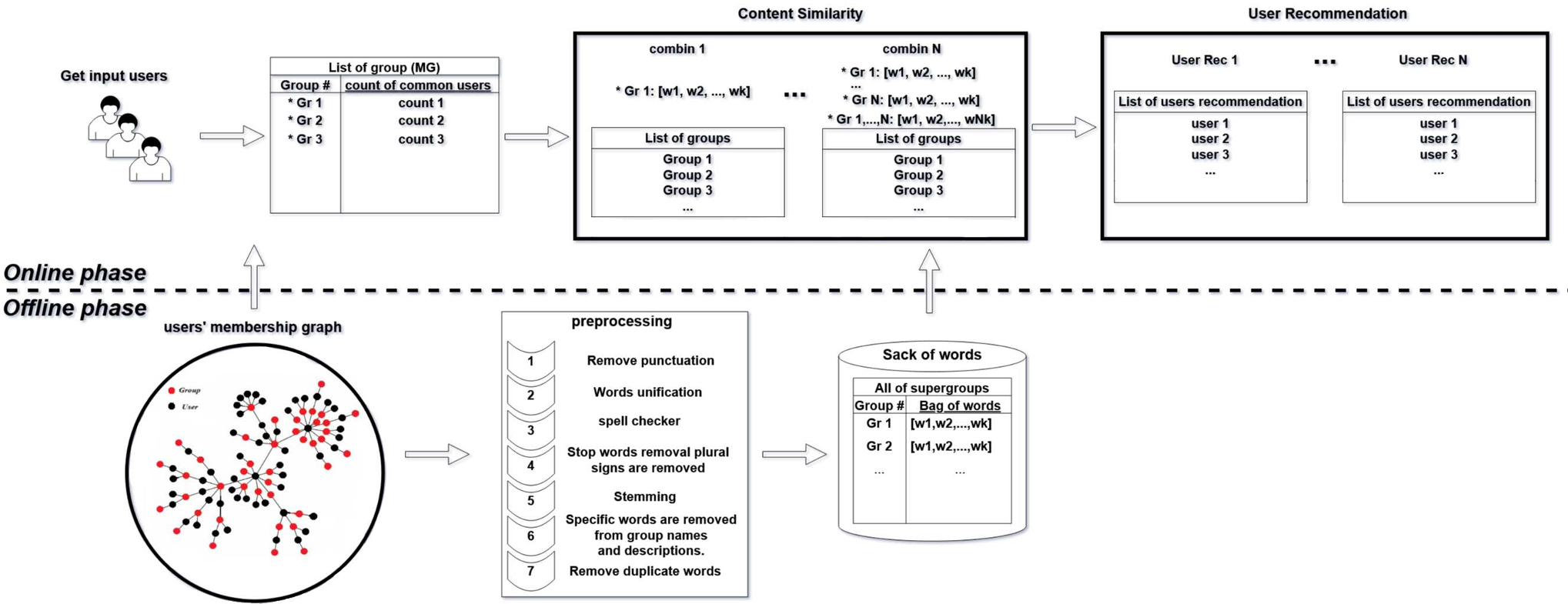 Fig 1: The dual-phase workflow integrating graph-based and content-based logic.
Experiments & Results: The "Goldilocks" Keyword Limit
The study evaluated the model using two categories of specialized supergroups (2,000–10,000 members each). The goal was to "predict" the remaining 20% of a group's members based on an 80% input.
Key Findings:
- Optimal Combination: The "Combine 4" approach (merging keywords of the top 4 groups) consistently yielded the lowest RMSE (Root-Mean-Square Error).
- The Decay of Relevance: There is a clear "U-shaped" or oscillating error curve. As shown in Figure 2, enlarging the "bag of words" to include 20 groups causes the RMSE to spike.
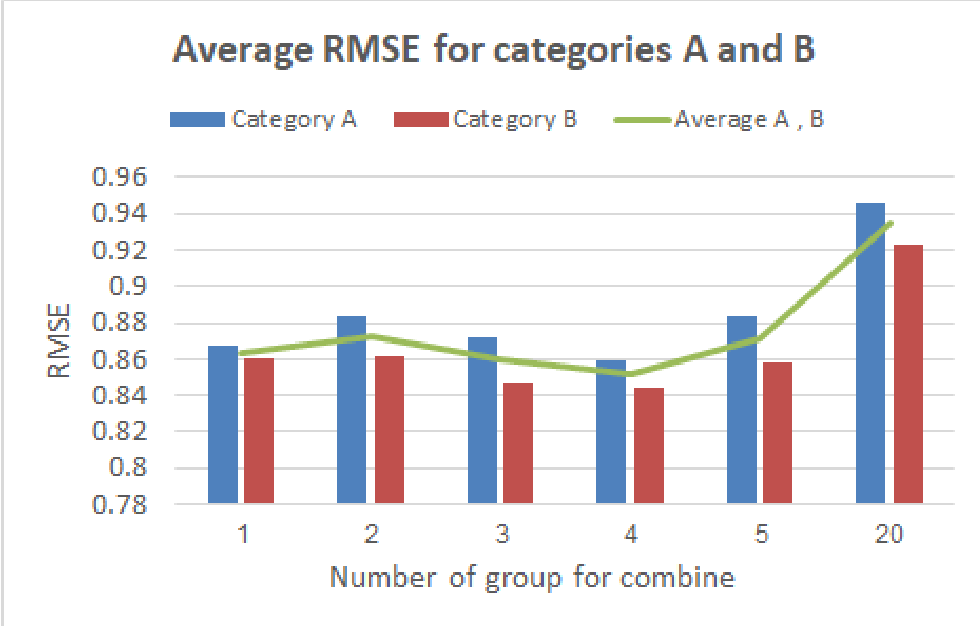 Fig 2: Mean RMSE across Categories A and B. Note how the error trend begins to rise significantly after the 4-group threshold.
The data suggests that merging 1 to 4 groups captures the "essence" of a topic, but beyond that, the inclusion of "noisy" or "annoying" words (as the authors call them) pollutes the query, leading the recommender toward unrelated users.
Critical Analysis & Conclusion
Takeaway
The study successfully demonstrates that a hybrid graph-text approach can overcome the data scarcity of instant messengers. The use of the Idekav system to crawl such a massive dataset (120M users) provides a rare glimpse into the structural dynamics of Telegram's supergroups.
Limitations
- Semantic Depth: The "Bag of Words" approach is a classic vector space model. Modern techniques like Word2Vec or Transformers (BERT/LLMs) could potentially capture semantic similarity better than raw keyword matching.
- Dynamic Interests: The model treats membership as a static state, whereas user interests in messengers evolve rapidly.
Future Outlook
The authors suggest moving beyond group profiles to analyze user message content directly. Incorporating temporal dynamics—how long a user stays in a group or their activity level—would likely push the RMSE even lower, turning Telegram from a simple chat app into a highly targeted social discovery engine.