
Bridging the Heritage Gap: A Hybrid Human-Machine Intelligence for Cultural Data
Hybrid Human-Machine Classification System for Cultural Heritage Data
The paper introduces a hybrid human-machine framework for the multi-label classification of cultural heritage data. It integrates a deep multi-input model (combining visual and semantic textual features) with crowd-sourced judgments to achieve SOTA-level metadata enrichment for historical collections.
TL;DR
Cultural heritage organizations face a massive metadata crisis: millions of digitized items remain "invisible" due to poor tagging. This paper presents a hybrid framework that fuses Deep Transfer Learning (enriched with DBpedia semantics) and Crowdsourcing (backed by reliability-weighted aggregation). The result is a robust system that achieves 65% accuracy—surpassing individual machine or human efforts—by letting algorithms handle scale and humans handle nuance.
Background: The Metadata Bottleneck
In the world of GLAM (Galleries, Libraries, Archives, and Museums), "unlabeled" means "non-existent." Without accurate tags for place, person, event, object, or tradition, a search for a 1968 festival in Geneva might return zero results despite the item being in the database.
The authors identify two failing extremes:
- The Machine Limit: Standard CNNs see pixels but lack the "cultural context" to distinguish a "tradition" from a simple "event."
- The Human Noise: Crowd workers, while cognitively superior, are inconsistent. Without rigorous quality control, redundant human input can actually decrease accuracy due to noise.
Methodology: Deep Learning Meets the Wisdom of Crowds
1. The Multi-Input Machine Model
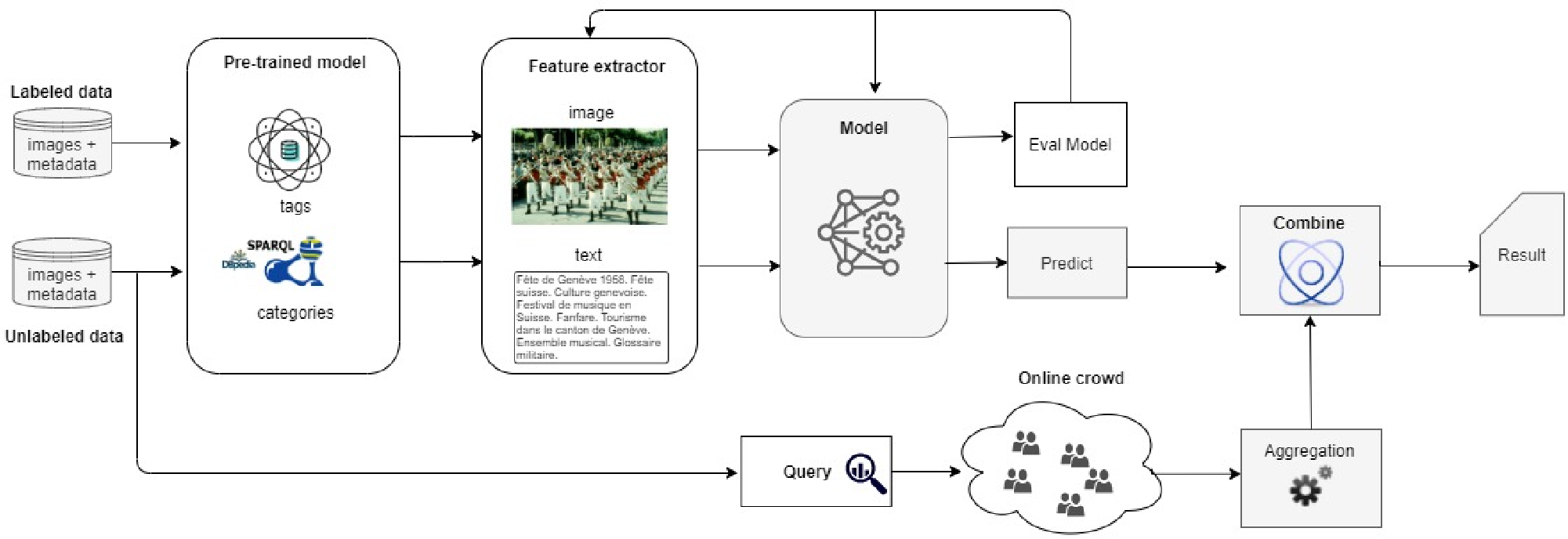
Instead of relying solely on pixels, the authors implement a multi-input architecture. They utilize MobileNet for visual feature extraction and GloVe for text embeddings.
The secret sauce? DBpedia Integration. By extracting entities from descriptions and querying their DBpedia categories, the model gains access to a world-class knowledge graph. For example, the term "fanfare" might be linked to "Fete Suisse," providing the necessary context for the system to correctly label a "Tradition."
2. Intelligent Crowd Aggregation
The paper doesn't just treat crowd workers as a monolithic source of truth. They evaluate:
- Majority Voting (MV): The baseline.
- Dawid-Skene Model: Estimated reliability using EM algorithms.
- Worker-Profile Model: A weighted approach based on the worker's historical reputation and specific task performance.
Experimental Results: The Power of Fusion
The researchers tested their methods on the NotreHistoire dataset, a collection of Swiss cultural history.
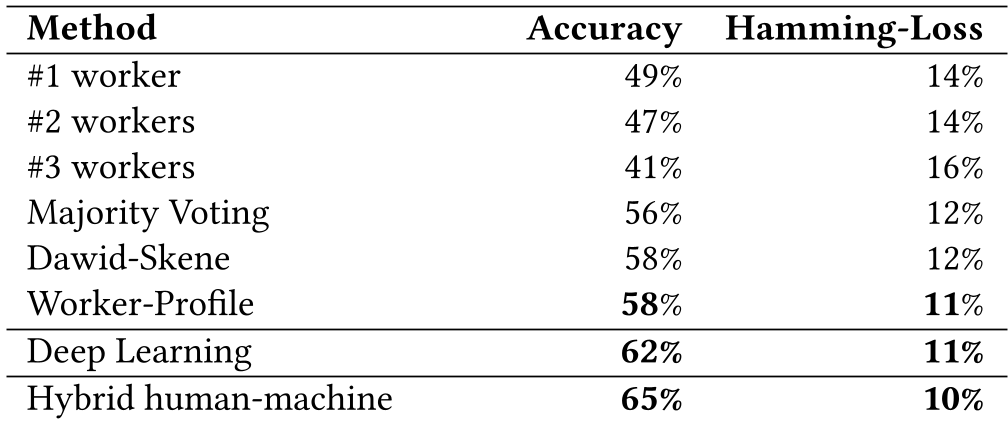
| Method | Accuracy | Hamming-Loss |
|---|---|---|
| Individual Worker | 49% | 14% |
| Deep Learning (Multi-input) | 62% | 11% |
| Hybrid Human-Machine | 65% | 10% |
The hybrid model uses a 0.7/0.3 weighted fusion, effectively using the machine's confidence scores as a primary filter and human insight as the specialized refinement.
Deep Insights: Why It Works
The "Aha!" moment comes from the ablation of text features. Adding titles and descriptions brought accuracy to 51%, but adding DBpedia Categories (TDVEC) boosted it further. This suggests that for cultural data, external logic is more valuable than internal pixels. Machines are excellent at seeing "shapes," but humans and knowledge graphs are necessary to understand "meaning."
Critical Analysis & Future Work
The study highlights a clear path for GLAM institutions: Human-in-the-loop (HITL) is not just a luxury; it's a necessity for high-stake historical accuracy.
Limitations:
- Dataset Size: With only 5,015 images, the deep learning model is highly dependent on pre-training.
- Cost/Latency: While more accurate, human intervention adds temporal and financial costs that need optimization.
Future Outlook: The next frontier is extending this to temporal classification (dating images by decade) and automatic tag generation, moving beyond the five fixed categories to a more fluid, descriptive metadata ecosystem.